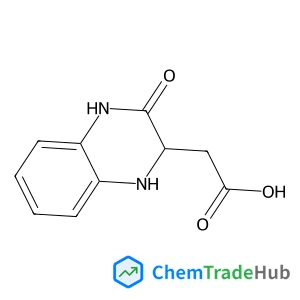
(3-Oxo-1,2,3,4-tetrahydro-2-quinoxalinyl)acetic acid
CAS Number:
136584-14-0
Molecular Formula:
C10H10N2O3
Rui Yang, Lin Xie, Nan Li, Pablo Froimowicz, Kan Zhang
A novel triptycene-containing dioxazine benzoxazine monomer (TB-al) and a main-chain triptycene-containing dioxazine benzoxazine copolymer (poly(triptycene-containing dioxazine benzoxazine-co-polydimethylsiloxane), TB-al-co-PDMS) have been synthesized and fully characterized. Polymerization of the monomer, TB-al, and the copolymer, TB-al-co-PDMS, was studied by in situ FT-IR and DSC. Fire-related properties and thermal stability of the resulting thermosets were evaluated by TGA and micro-scale combustion calorimetry (MCC). The obtained thermosets, poly(TB-al) and poly(TB-al-co-PDMS), exhibit outstanding thermal stability with Td10 values of 320 and 450 °C, char yields of 44 and 72% at 800 °C, low flammability as determined by HRC, affording values of 69.6 and 31.6 J g−1 K−1, and THR values of 10.5 and 9.4 kJ g−1, respectively. Remarkably, poly(TB-al-co-PDMS) presents excellent dielectric performance with a dielectric constant of 2.37 at 1 MHz and good hydrophobicity revealed by the low water uptake value of 0.056% after 120 h of sample immersion in water at room temperature. The combined properties and advantages of these triptycene-based thermosets (poly(TB-al) and poly(TB-al-co-PDMS)) clearly indicate their great potential for applications in the field of high-performance polymers.
DOI: 10.1039/C1CP20508K
L. Olivi, C. Dominici, F. Ziarelli
DOI: 10.1039/C1CP20346K
Micael J. T. Oliveira, Miguel A. L. Marques
DOI: 10.1039/C1CP20719A
Athi N. Naganathan
DOI: 10.1039/C1CP20964G
Jakob Kryger Sørensen, Emanuel Lörtscher, Tom Vosch, Heike Riel, Kristine Kilså, Thomas Bjørnholm, Herre van der Zant
DOI: 10.1039/C1CP20861F
Christine Cézard, Frédéric Aubry, Florence Djedaïni-Pilard, François-Yves Dupradeau
DOI: 10.1039/C1CP20854C
Princia Salvatore, Allan Glargaard Hansen, Thomas Bjørnholm, Richard John Nichols, Jens Ulstrup
DOI: 10.1039/C1CP21197H
Weiwei Zhou, Tao Chen, Kim Seng Tan, Xingtao Jia, Zhiqiang Luo, Chunxiao Cong, Huanping Yang, Chang Ming Li
DOI: 10.1039/C1CP21917K
This compound is mainly used as an intermediate in the synthesis of antipsychoti...
Waste containing 1-(D-Ribofuranosyl)-1,4-dihydro-3-pyridinecarboxamide (CAS: 191...
2-Methyl-2-propanyl 3-bromo-3-(hydroxymethyl)-1-azetidinecarboxylate (CAS: 20079...
N-(4-Chloro-2-pyridinyl)acetamide (CAS: 245056-66-0) is a chemical compound with...
5-Chloro-2-hydroxybenzoic acid, also known as 5-chlorosalicylic acid, is an arom...
When handling 1,1-Dichloro-1-fluoroethane (CAS: 1717-00-6), it is important to u...
Fmoc-(2S,3R)-3-phenylpyrrolidine-2-carboxylic acid is a white crystalline solid ...
4-Amino-5-bromo-2-pyridinecarboxylic acid is primarily used as a precursor in th...
Handling this compound should be done with personal protective equipment (PPE) i...
When handling 8-bromo-2,2-dimethyl-3,4-dihydro-2H-1,4-benzoxazin-3-one, use prop...

Polymer Chemistry welcomes submissions in all areas of polymer science that have a strong focus on macromolecular chemistry. Manuscripts may cover a broad range of fields, yet no direct application focus is required.
![4-Chloro-3-(trifluoromethyl)-1H-pyrrolo[2,3-b]pyridine structure](https://static.chemtradehub.com/structs/869/869335-75-1-a9d0.webp "4-Chloro-3-(trifluoromethyl)-1H-pyrrolo[2,3-b]pyridine structure")
![2,6-Bis({(2R)-2-[hydroxy(diphenyl)methyl]-1-pyrrolidinyl}methyl)-4-methylphenol structure](https://static.chemtradehub.com/structs/877/877395-58-9-70bf.webp "2,6-Bis({(2R)-2-[hydroxy(diphenyl)methyl]-1-pyrrolidinyl}methyl)-4-methylphenol structure")