












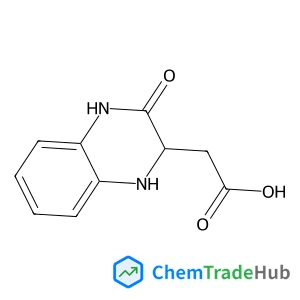
(3-Oxo-1,2,3,4-tetrahydro-2-quinoxalinyl)acetic acid
CAS Number:
136584-14-0
Molecular Formula:
C10H10N2O3
Hajime Torii, Hisako Sato
Chiro-optical spectroscopic methods, such as vibrational circular dichroism (VCD) spectroscopy, are regarded as useful measures that provide us information on the structural properties of chiral species, but for correct interpretation of the measured spectra, appropriate modeling that can be compared with the observed spectra is essential. In the present study, the origin of the VCD intensity enhancement observed upon fibril formation in a gelation process is examined theoretically. Comparing with the observed spectroscopic feature and also with the observed scanning electron microscope (SEM) image, it is derived that there are at least three hierarchical tiers of chirality in the gel. The VCD intensity enhancement originates from one of them on the ∼50 nm length scale, which consists of a co-axial antiparallel right-handed double helical structure that persistently continues over ∼100 molecules, indicating that the intermediate length-scale fibril formation plays a crucial role in the VCD intensity enhancement, in a way similar to some fibril-forming peptides examined previously. The time course of the gelation process observed by the time dependence of the VCD intensity is also shown and discussed.
Andreia Mota, Jason P. Hallett, Maxim L. Kuznetsov, Isabel Correia
DOI: 10.1039/C1CP20800D
Dvira Segal, Andrew J. Millis, David R. Reichman
DOI: 10.1039/C1CP20702D
Kwan Kim, Kyung Lock Kim, Jeong-Young Choi, Dongha Shin, Kuan Soo Shin
DOI: 10.1039/C1CP21249D
M. Busch, E. Ahlberg, I. Panas
DOI: 10.1039/C1CP20487D
Yuhui Lu, Craig Lent
DOI: 10.1039/C1CP21332F
Jonathan Romero, Andres Reyes, Jorge David, Albeiro Restrepo
DOI: 10.1039/C1CP20903E
Che-Hung Kuo, Chi-Ping Liu, Szu-Hsian Lee, Hsun-Yun Chang, Wei-Chun Lin, Yun-Wen You, Hua-Yang Liao
DOI: 10.1039/C1CP20590K
Shinobu Gonsui, Tetsuya Tsuda, Ken-ichi Fukui
DOI: 10.1039/C1CP20643E
J. M. Valverde, F. Pontiga, C. Soria-Hoyo, M. A. S. Quintanilla, H. Moreno, F. J. Duran, M. J. Espin
DOI: 10.1039/C1CP21939A
This compound is mainly used as an intermediate in the synthesis of antipsychoti...
Waste containing 1-(D-Ribofuranosyl)-1,4-dihydro-3-pyridinecarboxamide (CAS: 191...
2-Methyl-2-propanyl 3-bromo-3-(hydroxymethyl)-1-azetidinecarboxylate (CAS: 20079...
N-(4-Chloro-2-pyridinyl)acetamide (CAS: 245056-66-0) is a chemical compound with...
5-Chloro-2-hydroxybenzoic acid, also known as 5-chlorosalicylic acid, is an arom...
When handling 1,1-Dichloro-1-fluoroethane (CAS: 1717-00-6), it is important to u...
Fmoc-(2S,3R)-3-phenylpyrrolidine-2-carboxylic acid is a white crystalline solid ...
4-Amino-5-bromo-2-pyridinecarboxylic acid is primarily used as a precursor in th...
Handling this compound should be done with personal protective equipment (PPE) i...
When handling 8-bromo-2,2-dimethyl-3,4-dihydro-2H-1,4-benzoxazin-3-one, use prop...

Physical Chemistry Chemical Physics (PCCP) is an international journal co-owned by 19 physical chemistry and physics societies from around the world. This journal publishes original, cutting-edge research in physical chemistry, chemical physics and biophysical chemistry. To be suitable for publication in PCCP, articles must include significant innovation and/or insight into physical chemistry; this is the most important criterion that reviewers and Editors will judge against when evaluating submissions. The journal has a broad scope and welcomes contributions spanning experiment, theory, computation and data science. Topical coverage includes spectroscopy, dynamics, kinetics, statistical mechanics, thermodynamics, electrochemistry, catalysis, surface science, quantum mechanics, quantum computing and machine learning. Interdisciplinary research areas such as polymers and soft matter, materials, nanoscience, energy, surfaces/interfaces, and biophysical chemistry are welcomed if they demonstrate significant innovation and/or insight into physical chemistry. Joined experimental/theoretical studies are particularly appreciated when complementary and based on up-to-date approaches.
![6-Benzyl-4,5,6,7-tetrahydro-1H-pyrazolo[3,4-c]pyridin-3(2H)-one structure](https://static.chemtradehub.com/structs/909/909187-64-0-f54f.webp "6-Benzyl-4,5,6,7-tetrahydro-1H-pyrazolo[3,4-c]pyridin-3(2H)-one structure")





