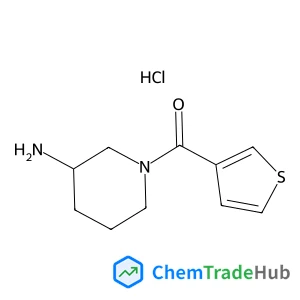
(3-Amino-piperidin-1-yl)-thiophen-3-yl-methanone hydrochloride
CAS Number:
1185316-70-4
Molecular Formula:
C10H15ClN2OS
Haoyu Jing, Nikki Cecil M. Magdaong, James R. Diers, Christine Kirmaier, David F. Bocian, Dewey Holten, Jonathan S. Lindsey
A new pentad array designed to exhibit panchromatic absorption and charge separation has been synthesized and characterized. The array is composed of a triad panchromatic absorber (a bis(perylene-monoimide)-porphyrin) to which are appended an electron acceptor (perylene-diimide) and an electron donor/hole acceptor (bacteriochlorin) in a crossbar arrangement. The motivation for incorporation of the bacteriochlorin versus a free-base or zinc chlorin utilized in prior constructs was to facilitate hole transfer to this terminal unit and thereby achieve a higher yield of charge separation across the array. The intense S0 → S1 (Qy) band of the bacteriochlorin also enhances absorption in the near-infrared spectral region. Due to synthetic constraints, a phenylethyne linker was used to join the bacteriochlorin to the core porphyrin of the panchromatic triad rather than the diphenylethyne linker employed for the prior chlorin-containing pentads. Static and time-resolved photophysical studies reveal enhanced excited-state quenching for the pentad in benzonitrile and dimethyl sulfoxide compared to the prior chlorin-containing analogues. Success was only partial, however, as a long-lived charge separated state was not observed despite the improved energetics for the final ground-state hole/electron-shift reaction. The apparent reason is more facile competing charge-recombination due to the shorter bacteriochlorin – porphyrin linker that increases electronic coupling for this process. The studies highlight design criteria for balancing panchromatic absorption and long-lived charge separation in molecular architectures for solar-energy conversion.
DOI: 10.1039/C9CP03635K
Karolina Rachuta, Jacek Koput, Gordon L. Hug, Mariusz Majchrzak
DOI: 10.1039/C9CP03749G
Antonio Frontera, Antonio Bauzá
DOI: 10.1039/C9CP03858B
Yongnan Xiong, Xiaofan Li, Shifang Xiao, Huiqiu Deng, Bowen Huang, Wenjun Zhu, Wangyu Hu
DOI: 10.1039/C9CP02920F
Ranajit Mondal, Madivala G. Basavaraj
DOI: 10.1039/C9CP03008E
Joel H. Bombile, Shreya Shetty, Michael J. Janik, Scott T. Milner
DOI: 10.1039/C9CP06039A
Helder M. Marques, Preston J. MacDougall
DOI: 10.1039/C9CP03783G
When handling 2-Methyl-2-propanyl 5-amino-2-thiophenecarboxylate (CAS: 1498311-5...
5-Bromo-1,2-dichloro-3-fluorobenzene (CAS: 1000572-93-9) is a crystalline solid ...
(2R)-2-Amino-2-(4-bromophenyl)ethanol (CAS: 354153-64-3) should be stored in a c...
Methyl 4-(aminomethyl)tetrahydro-2H-pyran-4-carboxylate hydrochloride (CAS: 3627...
1,4-Dimethyl-1H-pyrazole-5-sulfonyl chloride is primarily used as an intermediat...
Dinaphtho[1,2-b:2',1'-d]furan is generally safe when handled with appropriate pe...
The market for 7-Methyl-7,9-dihydro-1H-purine-2,6,8(3H)-trione (CAS: 612-37-3) i...
2-(4-Chlorophenyl)malonaldehyde (CAS: 205676-17-1) is a colorless or light yello...
2-Methylchrysene (CAS: 3351-32-4) is typically synthesized via the reaction of c...
N-(6-aminopyrimidin-4-yl)acetamide (CAS: 89533-23-3) is generally considered saf...

Physical Chemistry Chemical Physics (PCCP) is an international journal co-owned by 19 physical chemistry and physics societies from around the world. This journal publishes original, cutting-edge research in physical chemistry, chemical physics and biophysical chemistry. To be suitable for publication in PCCP, articles must include significant innovation and/or insight into physical chemistry; this is the most important criterion that reviewers and Editors will judge against when evaluating submissions. The journal has a broad scope and welcomes contributions spanning experiment, theory, computation and data science. Topical coverage includes spectroscopy, dynamics, kinetics, statistical mechanics, thermodynamics, electrochemistry, catalysis, surface science, quantum mechanics, quantum computing and machine learning. Interdisciplinary research areas such as polymers and soft matter, materials, nanoscience, energy, surfaces/interfaces, and biophysical chemistry are welcomed if they demonstrate significant innovation and/or insight into physical chemistry. Joined experimental/theoretical studies are particularly appreciated when complementary and based on up-to-date approaches.
![1-Oxa-8-azaspiro[4.5]decan-3-ol structure](https://static.chemtradehub.com/structs/757/757239-76-2-a0ec.webp "1-Oxa-8-azaspiro[4.5]decan-3-ol structure")