












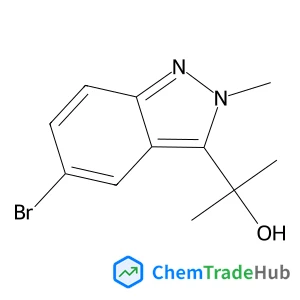
2-(5-Bromo-2-methyl-2H-indazol-3-yl)-2-propanol
CAS Number:
1823787-20-7
Molecular Formula:
C11H13BrN2O
Ranajit Mondal, Madivala G. Basavaraj
Evaporation of colloidal dispersions leading to patterning of particles is a simple and elegant route for controlling the self-assembly of particles on a solid surface. In this article, we demonstrate that the configuration in which a colloidal dispersion is dried greatly influences the patterning of particles on a solid surface after complete evaporation of the solvent. Evaporation experiments are carried out using well-characterized stable aqueous dispersions of hematite ellipsoids and polystyrene spheres. The drying of particle laden sessile drops always give a “coffee-ring” deposit irrespective of the particle concentration. At a particle concentration ≥0.3 wt% circular cracks appear in the annular region of the coffee-ring deposit owing to the ordered arrangement of ellipsoids. In stark contrast, the deposits formed by drying the dispersion of ellipsoids in the sphere-on-plate configuration show a transition from “concentric rings” to “concentric cracks” in the micro-structure of the particulate film with an increase in the concentration of particles. Further, our experimental findings reveal that long-range circular cracks and long-range assemblies of particles can be achieved by drying of the dispersion in the sphere-on-plate configuration. While the nature of patterns – that is – coffee-rings and concentric rings – is independent of the shape of the particles, a strikingly different crack morphology is shown to be dictated by the shape of the particles in the dispersion. The results presented show that the drying of colloidal dispersions in the sphere-on-plate configuration enables the fabrication of a long range ordered assembly of particles over an area as large as few square millimeters.
Zacharoula Iatridi, Yuri Roiter, Sergiy Minko
DOI: 10.1039/C1PY00090J
Qianfu Luo, Hui Cheng, He Tian
DOI: 10.1039/C1PY00167A
Ali Moayeri, Benoit Lessard, Milan Maric
DOI: 10.1039/C1PY00190F
Garret M. Miyake, Eugene Y.-X. Chen
DOI: 10.1039/C1PY00245G
Ruigang Liu, Honglang Kang, Bing Jia
DOI: 10.1039/C1PY00168J
Ryan J. Pounder, David J. Fox, Ian A. Barker, Michael J. Bennison, Andrew P. Dove
DOI: 10.1039/C1PY00254F
DeeDee Smith, Andrew C. Holley, Charles L. McCormick
DOI: 10.1039/C1PY00038A
Katja Skrabania, Anna Miasnikova, Achille Mayelle Bivigou-Koumba, Daniel Zehm
DOI: 10.1039/C1PY00173F
When handling 2-Methyl-2-propanyl 5-amino-2-thiophenecarboxylate (CAS: 1498311-5...
5-Bromo-1,2-dichloro-3-fluorobenzene (CAS: 1000572-93-9) is a crystalline solid ...
(2R)-2-Amino-2-(4-bromophenyl)ethanol (CAS: 354153-64-3) should be stored in a c...
Methyl 4-(aminomethyl)tetrahydro-2H-pyran-4-carboxylate hydrochloride (CAS: 3627...
1,4-Dimethyl-1H-pyrazole-5-sulfonyl chloride is primarily used as an intermediat...
Dinaphtho[1,2-b:2',1'-d]furan is generally safe when handled with appropriate pe...
The market for 7-Methyl-7,9-dihydro-1H-purine-2,6,8(3H)-trione (CAS: 612-37-3) i...
2-(4-Chlorophenyl)malonaldehyde (CAS: 205676-17-1) is a colorless or light yello...
2-Methylchrysene (CAS: 3351-32-4) is typically synthesized via the reaction of c...
N-(6-aminopyrimidin-4-yl)acetamide (CAS: 89533-23-3) is generally considered saf...

Physical Chemistry Chemical Physics (PCCP) is an international journal co-owned by 19 physical chemistry and physics societies from around the world. This journal publishes original, cutting-edge research in physical chemistry, chemical physics and biophysical chemistry. To be suitable for publication in PCCP, articles must include significant innovation and/or insight into physical chemistry; this is the most important criterion that reviewers and Editors will judge against when evaluating submissions. The journal has a broad scope and welcomes contributions spanning experiment, theory, computation and data science. Topical coverage includes spectroscopy, dynamics, kinetics, statistical mechanics, thermodynamics, electrochemistry, catalysis, surface science, quantum mechanics, quantum computing and machine learning. Interdisciplinary research areas such as polymers and soft matter, materials, nanoscience, energy, surfaces/interfaces, and biophysical chemistry are welcomed if they demonstrate significant innovation and/or insight into physical chemistry. Joined experimental/theoretical studies are particularly appreciated when complementary and based on up-to-date approaches.
![L-Lysine,N6-[2-[[(1,1-dimethylethoxy)carbonyl]amino]benzoyl]-N2-[(9H-fluoren-9-ylmethoxy)carbonyl]- structure](https://static.chemtradehub.com/structs/159/159322-59-5-c046.webp "L-Lysine,N6-[2-[[(1,1-dimethylethoxy)carbonyl]amino]benzoyl]-N2-[(9H-fluoren-9-ylmethoxy)carbonyl]- structure")
![2-[2-(2-Methoxyethoxy)ethoxy]-2-methylpropane structure](https://static.chemtradehub.com/structs/527/52788-79-1-71c1.webp "2-[2-(2-Methoxyethoxy)ethoxy]-2-methylpropane structure")


