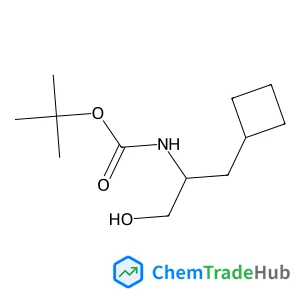
2-Methyl-2-propanyl (1-cyclobutyl-3-hydroxy-2-propanyl)carbamate
CAS Number:
816429-99-9
Molecular Formula:
C12H23NO3
Yuxuan Lin, Mengxiao Diao, Jingxin Dai, Zhen Xu, Xinwei Zhao, Xiaojie Wen, Lingbo Xing, Xiong Zhou, Qiwei Chen, Jing Liu, Kai Wu
A molecular investigation of Cu-elimination and subsequent C–C coupling of DCTP (4,4′′-dichloro-1,1′:3′,1′′-terphenyl)-Cu organometallic (OM) polymers on Cu(111) is conducted by scanning tunneling microscopy and spectroscopy, revealing that the Cu adatoms embedded in the DCTP-Cu chains are located at the hollow and bridge sites on the Cu(111) surface. The difference in the catalytic activities of these surface sites leads to stepwise elimination of Cu adatoms in the OM chains. Moreover, the interchain interaction plays an important role in the Cu-elimination process of the DCTP-Cu chains as well. The interchain steric hindrance, on the one hand, induces the formation of Cu-eliminated intermediates that are scarcely observed in other Ullmann coupling systems, and on the other hand, promotes the cooperative Cu-elimination and C–C coupling of the OM segments in neighboring chains. These findings demonstrate the key role of the molecule–substrate and intermolecular interactions in mediating the reaction processes of the extended molecular systems on the surface.

Acta Metallurgica Sinica-English Letters

Herald of the Russian Academy of Sciences

Bioorganic & Medicinal Chemistry

Critical Reviews in Solid State and Materials Sciences

Main Group Chemistry

Chinese Journal of Chemistry

Atomization and Sprays

Journal of the Indian Institute of Science

Polycyclic Aromatic Compounds

Topics in Catalysis
M. F. Knopper
DOI: 10.1039/C6PY01656A
Panpan Xu, Jingjing Shi, Mengmeng Zhu, Yaowu He, Hongtao Yu, Osamu Goto, Hong Meng
DOI: 10.1039/C6PY00989A
Kun Jiang, Yanan Liu, Yaping Yan, Shengliu Wang, Lianying Liu, Wantai Yang
DOI: 10.1039/C6PY02094A
Peng-Yun Li, Wei-Dong He, Sheng-Qi Chen, Xiao-Xia Lu, Jia-Min Li, Hui-Juan Li
DOI: 10.1039/C6PY00583G
Yaqing Qu, Xueying Chang, Shengli Chen
DOI: 10.1039/C7PY00508C
Tomoyuki Ikai, Daisuke Suzuki, Yutaka Kojima, Changsik Yun, Katsuhiro Maeda, Shigeyoshi Kanoh
DOI: 10.1039/C6PY00967K
Ruiqiang Wang, Xinbing Chen, Pei Chen, Zhongwei An, Suobo Zhang
DOI: 10.1039/C7PY00690J
Nghia P. Truong, John F. Quinn, Michael R. Whittaker
DOI: 10.1039/C6PY00639F
Katarzyna Kostrzewska, Joanna Ortyl, Robert Dobosz, Janina Kabatc
DOI: 10.1039/C7PY00621G
When handling 2-Methyl-2-propanyl 5-amino-2-thiophenecarboxylate (CAS: 1498311-5...
5-Bromo-1,2-dichloro-3-fluorobenzene (CAS: 1000572-93-9) is a crystalline solid ...
(2R)-2-Amino-2-(4-bromophenyl)ethanol (CAS: 354153-64-3) should be stored in a c...
Methyl 4-(aminomethyl)tetrahydro-2H-pyran-4-carboxylate hydrochloride (CAS: 3627...
1,4-Dimethyl-1H-pyrazole-5-sulfonyl chloride is primarily used as an intermediat...
Dinaphtho[1,2-b:2',1'-d]furan is generally safe when handled with appropriate pe...
The market for 7-Methyl-7,9-dihydro-1H-purine-2,6,8(3H)-trione (CAS: 612-37-3) i...
2-(4-Chlorophenyl)malonaldehyde (CAS: 205676-17-1) is a colorless or light yello...
2-Methylchrysene (CAS: 3351-32-4) is typically synthesized via the reaction of c...
N-(6-aminopyrimidin-4-yl)acetamide (CAS: 89533-23-3) is generally considered saf...

Physical Chemistry Chemical Physics (PCCP) is an international journal co-owned by 19 physical chemistry and physics societies from around the world. This journal publishes original, cutting-edge research in physical chemistry, chemical physics and biophysical chemistry. To be suitable for publication in PCCP, articles must include significant innovation and/or insight into physical chemistry; this is the most important criterion that reviewers and Editors will judge against when evaluating submissions. The journal has a broad scope and welcomes contributions spanning experiment, theory, computation and data science. Topical coverage includes spectroscopy, dynamics, kinetics, statistical mechanics, thermodynamics, electrochemistry, catalysis, surface science, quantum mechanics, quantum computing and machine learning. Interdisciplinary research areas such as polymers and soft matter, materials, nanoscience, energy, surfaces/interfaces, and biophysical chemistry are welcomed if they demonstrate significant innovation and/or insight into physical chemistry. Joined experimental/theoretical studies are particularly appreciated when complementary and based on up-to-date approaches.
![1-Oxa-8-azaspiro[4.5]decan-3-ol structure](https://static.chemtradehub.com/structs/757/757239-76-2-a0ec.webp "1-Oxa-8-azaspiro[4.5]decan-3-ol structure")