












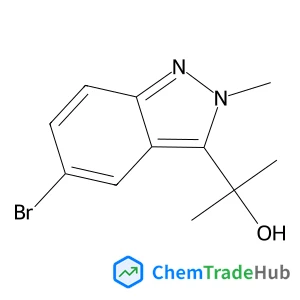
2-(5-Bromo-2-methyl-2H-indazol-3-yl)-2-propanol
CAS Number:
1823787-20-7
Molecular Formula:
C11H13BrN2O
Nghia P. Truong, John F. Quinn, Michael R. Whittaker
Filomicelles and nanoworms are an emerging subclass of nanomaterials with a special elongated shape. The physical properties of a filomicelle are distinct from a traditional spherical micelle, and as such have attracted tremendous interest in a variety of research areas. In this review, we highlight the substantial progress in the synthesis and application of polymeric nanoworms over the past two decades. Synthetic techniques summarized in this review are particle replication in nonwetting templates (PRINT), film stretching, self-assembly (SA), crystallization-driven self-assembly (CDSA), polymerization-induced self-assembly (PISA), and temperature-induced morphological transformation (TIMT). The applications of filomicelles as (i) templates for inorganic nanoparticles, (ii) building blocks for superstructures, (iii) synthetic dendritic cells for immunotherapy, (iv) constituents of thermoresponsive gels for biomedical applications, and (v) nanocarriers for cancer drug delivery are subsequently discussed. In the conclusion, we describe the current trajectory of research in the field and identify areas where further developments are of urgent need.
Hao Lu, Bangkai Gu, Song Fang
DOI: 10.1039/D0SE01558J
Ao Wang, Nathan L. Chang, Kaiwen Sun, Chaowei Xue, Renate J. Egan, Jianjun Li, Chang Yan, Jialiang Huang, Hui Rong, Charles Ramsden, Xiaojing Hao
DOI: 10.1039/D0SE01734E
Yukesh Kannah R., Kavitha S., Sivashanmugam P., Gopalakrishnan Kumar, Rajesh Banu J.
DOI: 10.1039/D0SE01814G
Chunyan Li
DOI: 10.1039/D0SE01780A
Tien D. Tran, Hoang V. Le, Ly T. Le, Anh D. Nguyen, Thi Dieu Thuy Ung, Phong D. Tran
DOI: 10.1039/D1SE00026H
Deepesh Gopalakrishnan, Samia Alkatie, Andrew Cannon, Sathish Rajendran, Naresh Kumar Thangavel, Neha Bhagirath, Emily M. Ryan, Leela Mohana Reddy Arava
DOI: 10.1039/D0SE01547D
R. Samantray, Vivekanand, K. Subramani, C. Jesica Anjeline, S. C. Mishra
DOI: 10.1039/D0SE01420F
Avani Chunduri, Nainesh Patel, Dattatray S. Dhawale, Ajayan Vinu, Hind Aljohani
DOI: 10.1039/D0SE01711F
Koichi Yatsuzuka, Kosei Yamauchi, Ken Kawano, Hironobu Ozawa, Ken Sakai
DOI: 10.1039/D0SE01597K
Jun Kubota, Takaya Okumura
DOI: 10.1039/D0SE01896A
When handling 2-Methyl-2-propanyl 5-amino-2-thiophenecarboxylate (CAS: 1498311-5...
5-Bromo-1,2-dichloro-3-fluorobenzene (CAS: 1000572-93-9) is a crystalline solid ...
(2R)-2-Amino-2-(4-bromophenyl)ethanol (CAS: 354153-64-3) should be stored in a c...
Methyl 4-(aminomethyl)tetrahydro-2H-pyran-4-carboxylate hydrochloride (CAS: 3627...
1,4-Dimethyl-1H-pyrazole-5-sulfonyl chloride is primarily used as an intermediat...
Dinaphtho[1,2-b:2',1'-d]furan is generally safe when handled with appropriate pe...
The market for 7-Methyl-7,9-dihydro-1H-purine-2,6,8(3H)-trione (CAS: 612-37-3) i...
2-(4-Chlorophenyl)malonaldehyde (CAS: 205676-17-1) is a colorless or light yello...
2-Methylchrysene (CAS: 3351-32-4) is typically synthesized via the reaction of c...
N-(6-aminopyrimidin-4-yl)acetamide (CAS: 89533-23-3) is generally considered saf...

Polymer Chemistry welcomes submissions in all areas of polymer science that have a strong focus on macromolecular chemistry. Manuscripts may cover a broad range of fields, yet no direct application focus is required.

![1-Oxa-8-azaspiro[4.5]decan-3-ol structure](https://static.chemtradehub.com/structs/757/757239-76-2-a0ec.webp "1-Oxa-8-azaspiro[4.5]decan-3-ol structure")



