












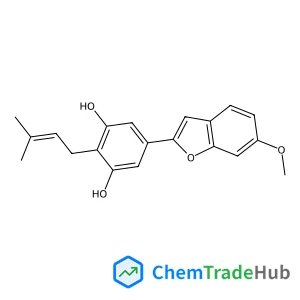
5-(6-Methoxy-1-benzofuran-2-yl)-2-(3-methyl-2-buten-1-yl)-1,3-benzenediol
CAS Number:
1017277-40-5
Molecular Formula:
C20H20O4
Haoyu Jing, Nikki Cecil M. Magdaong, James R. Diers, Christine Kirmaier, David F. Bocian, Dewey Holten, Jonathan S. Lindsey
Bacteriochlorophylls, nature's near-infrared absorbers, play an essential role in energy transfer in photosynthetic antennas and reaction centers. To probe energy-transfer processes akin to those in photosynthetic systems, nine synthetic bacteriochlorin–bacteriochlorin dyads have been prepared wherein the constituent pigments are joined at the meso-positions by a phenylethyne linker. The phenylethyne linker is an unsymmetric auxochrome, which differentially shifts the excited-state energies of the phenyl- or ethynyl-attached bacteriochlorin constituents in the dyad. Molecular designs utilized known effects of macrocycle substituents to engineer bacteriochlorins with S0 → S1 (Qy) transitions spanning 725–788 nm. The design-predicted donor–acceptor excited-state energy gaps in the dyads agree well with those obtained from time dependent density functional theory calculations and with the measured range of 197–1089 cm−1. Similar trends with donor–acceptor excited-state energy gaps are found for (1) the measured ultrafast energy-transfer rates of (0.3–1.7 ps)−1, (2) the spectral overlap integral (J) in Förster energy-transfer theory, and (3) donor–acceptor electronic mixing manifested in the natural transition orbitals for the S0 → S1 transition. Subtle outcomes include the near orthogonal orientation of the π-planes of the bacteriochlorin macrocycles, and the substituent-induced shift in transition-dipole moment from the typical coincidence with the NH–NH axis; the two features together afforded the Förster orientation term κ2 ranging from 0.55–1.53 across the nine dyads, a value supportive of efficient excited-state energy transfer. The molecular design and collective insights on the dyads are valuable for studies relevant to artificial photosynthesis and other processes requiring ultrafast energy transfer.
Alba Cuadrado, Alejandra Gilabert, Lluís Fajarí, Ignasi Sirés, Enric Brillas, Maria Pilar Almajano, Dolores Velasco, Josep M. Anglada, Luis Juliá
DOI: 10.1039/C9CP02444A
Lam K. Huynh
DOI: 10.1039/C9CP02187F
Yongli Shen, Kangjuan Yin, Zihui Xiao
DOI: 10.1039/C9CP03201K
Katsuhiko Satoh
DOI: 10.1039/C9CP03296G
V. K. Sharma, D. K. Rai, E. Mamontov
DOI: 10.1039/C9CP03767E
Andrés F. Marmolejo-Valencia, Zaahel Mata-Pinzón, Laura Dominguez, Carlos Amador-Bedolla
DOI: 10.1039/C9CP04041B
Mengyang Li, Zhibin Gao, Yanbo Han, Yaoxiao Zhao, Kun Yuan, Shigeru Nagase, Masahiro Ehara, Xiang Zhao
DOI: 10.1039/D0CP00167H
Najoua Derbel, Thibaud Cours, Alexander Alijah
DOI: 10.1039/C9CP06875A
Andrea Amadei, Massimiliano Aschi
DOI: 10.1039/C9CP03379C
When handling 2-Methyl-2-propanyl 5-amino-2-thiophenecarboxylate (CAS: 1498311-5...
5-Bromo-1,2-dichloro-3-fluorobenzene (CAS: 1000572-93-9) is a crystalline solid ...
(2R)-2-Amino-2-(4-bromophenyl)ethanol (CAS: 354153-64-3) should be stored in a c...
Methyl 4-(aminomethyl)tetrahydro-2H-pyran-4-carboxylate hydrochloride (CAS: 3627...
1,4-Dimethyl-1H-pyrazole-5-sulfonyl chloride is primarily used as an intermediat...
Dinaphtho[1,2-b:2',1'-d]furan is generally safe when handled with appropriate pe...
The market for 7-Methyl-7,9-dihydro-1H-purine-2,6,8(3H)-trione (CAS: 612-37-3) i...
2-(4-Chlorophenyl)malonaldehyde (CAS: 205676-17-1) is a colorless or light yello...
2-Methylchrysene (CAS: 3351-32-4) is typically synthesized via the reaction of c...
N-(6-aminopyrimidin-4-yl)acetamide (CAS: 89533-23-3) is generally considered saf...

Physical Chemistry Chemical Physics (PCCP) is an international journal co-owned by 19 physical chemistry and physics societies from around the world. This journal publishes original, cutting-edge research in physical chemistry, chemical physics and biophysical chemistry. To be suitable for publication in PCCP, articles must include significant innovation and/or insight into physical chemistry; this is the most important criterion that reviewers and Editors will judge against when evaluating submissions. The journal has a broad scope and welcomes contributions spanning experiment, theory, computation and data science. Topical coverage includes spectroscopy, dynamics, kinetics, statistical mechanics, thermodynamics, electrochemistry, catalysis, surface science, quantum mechanics, quantum computing and machine learning. Interdisciplinary research areas such as polymers and soft matter, materials, nanoscience, energy, surfaces/interfaces, and biophysical chemistry are welcomed if they demonstrate significant innovation and/or insight into physical chemistry. Joined experimental/theoretical studies are particularly appreciated when complementary and based on up-to-date approaches.

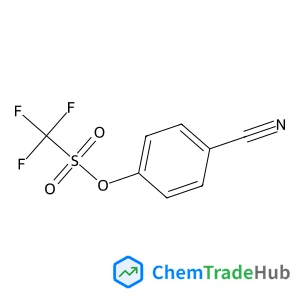
![2-[2-(2-Methoxyethoxy)ethoxy]-2-methylpropane structure](https://static.chemtradehub.com/structs/527/52788-79-1-71c1.webp "2-[2-(2-Methoxyethoxy)ethoxy]-2-methylpropane structure")
![L-Lysine,N6-[2-[[(1,1-dimethylethoxy)carbonyl]amino]benzoyl]-N2-[(9H-fluoren-9-ylmethoxy)carbonyl]- structure](https://static.chemtradehub.com/structs/159/159322-59-5-c046.webp "L-Lysine,N6-[2-[[(1,1-dimethylethoxy)carbonyl]amino]benzoyl]-N2-[(9H-fluoren-9-ylmethoxy)carbonyl]- structure")




