












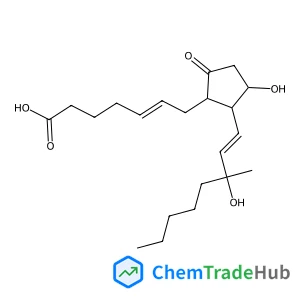
(5Z,11alpha,13E,15R)-11,15-Dihydroxy-15-methyl-9-oxoprosta-5,13-dien-1-oic acid
CAS Number:
55028-70-1
Molecular Formula:
C21H34O5
Ziqiao Chen, Xueting Li, Yuqing Huang, Shuohui Cao, Zhong Chen, Yulan Lin
NMR spectroscopy serves as an immensely powerful tool for component assignments and molecular structure elucidations. However, proton NMR spectra are generally trapped with spectral congestion caused by limited frequency differences and complex multiplets. 2D NMR can effectively relieve spectral congestion, but its resolution and acquisition efficiency are restricted by the broad spectral bandwidth. Herein, we introduce an NMR method based on chemical-shift-difference selection by chirp excitation to record high-resolution 2D NMR spectra for extracting coupling correlation networks and multiplet structures, suitable for measurements on complex samples. The performance of the proposed method is illustrated in determining diastereotopic methylene protons, small frequency-difference coupled proton pairs of furanose, pyranose and benzene rings. This study is expected to benefit molecular structure elucidation and composition analysis of complex samples in chemistry, biochemistry and metabonomics.
Jaewon Choi, So Yeon Park, Hye Yun Yang, Hae Jin Kim, Kyuwook Ihm, Jeong Ho Nam, Joung Real Ahn, Seung Uk Son
DOI: 10.1039/C1PY00260K
Nicolas Blanchard
DOI: 10.1039/C1PY00231G
Denise Azambuja, José I. Iribarren, Carlos A. Ferreira
DOI: 10.1039/C1PY00291K
Hongjun Yang, Junpeng Zhao, Manqing Yan, Stergios Pispas
DOI: 10.1039/C1PY00334H
Ruigang Liu, Honglang Kang, Bing Jia
DOI: 10.1039/C1PY00168J
Claudio De Rosa, Finizia Auriemma
DOI: 10.1039/C1PY00129A
Adeline Issoulie, Abdel Khoukh, Ahmed Benaboura, Maud Save, Christophe Derail, Laurent Billon
DOI: 10.1039/C1PY00066G
Natanya M. L. Hansen, David Plackett
DOI: 10.1039/C1PY00086A
Martin Helgesen, Morten V. Madsen, Birgitta Andreasen, Thomas Tromholt, Jens W. Andreasen, Frederik C. Krebs
DOI: 10.1039/C1PY00323B
Sijing Xia, Bin Yang, Guangzhao Li, Xiaoqing Zhu, Anning Wang, Jin Zhu
DOI: 10.1039/C1PY00223F
When handling 2-Methyl-2-propanyl 5-amino-2-thiophenecarboxylate (CAS: 1498311-5...
5-Bromo-1,2-dichloro-3-fluorobenzene (CAS: 1000572-93-9) is a crystalline solid ...
(2R)-2-Amino-2-(4-bromophenyl)ethanol (CAS: 354153-64-3) should be stored in a c...
Methyl 4-(aminomethyl)tetrahydro-2H-pyran-4-carboxylate hydrochloride (CAS: 3627...
1,4-Dimethyl-1H-pyrazole-5-sulfonyl chloride is primarily used as an intermediat...
Dinaphtho[1,2-b:2',1'-d]furan is generally safe when handled with appropriate pe...
The market for 7-Methyl-7,9-dihydro-1H-purine-2,6,8(3H)-trione (CAS: 612-37-3) i...
2-(4-Chlorophenyl)malonaldehyde (CAS: 205676-17-1) is a colorless or light yello...
2-Methylchrysene (CAS: 3351-32-4) is typically synthesized via the reaction of c...
N-(6-aminopyrimidin-4-yl)acetamide (CAS: 89533-23-3) is generally considered saf...

Physical Chemistry Chemical Physics (PCCP) is an international journal co-owned by 19 physical chemistry and physics societies from around the world. This journal publishes original, cutting-edge research in physical chemistry, chemical physics and biophysical chemistry. To be suitable for publication in PCCP, articles must include significant innovation and/or insight into physical chemistry; this is the most important criterion that reviewers and Editors will judge against when evaluating submissions. The journal has a broad scope and welcomes contributions spanning experiment, theory, computation and data science. Topical coverage includes spectroscopy, dynamics, kinetics, statistical mechanics, thermodynamics, electrochemistry, catalysis, surface science, quantum mechanics, quantum computing and machine learning. Interdisciplinary research areas such as polymers and soft matter, materials, nanoscience, energy, surfaces/interfaces, and biophysical chemistry are welcomed if they demonstrate significant innovation and/or insight into physical chemistry. Joined experimental/theoretical studies are particularly appreciated when complementary and based on up-to-date approaches.
methyl]-N,2-dimethyl-2-propanesulfinamide structure](https://static.chemtradehub.com/structs/256/2565792-50-7-8a26.webp "N-[(R)-[3-(Benzyloxy)-2-(dicyclohexylphosphino)phenyl](phenyl)methyl]-N,2-dimethyl-2-propanesulfinamide structure")
![3-[7-Amino-3-(3-pyridinyl)pyrazolo[1,5-a]pyrimidin-6-yl]phenol structure](https://static.chemtradehub.com/structs/861/861249-77-6-025b.webp "3-[7-Amino-3-(3-pyridinyl)pyrazolo[1,5-a]pyrimidin-6-yl]phenol structure")
![L-Lysine,N6-[2-[[(1,1-dimethylethoxy)carbonyl]amino]benzoyl]-N2-[(9H-fluoren-9-ylmethoxy)carbonyl]- structure](https://static.chemtradehub.com/structs/159/159322-59-5-c046.webp "L-Lysine,N6-[2-[[(1,1-dimethylethoxy)carbonyl]amino]benzoyl]-N2-[(9H-fluoren-9-ylmethoxy)carbonyl]- structure")



