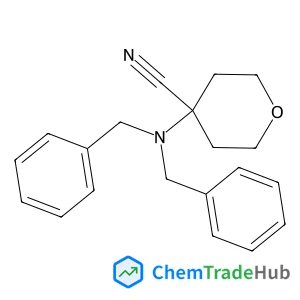
4-(Dibenzylamino)tetrahydro-2H-pyran-4-carbonitrile
CAS Number:
1630906-81-8
Molecular Formula:
C20H22N2O
Junjie Fu, Dandan Zhao, Chaoliang Zhao, Yanru Guo, Manying Liu, Zhi Zheng
Novel Ag-based thin film solar cells have attracted extensive attention in recent years in the photovoltaic (PV) field due to their outstanding properties like a high light absorption coefficient, low toxicity, abundance, and an appropriate band gap. The emerging Ag-based thin film materials such as Ag2S, AgBiS2, Ag3CuS2, AgInS2, AgBiSe2, Ag2ZnSnS4, Ag(In1−x,Gax)Se2, AgaBibIc, Cs2AgBiBr6, and Cu2AgBiI6 are becoming ideal materials for light absorbing layers in the new generation of PV devices. Although the efficiency of ATFSCs has improved significantly in recent years, it is much lower than those of other PV devices. The relatively low efficiency of ATFSCs is mainly caused by structural defects such as poor crystallinity, voids, and instability which occur during the preparation of light absorbing layers. This paper defines the concept and classification of Ag-based materials and introduces in detail a thin film preparation method by overcoming structural defects. Finally, the vision of achieving high-efficiency ATFSCs by improving structural defects is proposed.
Yanyan Yuan, Wenhua Zhang, Junfa Zhu, Jie Su, Jiawei Li
DOI: 10.1039/C5CP04802H
Lingting Ye, Shanwen Tao, Kui Xie
DOI: 10.1039/C5CP06742A
Daniel Murdock, Rebecca A. Ingle, Igor V. Sazanovich, Ian P. Clark, Yu Harabuchi, Tetsuya Taketsugu, Satoshi Maeda, Andrew J. Orr-Ewing, Michael N. R. Ashfold
DOI: 10.1039/C5CP06597F
Li-Yong Gan, Li-Hong Zhang, Qingyun Zhang, Chun-Sheng Guo, Udo Schwingenschlögl
DOI: 10.1039/C5CP05695K
Tetsu Yonezawa, Yoshiki Uchida, Hiroki Tsukamoto
DOI: 10.1039/C5CP06107E
Sangram K. Rath, Saji S. Edatholath, T. Umasankar Patro, Kathi Sudarshan, P. U. Sastry, Pradeep K. Pujari, G. Harikrishnan
DOI: 10.1039/C5CP04432D
N. Scott Bobbitt, Grady Schofield, Charles Lena, James R. Chelikowsky
DOI: 10.1039/C5CP02561C
Robert Pendrill, Olof Engström, Andrea Volpato, Mirco Zerbetto, Antonino Polimeno, Göran Widmalm
DOI: 10.1039/C5CP06288H
Yong Fu Nie, Qian Wang, Xiang Ying Chen, Zhong Jie Zhang
DOI: 10.1039/C5CP06147D
Zi He, Zhuan Liu, Kunkun Guo, Lina Ding
DOI: 10.1039/C5CP00183H
When handling 2-Methyl-2-propanyl 5-amino-2-thiophenecarboxylate (CAS: 1498311-5...
5-Bromo-1,2-dichloro-3-fluorobenzene (CAS: 1000572-93-9) is a crystalline solid ...
(2R)-2-Amino-2-(4-bromophenyl)ethanol (CAS: 354153-64-3) should be stored in a c...
Methyl 4-(aminomethyl)tetrahydro-2H-pyran-4-carboxylate hydrochloride (CAS: 3627...
1,4-Dimethyl-1H-pyrazole-5-sulfonyl chloride is primarily used as an intermediat...
Dinaphtho[1,2-b:2',1'-d]furan is generally safe when handled with appropriate pe...
The market for 7-Methyl-7,9-dihydro-1H-purine-2,6,8(3H)-trione (CAS: 612-37-3) i...
2-(4-Chlorophenyl)malonaldehyde (CAS: 205676-17-1) is a colorless or light yello...
2-Methylchrysene (CAS: 3351-32-4) is typically synthesized via the reaction of c...
N-(6-aminopyrimidin-4-yl)acetamide (CAS: 89533-23-3) is generally considered saf...

Physical Chemistry Chemical Physics (PCCP) is an international journal co-owned by 19 physical chemistry and physics societies from around the world. This journal publishes original, cutting-edge research in physical chemistry, chemical physics and biophysical chemistry. To be suitable for publication in PCCP, articles must include significant innovation and/or insight into physical chemistry; this is the most important criterion that reviewers and Editors will judge against when evaluating submissions. The journal has a broad scope and welcomes contributions spanning experiment, theory, computation and data science. Topical coverage includes spectroscopy, dynamics, kinetics, statistical mechanics, thermodynamics, electrochemistry, catalysis, surface science, quantum mechanics, quantum computing and machine learning. Interdisciplinary research areas such as polymers and soft matter, materials, nanoscience, energy, surfaces/interfaces, and biophysical chemistry are welcomed if they demonstrate significant innovation and/or insight into physical chemistry. Joined experimental/theoretical studies are particularly appreciated when complementary and based on up-to-date approaches.