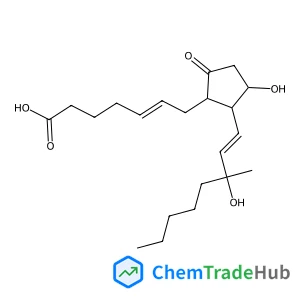
(5Z,11alpha,13E,15R)-11,15-Dihydroxy-15-methyl-9-oxoprosta-5,13-dien-1-oic acid
CAS Number:
55028-70-1
Molecular Formula:
C21H34O5
A. Vetrimani, K. Geetha, E. Angel Jemima, N. Arulnathan, Hyun-Seok Kim, A. Kathalingam
Green synthesis of copper oxide nanoparticles and its effects on photocatalytic dye degradation and antibacterial activities are reported. The synthesis of nanoparticles by green routes provides many advantages over chemical routes, including simplicity, cost-effectiveness, and fast processing route without using any costly or harmful chemicals. Tridax procumbense (coat buttons) plant root extract was used to synthesize copper oxide nanoparticles. The synthesized Tridax procumbense-copper oxide nanoparticles (TP-CuO NPs) were characterized by UV-visible spectroscopy, Fourier transform infrared spectroscopy (FTIR), scanning electron microscopy (SEM), transmission electron microscopy (TEM), dynamic light scattering spectroscopy (DLS), and X-ray diffraction (XRD) techniques. The synthesized TP-CuO NPs were applied for photocatalytic dye degradation and antibacterial activity studies. The TP-CuO NPs exhibited a maximum antibacterial activity at 500 μg mL−1 concentration against Staphylococcus aureus and E. coli showing inhibition zones of 7.5 mm and 7.2 mm, respectively. The photocatalytic ability of the TP-CuO was also tested against the textile dye Trypan blue (TB), and showed about 55% degradation after 48 h for 500 μg mL−1 CuO NP concentration, showing a concentration-dependent degradation efficiency. This is the first work on TP-derived CuO nanoparticles and their photocatalytic and antimicrobial applications. Overall, this study supports the superiority of green-synthesized TP-CuO NPs as photocatalytic and antimicrobial agents.
Y. Kamimura, A. Endo
DOI: 10.1039/C5CP05211D
Daniel Murdock, Rebecca A. Ingle, Igor V. Sazanovich, Ian P. Clark, Yu Harabuchi, Tetsuya Taketsugu, Satoshi Maeda, Andrew J. Orr-Ewing, Michael N. R. Ashfold
DOI: 10.1039/C5CP06597F
Lingting Ye, Shanwen Tao, Kui Xie
DOI: 10.1039/C5CP06742A
Dorian S. N. Parker, Ralf I. Kaiser, Oleg Kostko, Tyler P. Troy, Musahid Ahmed, Bing-Jian Sun, Shih-Hua Chen, A. H. H. Chang
DOI: 10.1039/C5CP02960K
Markus Martincic, Elzbieta Pach, Belén Ballesteros, Gerard Tobias
DOI: 10.1039/C5CP04664E
Nada Mehio, J. Casey Johnson, Vyacheslav S. Bryantsev
DOI: 10.1039/C5CP06165B
N. Scott Bobbitt, Grady Schofield, Charles Lena, James R. Chelikowsky
DOI: 10.1039/C5CP02561C
Vijay Beniwal, Shashi K. Shukla, Anil Kumar
DOI: 10.1039/C5CP05921F
Monica Bugeanu, Roberto Di Remigio, Krzysztof Mozgawa, Simen Sommerfelt Reine, Helmut Harbrecht, Luca Frediani
DOI: 10.1039/C5CP03410H
Ludmila B. Boinovich, Alexandre M. Emelyanenko, Kirill A. Emelyanenko, Konstantin I. Maslakov
DOI: 10.1039/C5CP06988B
When handling 2-Methyl-2-propanyl 5-amino-2-thiophenecarboxylate (CAS: 1498311-5...
5-Bromo-1,2-dichloro-3-fluorobenzene (CAS: 1000572-93-9) is a crystalline solid ...
(2R)-2-Amino-2-(4-bromophenyl)ethanol (CAS: 354153-64-3) should be stored in a c...
Methyl 4-(aminomethyl)tetrahydro-2H-pyran-4-carboxylate hydrochloride (CAS: 3627...
1,4-Dimethyl-1H-pyrazole-5-sulfonyl chloride is primarily used as an intermediat...
Dinaphtho[1,2-b:2',1'-d]furan is generally safe when handled with appropriate pe...
The market for 7-Methyl-7,9-dihydro-1H-purine-2,6,8(3H)-trione (CAS: 612-37-3) i...
2-(4-Chlorophenyl)malonaldehyde (CAS: 205676-17-1) is a colorless or light yello...
2-Methylchrysene (CAS: 3351-32-4) is typically synthesized via the reaction of c...
N-(6-aminopyrimidin-4-yl)acetamide (CAS: 89533-23-3) is generally considered saf...

Physical Chemistry Chemical Physics (PCCP) is an international journal co-owned by 19 physical chemistry and physics societies from around the world. This journal publishes original, cutting-edge research in physical chemistry, chemical physics and biophysical chemistry. To be suitable for publication in PCCP, articles must include significant innovation and/or insight into physical chemistry; this is the most important criterion that reviewers and Editors will judge against when evaluating submissions. The journal has a broad scope and welcomes contributions spanning experiment, theory, computation and data science. Topical coverage includes spectroscopy, dynamics, kinetics, statistical mechanics, thermodynamics, electrochemistry, catalysis, surface science, quantum mechanics, quantum computing and machine learning. Interdisciplinary research areas such as polymers and soft matter, materials, nanoscience, energy, surfaces/interfaces, and biophysical chemistry are welcomed if they demonstrate significant innovation and/or insight into physical chemistry. Joined experimental/theoretical studies are particularly appreciated when complementary and based on up-to-date approaches.