












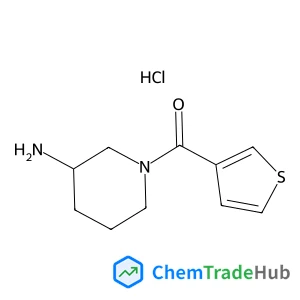
(3-Amino-piperidin-1-yl)-thiophen-3-yl-methanone hydrochloride
CAS Number:
1185316-70-4
Molecular Formula:
C10H15ClN2OS
Lijin Zhan, Yimei Fang, Ruotong Zhang, Xiancong Lu, Tie-yu Lü, Shunqing Wu
Silicene, a competitive two-dimensional (2D) material for future electronic devices, has attracted intensive attention in condensed matter physics. Utilizing an adaptive genetic algorithm (AGA), we identify a topological allotrope of silicene, named tilted penta (tPenta) silicene. Based on first-principles calculations, the geometric and electronic properties of tPenta silicene and its isoelectronic substitutions (Ge, Sn) are investigated. Our results indicate that tPenta silicene exhibits a semimetallic state with distorted Dirac cones in the absence of spin-orbit coupling (SOC). When SOC is considered, it shows semiconducting behavior with a gap opening of 2.4 meV at the Dirac point. Based on the results of invariant ( = 1) and the helical edge states, we demonstrate that tPenta silicene is a topological insulator. Furthermore, the effect of isoelectronic substitutions on tPenta silicene is studied. Two stoichiometric phases, i.e., tPenta Si0.333Ge0.667 and tPenta Si0.333Sn0.667 are found to retain the geometric framework of tPenta silicene and exhibit high stabilities. Our calculations show that both tPenta Si0.333Ge0.667 and tPenta Si0.333Sn0.667 are QSH insulators with enlarged band gaps of 32.5 meV and 94.3 meV, respectively, at the HSE06 level, offering great potential for practical applications at room temperature.
Samuel Tekobo, Eugene Pinkhassik
DOI: 10.1039/B817598E
Mamoru Fujitsuka, Sachiko Tojo, Teruo Shinmyozu, Tetsuro Majima
DOI: 10.1039/B810122A
Richie E. Kohman, Steven C. Zimmerman
DOI: 10.1039/B818183G
Neil M. Boag, K. Mohan Rao
DOI: 10.1039/B818537A
Kyung-Chang Seo, Young-Geol Kwon, Dae-Hee Kim, In-Sook Jang, Jin-Won Cho, Sung-Kee Chung
DOI: 10.1039/B821058F
Dragoslav Vidovic, Glesni A. Pierce, Simon Aldridge
DOI: 10.1039/B816042B
Hikaru Yanai, Takeo Taguchi
DOI: 10.1039/B817599C
Huan Pang, Feng Gao, Qingyi Lu
DOI: 10.1039/B816670F
Joe Briscoe, Diego E. Gallardo, Steve Dunn
DOI: 10.1039/B820797F
When handling 2-Methyl-2-propanyl 5-amino-2-thiophenecarboxylate (CAS: 1498311-5...
5-Bromo-1,2-dichloro-3-fluorobenzene (CAS: 1000572-93-9) is a crystalline solid ...
(2R)-2-Amino-2-(4-bromophenyl)ethanol (CAS: 354153-64-3) should be stored in a c...
Methyl 4-(aminomethyl)tetrahydro-2H-pyran-4-carboxylate hydrochloride (CAS: 3627...
1,4-Dimethyl-1H-pyrazole-5-sulfonyl chloride is primarily used as an intermediat...
Dinaphtho[1,2-b:2',1'-d]furan is generally safe when handled with appropriate pe...
The market for 7-Methyl-7,9-dihydro-1H-purine-2,6,8(3H)-trione (CAS: 612-37-3) i...
2-(4-Chlorophenyl)malonaldehyde (CAS: 205676-17-1) is a colorless or light yello...
2-Methylchrysene (CAS: 3351-32-4) is typically synthesized via the reaction of c...
N-(6-aminopyrimidin-4-yl)acetamide (CAS: 89533-23-3) is generally considered saf...

Physical Chemistry Chemical Physics (PCCP) is an international journal co-owned by 19 physical chemistry and physics societies from around the world. This journal publishes original, cutting-edge research in physical chemistry, chemical physics and biophysical chemistry. To be suitable for publication in PCCP, articles must include significant innovation and/or insight into physical chemistry; this is the most important criterion that reviewers and Editors will judge against when evaluating submissions. The journal has a broad scope and welcomes contributions spanning experiment, theory, computation and data science. Topical coverage includes spectroscopy, dynamics, kinetics, statistical mechanics, thermodynamics, electrochemistry, catalysis, surface science, quantum mechanics, quantum computing and machine learning. Interdisciplinary research areas such as polymers and soft matter, materials, nanoscience, energy, surfaces/interfaces, and biophysical chemistry are welcomed if they demonstrate significant innovation and/or insight into physical chemistry. Joined experimental/theoretical studies are particularly appreciated when complementary and based on up-to-date approaches.
![3-[7-Amino-3-(3-pyridinyl)pyrazolo[1,5-a]pyrimidin-6-yl]phenol structure](https://static.chemtradehub.com/structs/861/861249-77-6-025b.webp "3-[7-Amino-3-(3-pyridinyl)pyrazolo[1,5-a]pyrimidin-6-yl]phenol structure")
![L-Lysine,N6-[2-[[(1,1-dimethylethoxy)carbonyl]amino]benzoyl]-N2-[(9H-fluoren-9-ylmethoxy)carbonyl]- structure](https://static.chemtradehub.com/structs/159/159322-59-5-c046.webp "L-Lysine,N6-[2-[[(1,1-dimethylethoxy)carbonyl]amino]benzoyl]-N2-[(9H-fluoren-9-ylmethoxy)carbonyl]- structure")
![3-(benzotriazol-1-yl)-N-[[2-[(3-bromophenyl)methoxy]phenyl]methylideneamino]propanamide structure](https://static.chemtradehub.com/structs/559/5595-78-8-0a32.webp "3-(benzotriazol-1-yl)-N-[[2-[(3-bromophenyl)methoxy]phenyl]methylideneamino]propanamide structure")




