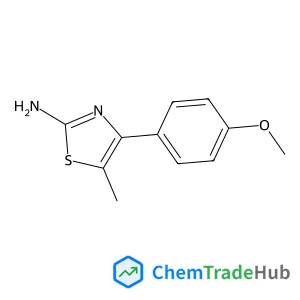
4-(4-Methoxyphenyl)-5-methyl-1,3-thiazol-2-amine
CAS Number:
105512-88-7
Molecular Formula:
C11H12N2OS
Samuel Tekobo, Eugene Pinkhassik
Organic nanodisks, a new type of organic nanoparticles suitable for creating polymer–polymer nanocomposites, are produced by controlled polymerization within the hydrophobic interior of bicelles (discoidal lipid aggregates) used here as recyclable scaffolds.
Sanaz Zarabi Golkhatmi, Peter D. Lund
DOI: 10.1039/D3MA00352C
Yuelin Wang, Thanh Ngoc Pham, Harry H. Halim, Likai Yan
DOI: 10.1039/D3MA00502J
Ayushi Kaushik, Subhrajyoti Bhandary, Ganesh D. Sharma, Jeyaraman Sankar
DOI: 10.1039/D3MA00610G
Margherita Cavallo, Matteo Signorile, Roberto Köferstein, Valentina Crocellà
DOI: 10.1039/D3MA00356F
Tuba Oz, Małgorzata Kujawska
DOI: 10.1039/D3MA00623A
Chang Liu, Lunxiang Yin, Yanli Guo, Bao Xie, Xu Wang, Yanqin Li
DOI: 10.1039/D3MA00925D
Lei Peng, Chenxu Zhang, Guanlun Zhou, Yongjian Wang
DOI: 10.1039/D3MA00243H
Swapnil Barthwal, Siddhant Singh, Abhishek K. Chauhan, Nimitha S. Prabhu, Akila G. Prabhudessai, K. Ramesh
DOI: 10.1039/D3MA00479A
(5-Sulfamoyl-3-pyridinyl)boronic acid is primarily used in chemical synthesis, p...
Benzyl 2-methyl-2-(methylsulfonyl)-4-pentenoate is typically synthesized via est...
When handling 8-Fluoroquinolin-6-ol (CAS: 209353-22-0), it is important to use p...
1,3-Dibromo-5-(2-methyl-2-propanyl)benzene (CAS: 129316-09-2) is a crystalline c...
Ethyl 7-chloro-4-oxo-1-(1,3-thiazol-2-yl)-1,4-dihydro-1,8-naphthyridine-3-carbox...
When handling Delta-7-Avenasterol (CAS: 23290-26-8), it is important to wear app...
Proper handling involves the use of personal protective equipment such as gloves...
When handling 2-Methyl-2-proanyl 4-[(2-aminophenyl)amino]-1-piperidinecarboxylat...
N-Methyl-4-chlorobenzylamine hydrochloride (CAS: 65542-24-7) is a organic compou...
[2-(Dodecyloxy)ethoxy]acetic acid (CAS: 27306-90-7) is generally considered safe...

ChemComm publishes urgent research which is of outstanding significance and interest to experts in the field, while also appealing to the journal’s broad chemistry readership. Our communication format is ideally suited to short, urgent studies that are of such importance that they require accelerated publication. Our scope covers all topics in chemistry, and research at the interface of chemistry and other disciplines (such as materials science, nanoscience, physics, engineering and biology) where there is a significant novelty in the chemistry aspects. Major topic areas covered include: Analytical Chemistry Catalysis Chemical Biology and medicinal chemistry Computational Chemistry and Machine Learning Energy and sustainable chemistry Environmental Chemistry Green Chemistry Inorganic Chemistry Materials Chemistry Nanoscience Organic Chemistry Physical Chemistry Polymer Chemistry Supramolecular Chemistry
![2-(5-Bromo-1H-pyrrolo[2,3-B]pyridin-3-YL)acetic acid structure](https://static.chemtradehub.com/structs/106/1060795-03-0-0589.webp "2-(5-Bromo-1H-pyrrolo[2,3-B]pyridin-3-YL)acetic acid structure")