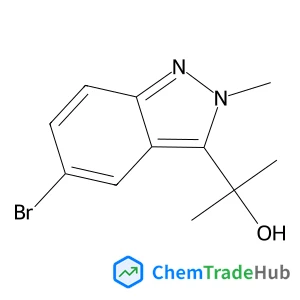
2-(5-Bromo-2-methyl-2H-indazol-3-yl)-2-propanol
CAS Number:
1823787-20-7
Molecular Formula:
C11H13BrN2O
Hari O. S. Yadav, An-Tsung Kuo, Shingo Urata, Kosuke Funahashi, Yutaka Imamura
Molecular dynamics simulations were employed to investigate the adsorption behavior of a variety of amino-acid side-chain analogs (SCAs) and a β-hairpin (HP7) peptide on a series of liquid-like self-assembled monolayers (SAMs) with terminal functional groups of –OH, –OCH3, –CH3, and –CF3. The relationships between the adsorption free energy of the SCAs and the interfacial properties of water on the SAMs were examined to determine the acute predictors of protein adsorption on the SAM surfaces. The structural changes of HP7 on the SAM surfaces were also investigated to understand the relationship between the surface nature and protein denaturation. It was found that the adsorption free energy of the SCAs was linearly related to the surface hydrophobicity, which was computed as the free energy of cavity formation near the SAM–water interfaces. In addition, the hydrophobic –CH3 and –CF3 SAMs produced substantial conformational changes in HP7 because of the strong hydrophobic attractions to the nonpolar side chains. The hydrophilic surface terminated by –OH also promoted structural changes in HP7 resulting from the formation of hydrogen bonds between the hydrophilic tail and HP7. Consequently, the moderate amphiphilic surface terminated by –OCH3 avoided the denaturation of HP7 most efficiently, thus improving the biocompatibility of the surface. In conclusion, these results provide a deep understanding of protein adsorption for a wide range of polymeric surfaces, and they can potentially aid the design of appropriate biocompatible coatings for medical applications.
Stuart T. Caldwell, Louis J. Farrugia, Shanika Gunatilaka Hewage, Nadiya Kryvokhyzha, Vincent M. Rotello, Graeme Cooke
DOI: 10.1039/B900269N
Siriporn Jiwpanich, Britto S. Sandanaraj, S. Thayumanavan
DOI: 10.1039/B815263B
Hideyuki Otsuka, Takatoshi Muta, Masahide Sakada, Takeshi Maeda, Atsushi Takahara
DOI: 10.1039/B818014H
Xin-Long Wang, Chao Qin, Ya-Qian Lan, Kui-Zhan Shao, Zhong-Min Su, En-Bo Wang
DOI: 10.1039/B815629H
Suzanne Crilly, Edmond Magner
DOI: 10.1039/B819618D
DOI: 10.1039/B820022J
Dhilon S. Patel, Prasad V. Bharatam
DOI: 10.1039/B816595E
Nolene Byrne, C. Austen Angell
DOI: 10.1039/B817590J
Joe Briscoe, Diego E. Gallardo, Steve Dunn
DOI: 10.1039/B820797F
Daniel Oves-Costales, Lijiang Song, Gregory L. Challis
DOI: 10.1039/B823147H
When handling 2-Methyl-2-propanyl 5-amino-2-thiophenecarboxylate (CAS: 1498311-5...
5-Bromo-1,2-dichloro-3-fluorobenzene (CAS: 1000572-93-9) is a crystalline solid ...
(2R)-2-Amino-2-(4-bromophenyl)ethanol (CAS: 354153-64-3) should be stored in a c...
Methyl 4-(aminomethyl)tetrahydro-2H-pyran-4-carboxylate hydrochloride (CAS: 3627...
1,4-Dimethyl-1H-pyrazole-5-sulfonyl chloride is primarily used as an intermediat...
Dinaphtho[1,2-b:2',1'-d]furan is generally safe when handled with appropriate pe...
The market for 7-Methyl-7,9-dihydro-1H-purine-2,6,8(3H)-trione (CAS: 612-37-3) i...
2-(4-Chlorophenyl)malonaldehyde (CAS: 205676-17-1) is a colorless or light yello...
2-Methylchrysene (CAS: 3351-32-4) is typically synthesized via the reaction of c...
N-(6-aminopyrimidin-4-yl)acetamide (CAS: 89533-23-3) is generally considered saf...

Physical Chemistry Chemical Physics (PCCP) is an international journal co-owned by 19 physical chemistry and physics societies from around the world. This journal publishes original, cutting-edge research in physical chemistry, chemical physics and biophysical chemistry. To be suitable for publication in PCCP, articles must include significant innovation and/or insight into physical chemistry; this is the most important criterion that reviewers and Editors will judge against when evaluating submissions. The journal has a broad scope and welcomes contributions spanning experiment, theory, computation and data science. Topical coverage includes spectroscopy, dynamics, kinetics, statistical mechanics, thermodynamics, electrochemistry, catalysis, surface science, quantum mechanics, quantum computing and machine learning. Interdisciplinary research areas such as polymers and soft matter, materials, nanoscience, energy, surfaces/interfaces, and biophysical chemistry are welcomed if they demonstrate significant innovation and/or insight into physical chemistry. Joined experimental/theoretical studies are particularly appreciated when complementary and based on up-to-date approaches.
![4-Chloro-N-{[4-(dimethylamino)phenyl]carbamoyl}benzenesulfonamide structure](https://static.chemtradehub.com/structs/558/5581-42-0-7dcb.webp "4-Chloro-N-{[4-(dimethylamino)phenyl]carbamoyl}benzenesulfonamide structure")