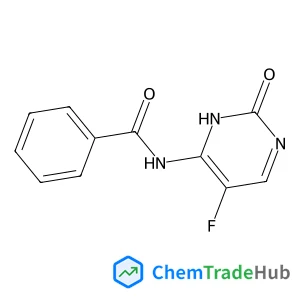
N-(5-Fluoro-2-oxo-2,3-dihydro-4-pyrimidinyl)benzamide
CAS Number:
10357-07-0
Molecular Formula:
C11H8FN3O2
Koray Alper, Yun-Yan Wang, Xianzhi Meng, Kubilay Tekin, Selhan Karagoz
Supercritical ethanol liquefaction of teak wood was carried out at 300 °C for 30 min without and with the use of Mg(ClO4)2, HClO4, and HClO4/Mg(ClO4)2 at various loadings (2–10 mmol). The bio-oil yield from the non-catalytic supercritical ethanol liquefaction of teak wood was ∼41 wt%. The highest bio-oil yield (∼58.2 wt%) was obtained with the catalytic run using 2 mmol of Mg(ClO4)2. In the catalyzed trials, with the use of either Mg(ClO4)2 or HClO4, an increase in catalyst amounts resulted in a decrease in bio-oil yields. There was no clear trend for the use of co-catalysts. A degree of de-oxygenation was observed with the use of the catalysts studied. The O/C atomic ratio of the bio-oil from the non-catalytic was 0.44. The O/C atomic ratios in the bio-oil produced from catalytic runs ranged from 0.25 to 0.38. In the bio-oil from the non-catalytic run, the major compound was phenolic species, whereas esters were dominant in the bio-oils from the catalytic runs. The type of catalyst and its amount had significant effects on the product distributions and compositions. The prominent ester compounds were ethyl lactate and ethyl levulinate. The highest relative yield of ethyl levulinate was 49.1% and obtained with the use of the Mg(ClO4)2/HClO4 (2 mmol : 10 mmol) catalyst. The heating values of the bio-oils from catalytic runs were higher than that of the non-catalytic run. The highest heating value of 31.21 MJ kg−1 was obtained with the Mg(ClO4)2/HClO4 (2 mmol : 10 mmol) catalyst.
Jinxing Ye, Darren J. Dixon, Peter S. Hynes
DOI: 10.1039/B508833J
Dirk Jan V. C. van Steenis, Olivier R. P. David, Gino P. F. van Strijdonck, Jan H. van Maarseveen, Joost N. H. Reek
DOI: 10.1039/B507776A
Kazunori Nakashima, Tatsuo Maruyama, Noriho Kamiya, Masahiro Goto
DOI: 10.1039/B505479F
Avelino Corma, Marcelo E. Domine
DOI: 10.1039/B506685A
Patrik Västilä, Jenny Wettergren, Hans Adolfsson
DOI: 10.1039/B505516D
Robin B. Bedford, Duncan W. Bruce, Robert M. Frost, Michael Hird
DOI: 10.1039/B507133J
Jeane Bordini, Peter C. Ford, Elia Tfouni
DOI: 10.1039/B507407J
Chantal Gondran, Olivier Renaudet, Pascal Dumy, Hugues Driguez, Sébastien Fort, Serge Cosnier
DOI: 10.1039/B506699A
Nicolai Dieltiens, Diederica D. Claeys, Bart Allaert, Francis Verpoort, Christian V. Stevens
DOI: 10.1039/B508663A
Patrick J. Hrdlicka, T. Santhosh Kumar, Jesper Wengel
DOI: 10.1039/B506986F
Waste containing N-Methoxy-N-methyl-1,3-thiazole-5-carboxamide (CAS: 898825-89-3...
N-(4-Biphenylyl)dibenzo[b,d]furan-4-amine should be stored in a tightly sealed c...
The market for 3-Acetamido-5-amino-2,4,6-triiodobenzoic acid (CAS: 1713-07-1) is...
Benzyl 2-O-acetyl-3,4,6-tri-O-benzyl-beta-D-galactopyranoside (CAS: 61820-03-9) ...
2-Ethylpiperazine dihydrochloride (CAS: 438050-52-3) is regulated under the Glob...
1,1'-[1,3-Phenylenebis(methylene)]bis(3-methyl-1H-pyrrole-2,5-dione) (CAS: 11946...
Several alternatives can be used in the synthesis of 5-Fluoro-2-(1-pyrrolidinyl)...
Proper personal protective equipment (PPE) must be worn when handling this compo...
When handling 6-Bromoimidazo[1,2-a]pyridin-8-amine, it is important to wear appr...
Alternatives to (2S,4R)-4-(4-Nitrobenzyl)pyrrolidine-2-carboxylic acid hydrochlo...
![4-Chloro-2-{[(2-chlorophenoxy)acetyl]amino}benzoic acid structure](https://static.chemtradehub.com/structs/351/351424-20-9-9467.webp "4-Chloro-2-{[(2-chlorophenoxy)acetyl]amino}benzoic acid structure")