













The highly selective synthesis of 5-methyl vanillin from the by-product in vanilla industry and the scent influence for vanillin
Literature Information
Publication Date
2021-01-08
DOI
10.1039/D1SE00011J
Impact Factor
6.367
Authors
Haifang Mao, Hongzhao Wang, Ting Tang, Qixuan Shi, Haiyan Yu, Xiaojun Hu, Zuobing Xiao, Pingyi Zhang, Jibo Liu
View Original
Abstract
Herein, with the aim of the comprehensive utilization of a useless by-product, a highly selective method was proposed for the production of 5-methyl vanillin (M-vanillin) by employing o-vanillin as a raw material, which is a useless by-product in the vanillin industry. The olfactory thresholds indicated that the scent of vanillin is inhibited by the presence of o-vanillin, while the scent of vanillin is promoted by the synergistic effect of M-vanillin. M-Vanillin was generated through a three-step highly efficient procedure, including hydrogenation reduction, addition reaction and oxidation. The key intermediate (3-methoxyl-4-hydroxy-5-methylmandelic acid, 5-MVMA) was catalyzed to oxidize to M-vanillin with 92% yield using a porous NiCo2O4/SiO2 composite catalyst via a green procedure at 1 atm atmospheric pressure and 80 °C. The multilayer adsorption–desorption curve showed that the specific surface area of NiCo2O4 increased from 14 m2 g−1 to 170.78 m2 g−1 after it was loaded on the SiO2 substrate, which provided favorable conditions for the substrate and O2 adsorption. XPS and in situ ATR-FTIR indicated that the Co2+/Co3+ and Ni2+/Ni3+ valence pair co-existed in the catalyst, which resulted in high selectivity for the production of M-vanillin.
Recommended Journals
Related Literature
New ligand platforms for developing the chemistry of the TiN–NR2 functional group and the insertion of alkynes into the N–N bond of a TiN–NPh2 ligand
Jonathan D. Selby, Catherine D. Manley, Marta Feliz, Andrew D. Schwarz, Eric Clot, Philip Mountford
2007-09-21
Communication
DOI: 10.1039/B711941K
The effect of steric bulk in Sonogashira coupling reactions
Markus an der Heiden, Herbert Plenio
2006-12-11
Communication
DOI: 10.1039/B616608C
Control of nano-micrometric twist and helical ribbon formation with gemini–oligoalanine via interpeptidic β-sheet structure formation
Aurélie Brizard, Roni Kiagus Ahmad, Reiko Oda
2007-03-06
Communication
DOI: 10.1039/B700959C
From inconsistent results to high speed hydrosilylation
Virginie Comte, Cédric Balan, Pierre Le Gendre, Claude Moïse
2007-01-10
Communication
DOI: 10.1039/B617413B
Physicochemical characterization of octakis(alkyloxy)-substituted Zn(ii)-phthalocyanines non-covalently incorporated into an organogel and their remarkable morphological effect on the nanoscale-fibers
David Díaz Díaz, Tomás Torres, Rudolf Zentel, Riju Davis, Martin Brehmer
2007-05-17
Communication
DOI: 10.1039/B703685J
Maximizing the relaxivity of HSA-bound gadolinium complexes by simultaneous optimization of rotation and water exchange
Stefano Avedano, Lorenzo Tei, Alberto Lombardi, Giovanni B. Giovenzana, Silvio Aime, Dario Longo, Mauro Botta
2007-10-26
Communication
DOI: 10.1039/B714438E
Template-directed supramolecular self-assembly of coordination dumbbells at surfaces
Nian Lin, Alexander Langner, Steven L. Tait, Chandrasekar Rajadurai, Mario Ruben
2007-09-20
Communication
DOI: 10.1039/B712082F
Recent advances in polymer protected gold nanoparticles: synthesis, properties and applications
Jun Shan, Heikki Tenhu
2007-07-09
Feature Article
DOI: 10.1039/B707740H
Lewis acid-catalyzed formation of indene derivatives via tandem reactions of arylacetylenes with the cations generated from 2-silylmethyl cyclopropyl carbinols
Veejendra K. Yadav, Naganaboina Vijaya Kumar, Masood Parvez
2007-03-06
Communication
DOI: 10.1039/B700246G
Maximising opportunities in supercritical chemistry: the continuous conversion of levulinic acid to γ-valerolactone in CO2
Richard A. Bourne, James G. Stevens, Jie Ke, Martyn Poliakoff
2007-10-16
Communication
DOI: 10.1039/B708754C
You might also like
Compound Q&A
What regulatory guidelines apply to 4-Amino-3-bromophenol (CAS: 74440-80-5)?
4-Amino-3-bromophenol (CAS: 74440-80-5) falls under the classification of a haza...
74440-80-54-Amino-3-bromopheno...
Compound Q&A
How should (17beta)-3-Oxoestr-4-en-17-yl acetate (CAS: 1425-10-1) be stored?
(17beta)-3-Oxoestr-4-en-17-yl acetate should be stored in a cool, dry place away...
1425-10-1(17beta)-3-Oxoestr-4...
Compound Q&A
What are the physical and chemical properties of 2-[(2,2-Diethoxyethyl)disulfanyl]-1,1-diethoxyethane (CAS: 76505-71-0)?
2-[(2,2-Diethoxyethyl)disulfanyl]-1,1-diethoxyethane (CAS: 76505-71-0) is a colo...
76505-71-02-[(2,2-Diethoxyethy...
Compound Q&A
What is the market or research trend for 1-(β-D-ribofuranosyl)-1H-imidazo[4,5-c]pyridin-4-amine?
The market and research for 1-(β-D-ribofuranosyl)-1H-imidazo[4,5-c]pyridin-4-ami...
6736-58-91-(beta-D-Ribofurano...
Compound Q&A
How should waste containing Conjugated Estrogen (CAS: 12126-59-9) be handled?
Waste containing Conjugated Estrogen (CAS: 12126-59-9) should be collected and d...
12126-59-9Conjugated Estrogen
Compound Q&A
What is the market or research trend for Bis(2,2,2-trifluoroethyl) (methoxycarbonylmethyl)phosphonate?
The market for Bis(2,2,2-trifluoroethyl) (methoxycarbonylmethyl)phosphonate (CAS...
88738-78-7Bis(2,2,2-trifluoroe...
Compound Q&A
Are there alternatives to 3,4'-Di-O-methylellagic acid (CAS: 57499-59-9) in synthesis?
There are several alternatives to 3,4'-Di-O-methylellagic acid (CAS: 57499-59-9)...
57499-59-93,4'-Di-O-methylella...
Compound Q&A
What regulatory guidelines apply to 2-Chloro-N,N-dimethylpyridin-4-amine (CAS: 59047-70-0)?
2-Chloro-N,N-dimethylpyridin-4-amine (CAS: 59047-70-0) is regulated under the Gl...
59047-70-02-Chloro-N,N-dimethy...
Compound Q&A
What is cerium(3+);oxygen(2-);vanadium(5+) (CAS: 13597-19-8)?
Cerium(3+);oxygen(2-);vanadium(5+) (CAS: 13597-19-8) is a complex inorganic comp...
13597-19-8cerium(3+);oxygen(2-...
Compound Q&A
Is 7-Chloro-1-iodoisoquinoline (CAS: 1203579-27-4) safe?
7-Chloro-1-iodoisoquinoline (CAS: 1203579-27-4) is generally considered safe whe...
1203579-27-47-Chloro-1-iodoisoqu...
Source Journal
Recommended Compounds
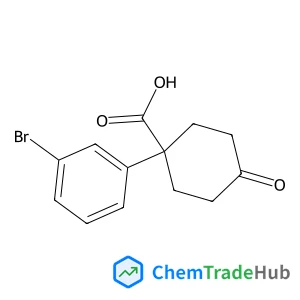
1-(3-Bromophenyl)-4-oxocyclohexanecarboxylic acid
CAS Number:
1385694-53-0
Molecular Formula:
C13H13BrO3
![(2S)-2-({N-[(2S)-2-Ammonio-4-methylpentanoyl]glycyl}amino)-3-phenylpropanoate structure](https://static.chemtradehub.com/structs/429/4294-25-1-0842.webp "(2S)-2-({N-[(2S)-2-Ammonio-4-methylpentanoyl]glycyl}amino)-3-phenylpropanoate structure")
(2S)-2-({N-[(2S)-2-Ammonio-4-methylpentanoyl]glycyl}amino)-3-phenylpropanoate
CAS Number:
4294-25-1
Molecular Formula:
C17H25N3O4
Recommended Suppliers





Disclaimer
This page provides academic journal information for reference and research purposes only. We are not affiliated with any journal publishers and do not handle publication submissions. For publication-related inquiries, please contact the respective journal publishers directly.
If you notice any inaccuracies in the information displayed, please contact us at support@chemtradehub.com. We will promptly review and address your concerns.