












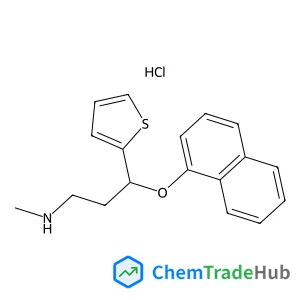
N-Methyl-3-(1-naphthyloxy)-3-(2-thienyl)-1-propanamine hydrochloride (1:1)
CAS Number:
1188266-11-6
Molecular Formula:
C18H20ClNOS
A. S. Russel, Puneet Kumar Chaudhary, Pulkit Jain, Goutam Deo
Microkinetic modelling of dry reforming of methane (DRM) with O2 co-feed was performed using a previously developed reforming mechanism. The model was validated by comparing simulated results with experimentally determined data over a variety of reaction conditions. Numerically predicted results show that co-feeding O2 improved CH4 conversion, reduced carbon deposition, and increased H2/CO ratio. Microkinetic analysis shows that during oxidative dry reforming of methane (ODRM), the surface coverage of empty sites tracks the CH4 conversion. Furthermore, the H2/CO ratio is directly related to the surface H* and CO* coverages. Sensitivity analysis highlighted that CH4 dissociation is the rate-determining step for ODRM reaction, and the adsorption–desorption steps are equilibrated. We were able to obtain a reduced mechanism (35 steps) for ODRM by applying a previously suggested hierarchical chemistry reduction strategy on the full mechanism (52 steps). The apparent activation energy for CH4 consumption and orders of the reaction were also determined.
Ivan S. Golovanov, Vladimir A. Tartakovsky, Alexey Yu. Sukhorukov, Sema L. Ioffe
DOI: 10.1039/C8OB01039K
Mu Chen, Jia-Qing Cao, Song Ang, Ting-Ni Zeng, Ni-Ping Li, Tang-Jia Yang, Jun-Shan Liu, Yan Wu, Wen-Cai Ye, Lei Wang
DOI: 10.1039/D1QO01629F
Jenny K. Ekegren, Peter Roth, Klas Källström, Tibor Tarnai, Pher G. Andersson
DOI: 10.1039/B208907F
Jing Xu, Da-Jun Zheng, Mi-Mi Su, Yan-Chi Chen, Qing-Cai Jiao
DOI: 10.1039/C8OB01908H
Aubrey J. Ellison
DOI: 10.1039/C8OB01773E
Xianwei Li, Tianzhang Wang, Yu-Jing Lu, Shaomin Ji, Yanping Huo, Bifu Liu
DOI: 10.1039/C8OB01532E
Han Xu, Feng Sha, Qiong Li, Xin-Yan Wu
DOI: 10.1039/C8OB01970C
Per Wiklund, Jan Bergman
DOI: 10.1039/B209505J
N-(4-Methoxybenzyl)-2-pyridinamine (CAS: 52818-63-0) is increasingly being used ...
When handling Ethyl 4-(2-chlorophenyl)-1,3-thiazole-2-carboxylate, appropriate p...
Diethyldiselane (CAS: 628-39-7) is classified under the Globally Harmonized Syst...
The market for oxocopper (CAS: 12053-18-8) is primarily driven by its use in cat...
The market for 5-{[(2-Methyl-2-propanyl)oxy]carbonyl}-5-azaspiro[2.4]heptane-7-c...
2-(1-Pyrrolidinyl)-4-pyridinamine is a chemical compound with the CAS number 359...
2-(3-Pyridinyl)-1-azabicyclo[2.2.2]octane (CAS: 91556-75-1) is a crystalline sol...
(S)-Alpha-allyl-proline hydrochloride is usually synthesized via a Wittig reacti...
3-Methyl-1,2-oxazole-5-carboxylic acid (CAS: 4857-42-5) is an organic compound w...
Lys-SMCC-DM1 is synthesized via a multi-step process involving the coupling of S...

Reaction Chemistry & Engineering is an interdisciplinary journal reporting cutting-edge research focused on enhancing the understanding and efficiency of reactions. Reaction engineering leverages the interface where fundamental molecular chemistry meets chemical engineering and technology. Challenges in chemistry can be overcome by the application of new technologies, while engineers may find improved solutions for process development from the latest developments in reaction chemistry. Reaction Chemistry & Engineering is a unique forum for researchers whose interests span the broad areas of chemical engineering and chemical sciences to come together in solving problems of importance to wider society. All papers should be written to be approachable by readers across the engineering and chemical sciences. Papers that consider multiple scales, from the laboratory up to and including plant scale, are particularly encouraged.
![5'-Fluoro-[2,3'-biindolinylidene]-2',3-dione structure](https://static.chemtradehub.com/structs/251/251903-00-1-9cb1.webp "5'-Fluoro-[2,3'-biindolinylidene]-2',3-dione structure")



