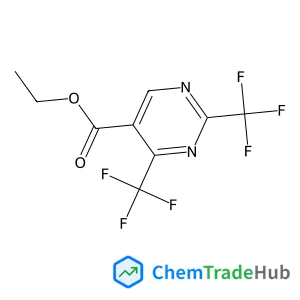
Ethyl 2,4-bis(trifluoromethyl)-5-pyrimidinecarboxylate
CAS Number:
188781-15-9
Molecular Formula:
C9H6F6N2O2
Mark E. Fuller, Philipp Morsch, Matthias Preußker, C. Franklin Goldsmith, K. Alexander Heufer
Modern engine concepts present several opportunities for nitrogen combustion chemistry, particularly the interaction of NOx (NO + NO2) with fuel fragments and products of partial combustion. Current mass-production internal combustion engines are routinely fitted with exhaust gas recirculation (EGR) systems which mix exhaust gases containing NOx with a fresh charge of unburnt fuel and air. Further, interest in application of alkyl nitrates as reactivity enhancers in experimental engine concepts also leads to conditions in which the concentrations of NOx and fuel or fuel fragments are high and the ensuing chemistry plays a major role in the mixture reactivity. In this work, ignition delay times for n-pentane doped with NOx (NO + NO2) were examined in a rapid compression machine. Blends of n-pentane and oxygen at stoichiometric ratios of 0.5, 1.0, and 2.0 were prepared in nitrogen or 1 : 1 nitrogen/argon bath gas blends at a dilution ratio of 7.52 : 1 diluent : oxygen and doped with either NO or NO2 at concentrations of up to 1000 ppm. Ignition delay times were observed for post-compression pressures of 15 bar nominal and temperatures between 650 and 1000 K. A new chemical kinetic model is presented which is constructed upon recent, verified literature mechanisms for pentane combustion and for the combustion of small hydrocarbons and nitrogenated species. Additional recent developments in nitrogen combustion chemistry are applied to update the mechanism and new classes of reactions between fuel fragments and nitrogenated species are introduced and added systematically to the model. The reaction rates for the mechanism are taken from the literature or estimated by analogy and are then manually adjusted as informed by simulation results and sensitivity analysis. Further fine optimization of the model is accomplished utilizing an automated routine. Comparison is made with another pentane–NOx model in the literature and associated data from jet-stirred reactor (JSR) experiments. The model presented in this work is found to have superior performance in predicting and modeling the ignition delay times and similar behaviour in reproducing JSR species profiles as compared with the baseline literature mechanism.
Jongcheol Seo, Stephan Warnke, Sandy Gewinner, Wieland Schöllkopf, Michael T. Bowers, Gert von Helden
DOI: 10.1039/C6CP04941A
Satrajit Chakrabarty, Evan R. Williams
DOI: 10.1039/C6CP05033F
A. Pham, H. Y. Xiao, X. T. Zu, S. Li
DOI: 10.1039/C6CP02206E
James L. White, Wei Zhou, Vitalie Stavila, Leonard E. Klebanoff, Terrence J. Udovic
DOI: 10.1039/C6CP04469G
Jie Cui, Shuhua Liang, Jianmin Zhang
DOI: 10.1039/C6CP03946D
Gábor Schuszter, Fabian Brau, A. De Wit
DOI: 10.1039/C6CP05067K
Ye Zhu, Chenglin Yi, Qiong Hu, Wei Wei, Xiaoya Liu
DOI: 10.1039/C6CP04978H
DOI: 10.1039/C6CP04816A
Anthony Cirri, Alexey Silakov, Lasse Jensen, Benjamin J. Lear
DOI: 10.1039/C6CP02205G
When handling lithium chloride hydrate (1:1:1) (CAS: 16712-20-2), it is importan...
4-(4H-1,2,4-Triazol-4-yl)piperidine is generally considered safe for use in phar...
Waste containing 1,3-Thiazole-2-carboxamide (CAS: 16733-85-0) should be collecte...
5-(Difluoromethyl)-2-fluorobenzonitrile (CAS: 934175-58-3) is subject to regulat...
Methyl 3-acetamido-2-thiophenecarboxylate can be synthesized by the reaction of ...
4-Isoquinolinecarbonitrile is a chemical compound with the CAS number 34846-65-6...
Store Methyl 1H-1,2,3-triazole-4-carboxylate (CAS: 877309-59-6) in a cool, dry p...
6-Bromo[1,3]thiazolo[5,4-b]pyridin-2-amine (CAS: 1160791-13-8) is subject to the...
(2S,3S)-2-Ammonio-3-(3,4-dihydroxyphenyl)-3-hydroxypropanoate (CAS: 23651-95-8) ...
7-Bromo-3-methyl-3,4-dihydroquinazolin-4-one is a solid with a crystalline form....

Reaction Chemistry & Engineering is an interdisciplinary journal reporting cutting-edge research focused on enhancing the understanding and efficiency of reactions. Reaction engineering leverages the interface where fundamental molecular chemistry meets chemical engineering and technology. Challenges in chemistry can be overcome by the application of new technologies, while engineers may find improved solutions for process development from the latest developments in reaction chemistry. Reaction Chemistry & Engineering is a unique forum for researchers whose interests span the broad areas of chemical engineering and chemical sciences to come together in solving problems of importance to wider society. All papers should be written to be approachable by readers across the engineering and chemical sciences. Papers that consider multiple scales, from the laboratory up to and including plant scale, are particularly encouraged.