












Direct synthesis of 2,4,5-trisubstituted imidazoles from primary alcohols by diruthenium(ii) catalysts under aerobic conditions
Literature Information
Publication Date
2019-01-09
DOI
10.1039/C8OB02785D
Impact Factor
3.876
Authors
Saranya Sundar, Ramesh Rengan
View Original
Abstract
Herein we report a straightforward synthetic approach to 2,4,5-trisubstituted imidazoles from readily available primary alcohols using arene diruthenium(II) catalysts. Dinuclear arene ruthenium complexes have been synthesized and structurally characterized with the aid of analytical and spectral techniques. A library of 2,4,5-trisubstituted imidazoles was achieved with a yield up to 95% by loading 0.25 mol% of the catalyst. The present protocol is environmentally benign, which is performed under aerobic conditions and liberates water as the sole by-product.
Recommended Journals
Related Literature
A highly efficient catalytic system for cross-coupling of aryl chlorides and bromides with malononitrile anion by palladium carbene complexes
Chengwei Gao, Xiaochun Tao, Yanlong Qian, Jiling Huang
2003-05-20
Communication
DOI: 10.1039/B302890A
Total synthesis of (+)-belactosin A
Alan Armstrong, James N. Scutt
2004-01-27
Communication
DOI: 10.1039/B316142K
NMR and ion selective electrode studies of hydraphile channels correlate with biological activity in E. coli and B. subtilis
W. Matthew Leevy, Michelle E. Weber, Paul H. Schlesinger
2004-11-25
Communication
DOI: 10.1039/B413588A
Supramolecular control of complexation-induced fluorescence change of water-soluble, β-cyclodextrin-modified CdS quantum dots
Kumaranand Palaniappan, Stephen A. Hackney, Jian Liu
2004-10-11
Communication
DOI: 10.1039/B409075F
Self-assembled arrays of zinc oxide nanoparticles from monolayer films of diblock copolymer micelles
Seong Il Yoo, Byeong-Hyeok Sohn, Wang-Cheol Zin, Sung-Jin An, Gyu-Chul Yi
2004-11-05
Communication
DOI: 10.1039/B409934F
Comment: 2004’s fastest organic and biomolecular chemistry!
Caroline V. Potter, Sarah Thomas, Janet L. Dean, Adrian P. Kybett, Richard Kidd, Melanie James, Helen Saxton
2004-11-26
Comment
DOI: 10.1039/B417565B
Formation of dimers of inclusion cryptand/paraquat complexes driven by dipole–dipole and face-to-face π-stacking interactions
Feihe Huang, Liang Zhou, Jason W. Jones, Harry W. Gibson, Mehdi Ashraf-Khorassani
2004-10-14
Communication
DOI: 10.1039/B411234B
Chemistry of materials under extreme high pressure-high-temperature conditions
2003-03-27
Focus
DOI: 10.1039/B300963G
Synthesis and characterization of a benzene-centered, phthalocyanine hexamer
Giovanni Bottari, Tomás Torres
2004-10-14
Communication
DOI: 10.1039/B411960F
Photoactive dimesogen having different pathways of light driven phase transitions at different temperatures
V. Ajay Mallia, Nobuyuki Tamaoki
2004-10-01
Communication
DOI: 10.1039/B410902C
You might also like
Compound Q&A
What industries use (1R,3S)-1,3-Cyclopentanediol (CAS: 16326-97-9)?
(1R,3S)-1,3-Cyclopentanediol finds applications in various industries. In the ph...
16326-97-9(1R,3S)-1,3-Cyclopen...
Compound Q&A
What precautions should be taken when handling N'-[4-(Dimethylamino)phenyl]-N,N-dimethyl-1,4-benzenediamine (CAS: 637-31-0)?
When handling N'-[4-(Dimethylamino)phenyl]-N,N-dimethyl-1,4-benzenediamine, it i...
637-31-0N'-[4-(Dimethylamino...
Compound Q&A
Are there alternatives to 5-(2,4-Difluorophenyl)-2-methoxypyrimidine (CAS: 1352318-16-1) in synthesis?
There are several alternatives to 5-(2,4-Difluorophenyl)-2-methoxypyrimidine in ...
1352318-16-15-(2,4-Difluoropheny...
Compound Q&A
What regulatory guidelines apply to 1-(3-Methoxyphenoxy)propan-2-ol (CAS: 382141-68-6)?
1-(3-Methoxyphenoxy)propan-2-ol (CAS: 382141-68-6) must comply with the Globally...
382141-68-61-(3-Methoxyphenoxy)...
Compound Q&A
Is Tetrodotoxin Citrate (CAS: 18660-81-6) safe?
Tetrodotoxin Citrate is extremely dangerous and should be handled with extreme c...
18660-81-6Tetrodotoxin Citrate
Compound Q&A
What are the main uses of 2-Methyl-2-propanyl [(1R,3S)-3-hydroxycyclopentyl]carbamate (CAS: 225641-84-9)?
2-Methyl-2-propanyl [(1R,3S)-3-hydroxycyclopentyl]carbamate (CAS: 225641-84-9) i...
225641-84-92-Methyl-2-propanyl ...
Compound Q&A
How should waste containing 4-(2-Hydroxyhexafluoroisopropyl)Benzoic Acid (CAS: 16261-80-6) be handled?
Waste containing 4-(2-Hydroxyhexafluoroisopropyl)Benzoic Acid (CAS: 16261-80-6) ...
16261-80-64-(2-Hydroxyhexafluo...
Compound Q&A
How is 2-Methyl-2-proanyl {(2S)-1-[(benzyloxy)amino]-3-hydroxy-3-methyl-1-oxo-2-butanyl}carbamate (CAS: 102507-19-7) typically synthesized?
2-Methyl-2-proanyl {(2S)-1-[(benzyloxy)amino]-3-hydroxy-3-methyl-1-oxo-2-butanyl...
102507-19-72-Methyl-2-propanyl ...
Compound Q&A
What is Benzeneethanamine, α-ethyl-, hydrochloride (1:1) (CAS: 20735-15-3)?
Benzeneethanamine, α-ethyl-, hydrochloride (1:1) is an organic compound with the...
20735-15-3Benzeneethanamine, α...
Compound Q&A
Are there alternatives to 3-{(E)-[4-(Dimethylamino)phenyl]diazenyl}benzoic acid (CAS: 20691-84-3) in synthesis?
In the synthesis of compounds similar to 3-{(E)-[4-(Dimethylamino)phenyl]diazeny...
20691-84-33-{(E)-[4-(Dimethyla...
Source Journal
Organic & Biomolecular Chemistry

CiteScore:
3.4
Self-citation Rate:
10.3%
Articles per Year:
1041
Organic & Biomolecular Chemistry (OBC) publishes original and high impact research and reviews in organic chemistry. We welcome research that shows new or significantly improved protocols or methodologies in total synthesis, synthetic methodology or physical and theoretical organic chemistry as well as research that shows a significant advance in the organic chemistry or molecular design aspects of chemical biology, catalysis, supramolecular and macromolecular chemistry, theoretical chemistry, mechanism-oriented physical organic chemistry, medicinal chemistry or natural products. Articles published in the journal should report new work which makes a highly-significant impact in the field. Routine and incremental work is generally not suitable for publication in the journal. More details about key areas of our scope are below. In all cases authors should include in their article clear rationale for why their research has been carried out.
Recommended Compounds
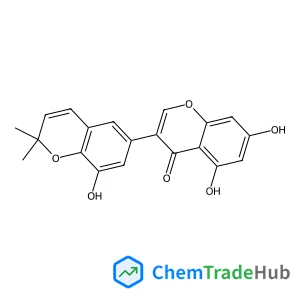
5,7,8'-Trihydroxy-2',2'-dimethyl-2'H,4H-3,6'-bichromen-4-one
CAS Number:
129280-33-7
Molecular Formula:
C20H16O6
Recommended Suppliers





Disclaimer
This page provides academic journal information for reference and research purposes only. We are not affiliated with any journal publishers and do not handle publication submissions. For publication-related inquiries, please contact the respective journal publishers directly.
If you notice any inaccuracies in the information displayed, please contact us at support@chemtradehub.com. We will promptly review and address your concerns.