













Synthesis and photophysical properties of donor-substituted phenyl-phosphachromones as potential TADF materials
Literature Information
Publication Date
2021-02-05
DOI
10.1039/D1QO00121C
Impact Factor
5.281
Authors
Shuangshuang Xu, Haiyang Huang, Chengxiong Yuan, Fen Liu, Haixin Ding, Qiang Xiao
View Original
Abstract
A series of novel arylamine-substituted phenyl-phosphachromones were constructed via post-functionalization. As a new type of D–π–A functional molecule, their photophysical properties can be well tuned by different amino substituents at different positions with variable Stokes shifts (Δλ = 127–299 nm). Moreover, compounds 4a, 4b, 4f, 4m, and 4n exhibit an unusual dual emission with a large wavelength difference. Strong intermolecular interactions were also observed for these compounds, and therein, a sandwich π(donor)–π(donor) stacking interaction was found in the solid-state structure of 4e. Moreover, (TD-)DFT computations were performed to rationalize the observed electronic properties and intramolecular interactions. Finally, the delayed fluorescence of these D–π–A molecules in the film was observed and further confirmed to be a result of thermally activated delayed fluorescence and mixed room-temperature phosphorescence.
Related Literature
Semi-quantitative estimation by IR of framework, extraframework and defect Al species of HBEA zeolites
Isabelle Gener, Philippe Ayrault, Michel Guisnet
2004-09-01
Communication
DOI: 10.1039/B409964H
Novel aggregation of [Ni(thiolato)2(amine)2]-type square planes assisted by silver(i) ions
Takumi Konno, Masafumi Usami, Masakazu Hirotsu, Takashi Yoshimura, Tatsuya Kawamoto
2004-09-01
Communication
DOI: 10.1039/B404512B
Molecularly imprinted polymer sensor arrays
Nathaniel T. Greene, Stephen L. Morgan, Ken D. Shimizu
2004-04-28
Communication
DOI: 10.1039/B401677G
A novel fluoride sensor based on fluorescence enhancement
Guoxiang Xu, Matthew A. Tarr
2004-04-02
Communication
DOI: 10.1039/B316121H
A bidentate borane as colorimetric fluoride ion sensor
Stéphane Solé, François P. Gabbaï
2004-04-28
Communication
DOI: 10.1039/B403596H
Nano-complex formation of cyclodextrin and azobenzene using supercritical carbon dioxide
Min Wu, Yoshiaki Yuguchi, Takako Kumagai, Takashi Endo, Takahiro Hirotsu
2004-05-10
Communication
DOI: 10.1039/B400289J
Ferromagnetic NiII–GdIII interactions in complexes with NiGd, NiGdNi, and NiGdGdNi cores supported by tripodal ligands
Tomoka Yamaguchi, Yukinari Sunatsuki, Masaaki Kojima, Haruo Akashi, Masanobu Tsuchimoto, Nazzareno Re, Shutaro Osa, Naohide Matsumoto
2004-04-05
Communication
DOI: 10.1039/B401033G
Rapid cloning and expression of a fungal polyketide synthase gene involved in squalestatin biosynthesis
Russell J. Cox, Frank Glod, Deirdre Hurley, Colin M. Lazarus, Thomas. P. Nicholson, Brian A. M. Rudd, Thomas J. Simpson, Barrie Wilkinson, Ying Zhang
2004-09-24
Communication
DOI: 10.1039/B411973H
LiSr2(NCN)I3: the first empty tetrahedral strontium(ii) entity coordinated by carbodiimide units but without strontium–strontium bonding
Wuping Liao, Jörg von Appen, Richard Dronskowski
2004-09-02
Communication
DOI: 10.1039/B408647C
An enantioselective imprinted receptor for Z-glutamate exhibiting a binding induced color change
Panagiotis Manesiotis, Andrew J. Hall, Marco Emgenbroich, Milena Quaglia, Ersilia De Lorenzi, Börje Sellergren
2004-09-09
Communication
DOI: 10.1039/B407870E
You might also like
Compound Q&A
What precautions should be taken when handling 2-Chloro-1,2-bis(4-methylphenyl)ethanone (CAS: 71193-32-3)?
When handling 2-Chloro-1,2-bis(4-methylphenyl)ethanone (CAS: 71193-32-3), it is ...
71193-32-32-Chloro-1,2-bis(4-m...
Compound Q&A
What industries use 4-Ethoxy-3-(5-methyl-4-oxo-7-propyl-1,4-dihydroimidazo[5,1-f][1,2,4]triazin-2-yl)benzenesulfonyl chloride (CAS: 224789-26-8)?
4-Ethoxy-3-(5-methyl-4-oxo-7-propyl-1,4-dihydroimidazo[5,1-f][1,2,4]triazin-2-yl...
224789-26-84-Ethoxy-3-(5-methyl...
Compound Q&A
How should Methyl 3-Oxo-4-Androsten-17-Carboxylate (CAS: 2681-55-2) be stored?
Methyl 3-Oxo-4-Androsten-17-Carboxylate (CAS: 2681-55-2) should be stored in a c...
2681-55-2Methyl 3-Oxo-4-Andro...
Compound Q&A
What are the main uses of (R)-3-Amino-4-(3-hexylphenylamino)-4-oxobutylphosphonic acid (CAS: 909725-61-7)?
(R)-3-Amino-4-(3-hexylphenylamino)-4-oxobutylphosphonic acid is primarily used i...
909725-61-7(R)-3-Amino-4-(3-hex...
Compound Q&A
What regulatory guidelines apply to 2-Methyl-2-propanyl 3-amino-3-carbamoyl-1-azetidinecarboxylate (CAS: 1254120-14-3)?
2-Methyl-2-propanyl 3-amino-3-carbamoyl-1-azetidinecarboxylate (CAS: 1254120-14-...
1254120-14-32-Methyl-2-propanyl ...
Compound Q&A
Are there alternatives to (E)-4-(tert-Butoxy)-4-oxobut-2-enoic acid (CAS: 135355-96-3) in synthesis?
There are alternative reagents that can be used in synthesis instead of (E)-4-(t...
135355-96-3(E)-4-(tert-Butoxy)-...
Compound Q&A
What are the physical and chemical properties of [2-(3-Chlorophenyl)-1,3-thiazol-4-yl]methanol (CAS: 121202-20-8)?
[2-(3-Chlorophenyl)-1,3-thiazol-4-yl]methanol (CAS: 121202-20-8) is a crystallin...
121202-20-8[2-(3-Chlorophenyl)-...
Compound Q&A
What is the market or research trend for Methyl (2S)-[(4S)-2,2-dimethyl-1,3-dioxolan-4-yl]{[(4-methylphenyl)sulfonyl]oxy}acetate (CAS: 166249-17-8)?
The market and research trends for Methyl (2S)-[(4S)-2,2-dimethyl-1,3-dioxolan-4...
166249-17-8Methyl (2S)-[(4S)-2,...
Compound Q&A
What is the market or research trend for 1-Bromo-2-isocyanatoethane (CAS: 42865-19-0)?
The market for 1-Bromo-2-isocyanatoethane (CAS: 42865-19-0) is driven by its use...
42865-19-01-Bromo-2-isocyanato...
Compound Q&A
What are the main uses of 4-Nitro-D-phenylalanine hydrochloride (CAS: 147065-06-3)?
4-Nitro-D-phenylalanine hydrochloride (CAS: 147065-06-3) is primarily used in re...
147065-06-34-Nitro-D-phenylalan...
Source Journal
Organic Chemistry Frontiers

CiteScore:
7.8
Self-citation Rate:
8.7%
Articles per Year:
724
Organic Chemistry Frontiers publishes high-quality research from across organic chemistry. Emphases are placed on studies that make significant contributions to the field of organic chemistry by reporting either new or significantly improved protocols or methodologies. Topics include, but are not limited to the following: Organic synthesis Development of synthetic methodologies Catalysis Natural products Functional organic materials Supramolecular and macromolecular chemistry Physical and computational organic chemistry
Recommended Compounds

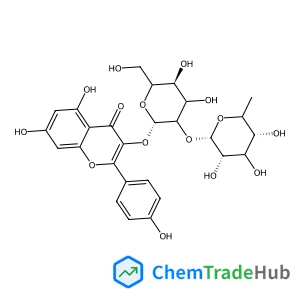
5,7-Dihydroxy-2-(4-hydroxyphenyl)-4-oxo-4H-chromen-3-yl 2-O-(6-deoxy-alpha-L-mannopyranosyl)-beta-D-glucopyranoside
CAS Number:
32602-81-6
Molecular Formula:
C27H30O15

Recommended Suppliers





Disclaimer
This page provides academic journal information for reference and research purposes only. We are not affiliated with any journal publishers and do not handle publication submissions. For publication-related inquiries, please contact the respective journal publishers directly.
If you notice any inaccuracies in the information displayed, please contact us at support@chemtradehub.com. We will promptly review and address your concerns.