












Organocatalytic synthesis of poly(hydroxymethylfuroate) via ring-opening polymerization of 5-hydroxymethylfurfural-based cyclic oligoesters‡
Literature Information
Publication Date
2022-02-04
DOI
10.1039/D1PY01687C
Impact Factor
5.582
Authors
Daniele Ragno, Graziano Di Carmine, Micaela Vannini, Olga Bortolini, Daniela Perrone, Sara Buoso, Monica Bertoldo, Alessandro Massi
View Original
Abstract
The synthesis of hydroxymethylfuroate macrocyclic oligoesters c(HMF)n promoted by an N-heterocyclic carbene (NHC) organocatalyst is herein presented together with the subsequent organocatalytic, entropically-driven ring-opening polymerization (ED-ROP) leading to the fully furan-based poly(hydroxymethylfuroate) (PHMF). The target macrocycles (mostly trimer and tetramer species) have been obtained directly from the platform chemical HMF (77% isolated yield) under high dilution conditions using a quinone as the external oxidant and the green solvent Me-THF. The ED-ROP of c(HMF)n has been optimized at 160 °C (melt condensation technique) with the couple triazabicyclodecene (TBD)/n-octanol (1 : 1) as catalyst/initiator of the polymerization process in the presence of commercial antioxidants Irganox 1010 (0.1% w/w) and Irgafos 126 (0.3% w/w) to suppress degradation side reactions. Under these conditions, the bio-based PHMF (poly-HMF) was obtained as a color-free polymer with number-average molecular weight up to 48 600 g mol−1 and dispersity between 1.5 and 1.9 as determined by NMR and GPC analyses. The thermal behavior of the novel furan-based polyester PHMF was investigated (TGA and DSC analyses) observing a good thermal stability (onset temperature of degradation ∼310 °C) and a semicrystalline structure with melting temperature above 160 °C when processed from solvent, thus making PHMF a promising material for processing as other commercial polyesters.
Related Literature
Intramolecular charge transfer and dual fluorescence of 4-(dimethylamino)benzonitrile: ultrafast branching followed by a two-fold decay mechanism‡
Pedro B. Coto, Luis Serrano-Andrés, Thomas Gustavsson, Takashige Fujiwara, Edward C. Lim
2011-07-18
Paper
DOI: 10.1039/C1CP21089K
Aromaticity in all-metal annular systems: the counter-ion effect
Arindam Chakraborty, Santanab Giri, Soma Duley, Anakuthil Anoop, Patrick Bultinck, Pratim K. Chattaraj
2011-07-26
Perspective
DOI: 10.1039/C1CP21430F
Oxygen-containing gas-phase diatomic trications and tetracations: ReOz+, NbOz+ and HfOz+ (z = 3, 4)
V. Brites, K. Franzreb, J. N. Harvey, S. G. Sayres, M. W. Ross, D. E. Blumling, A. W. Castleman, Jr., M. Hochlaf
2011-07-15
Paper
DOI: 10.1039/C1CP21566C
Structural characterization and DFT study of VIVO(acac)2 in imidazolium ionic liquids
Andreia Mota, Jason P. Hallett, Maxim L. Kuznetsov, Isabel Correia
2011-07-25
Paper
DOI: 10.1039/C1CP20800D
Improving the gas–solids contact efficiency in a fluidized bed of CO2 adsorbent fine particles
J. M. Valverde, F. Pontiga, C. Soria-Hoyo, M. A. S. Quintanilla, H. Moreno, F. J. Duran, M. J. Espin
2011-07-11
Communication
DOI: 10.1039/C1CP21939A
Synthesis of Ge-imogolite: influence of the hydrolysis ratio on the structure of the nanotubes
L. Olivi, C. Dominici, F. Ziarelli
2011-07-12
Paper
DOI: 10.1039/C1CP20346K
A statistical approach to inelastic electron tunneling spectroscopy on fullerene-terminated molecules
Jakob Kryger Sørensen, Emanuel Lörtscher, Tom Vosch, Heike Riel, Kristine Kilså, Thomas Bjørnholm, Herre van der Zant
2011-06-23
Paper
DOI: 10.1039/C1CP20861F
Interaction between NO and Na, O, S, Cl on Au and Pd(111) surfaces
Ren-Yu Tian, Xiao-Bao Yang, Song-Lin Peng
2011-07-07
Paper
DOI: 10.1039/C1CP20974D
Preparation of polymer-supported gold nanoparticles based on resins containing ionic liquid-like fragments: easy control of size and stability
M. Isabel Burguete, Eduardo García-Verdugo, Santiago V. Luis, Julián A. Restrepo
2011-07-27
Paper
DOI: 10.1039/C1CP20970A
You might also like
Compound Q&A
What are the main uses of 1-(3-Aminophenyl)-3-[(3R)-1-(3,3-dimethyl-2-oxobutyl)-2-oxo-5-(2-pyridinyl)-2,3-dihydro-1H-1,4-benzodiazepin-3-yl]urea (CAS: 155412-88-7)?
This compound is mainly used as an intermediate in the synthesis of antipsychoti...
155412-88-71-(3-Aminophenyl)-3-...
Compound Q&A
How should waste containing 1-(D-Ribofuranosyl)-1,4-dihydro-3-pyridinecarboxamide (CAS: 19132-12-8) be handled?
Waste containing 1-(D-Ribofuranosyl)-1,4-dihydro-3-pyridinecarboxamide (CAS: 191...
19132-12-81-(D-Ribofuranosyl)-...
Compound Q&A
What regulatory guidelines apply to 2-Methyl-2-propanyl 3-bromo-3-(hydroxymethyl)-1-azetidinecarboxylate (CAS: 2007919-81-3)?
2-Methyl-2-propanyl 3-bromo-3-(hydroxymethyl)-1-azetidinecarboxylate (CAS: 20079...
2007919-81-32-Methyl-2-propanyl ...
Compound Q&A
What is N-(4-Chloro-2-pyridinyl)acetamide (CAS: 245056-66-0)?
N-(4-Chloro-2-pyridinyl)acetamide (CAS: 245056-66-0) is a chemical compound with...
245056-66-0N-(4-Chloro-2-pyridi...
Compound Q&A
What is 5-Chloro-2-hydroxybenzoic acid (CAS: 321-14-2)?
5-Chloro-2-hydroxybenzoic acid, also known as 5-chlorosalicylic acid, is an arom...
321-14-25-Chloro-2-hydroxybe...
Compound Q&A
What precautions should be taken when handling 1,1-Dichloro-1-fluoroethane (CAS: 1717-00-6)?
When handling 1,1-Dichloro-1-fluoroethane (CAS: 1717-00-6), it is important to u...
1717-00-61,1-Dichloro-1-fluor...
Compound Q&A
What are the physical and chemical properties of Fmoc-(2S,3R)-3-phenylpyrrolidine-2-carboxylic acid (CAS: 281655-32-1)?
Fmoc-(2S,3R)-3-phenylpyrrolidine-2-carboxylic acid is a white crystalline solid ...
281655-32-1Fmoc-(2S,3R)-3-pheny...
Compound Q&A
What are the main uses of 4-Amino-5-bromo-2-pyridinecarboxylic acid (CAS: 1363381-01-4)?
4-Amino-5-bromo-2-pyridinecarboxylic acid is primarily used as a precursor in th...
1363381-01-44-Amino-5-bromo-2-py...
Compound Q&A
What precautions should be taken when handling (S)-tert-butyl 2-((2-(4-bromophenyl)-2-oxoethyl)carbamoyl)pyrrolidine-1-carboxylate (CAS: 1007881-98-2)?
Handling this compound should be done with personal protective equipment (PPE) i...
1007881-98-2(S)-tert-butyl 2-((2...
Compound Q&A
What precautions should be taken when handling 8-bromo-2,2-dimethyl-3,4-dihydro-2H-1,4-benzoxazin-3-one (CAS: 688363-73-7)?
When handling 8-bromo-2,2-dimethyl-3,4-dihydro-2H-1,4-benzoxazin-3-one, use prop...
688363-73-78-bromo-2,2-dimethyl...
Source Journal
Polymer Chemistry

CiteScore:
8.6
Self-citation Rate:
7.3%
Articles per Year:
457
Polymer Chemistry welcomes submissions in all areas of polymer science that have a strong focus on macromolecular chemistry. Manuscripts may cover a broad range of fields, yet no direct application focus is required.
Recommended Compounds
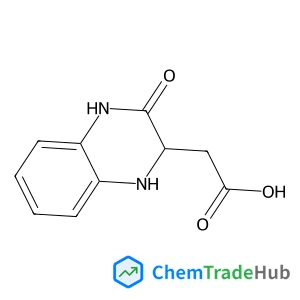
(3-Oxo-1,2,3,4-tetrahydro-2-quinoxalinyl)acetic acid
CAS Number:
136584-14-0
Molecular Formula:
C10H10N2O3

![Pyrazolo[1,5-a]pyridine-3-carbothioamide structure](https://static.chemtradehub.com/structs/885/885275-44-5-aae0.webp "Pyrazolo[1,5-a]pyridine-3-carbothioamide structure")
Recommended Suppliers








Disclaimer
This page provides academic journal information for reference and research purposes only. We are not affiliated with any journal publishers and do not handle publication submissions. For publication-related inquiries, please contact the respective journal publishers directly.
If you notice any inaccuracies in the information displayed, please contact us at support@chemtradehub.com. We will promptly review and address your concerns.