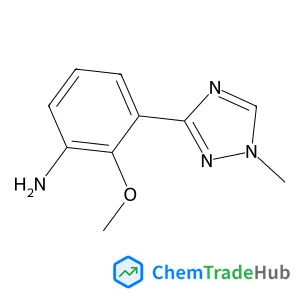
2-Methoxy-3-(1-methyl-1H-1,2,4-triazol-3-yl)aniline
CAS Number:
1609394-10-6
Molecular Formula:
C10H12N4O
Tianwen Yu, Yifei Shan, Zhixi Li, Xiaoxiao Wang, Huanan Cui, Kun Yang, Yongyan Cui
Wearable electronic devices, represented by wearable sensors with self-healing properties, are key to the development of the relevant research studies. However, problems of sensors such as low sensitivity, low flexibility, low durability and poor self-healing ability remain to be solved. Herein, we designed and prepared a new type of silicone-based self-healing elastomer MVSR-UPY in which methyl vinyl silicone rubber was modified by an olefin decomposition reaction, and then constructed a quadruple hydrogen bonding network by introducing 2-ureido-4[1H]-pyrimidinones (UPY). The prepared elastomer that can be recycled and reprocessed was endowed with excellent self-healing and super-stretching properties of up to 2000%. A three-layer (LBL) strain sensor with high sensitivity and durability was fabricated using the elastomer as the substrate, which was able to monitor various activities of the human body accurately. It is notable that writing different letters on the sensor produces different resistance signals and makes it possible for us to distinguish between the written letters. Therefore, the sensor we designed can meet the various needs of wearable electronic devices and provide more possibilities for its development.
H. Weyten, A. Buekenhoudt, L. E. M. Gevers, I. F. J. Vankelecom, P. A. Jacobs
DOI: 10.1039/B312580G
Eunjoo Jang, Shinae Jun, Lyongsun Pu
DOI: 10.1039/B310853H
Lee J. Higham, P. Gabriel Kelly, David M. Corr, Helge Müller-Bunz, Brian J. Walker, Declan G. Gilheany
DOI: 10.1039/B316759C
Richard E. Douthwaite, Jennifer Houghton, Benson M. Kariuki
DOI: 10.1039/B314814A
Qun Tang, Wenjia Zhou, Jianmin Shen, Wu Zhang, Lingfen Kong
DOI: 10.1039/B313387G
Juan C. Mareque-Rivas, Ravi Prabaharan, Rafael Torres Martín de Rosales
DOI: 10.1039/B310956A
Fuquan Song, Roderick D. Cannon, Manfred Bochmann
DOI: 10.1039/B314845A
Naoyoshi Maezaki, Hiroaki Tominaga, Naoto Kojima, Minori Yanai, Daisuke Urabe, Tetsuaki Tanaka
DOI: 10.1039/B312362F
Paul D. Beer, David P. Cormode, Jason J. Davis
DOI: 10.1039/B313658B
Mandakini Kanungo, Maryanne M. Collinson
DOI: 10.1039/B311936J
1H-Indazole-6-carbonitrile finds applications in pharmaceuticals, where it serve...
Waste containing Dioctyl (2E)-2-butenedioate (CAS: 2997-85-5) should be collecte...
Sodium [(1,2-benzoxazol-3-ylmethyl)sulfonyl]azanide is primarily used in pharmac...
Dimethyl 4-(4,4,5,5-tetramethyl-1,3,2-dioxaborolan-2-yl)-2,6-pyridinedicarboxyla...
Waste containing 2-Fluoro-6-hydrazinopyridine (CAS: 80714-39-2) should be manage...
6-Formyl-2-pyridinecarboxylic acid is an organic compound with the molecular for...
Research trends for this compound indicate a focus on its potential applications...
9H-Tribenzo[b,d,f]azepine is typically synthesized via a multi-step process invo...
1-Cyclopropyl-7-ethoxy-6-fluoro-8-methoxy-4-oxo-1,4-dihydro-3-quinolinecarboxyli...
Waste containing Methyl 3-oxo-1,2,3,4-tetrahydro-6-quinoxalinecarboxylate (CAS: ...

Polymer Chemistry welcomes submissions in all areas of polymer science that have a strong focus on macromolecular chemistry. Manuscripts may cover a broad range of fields, yet no direct application focus is required.
![2-Methyl-2-propanyl 4-{2-fluoro-5-[(4-oxo-3,4-dihydro-1-phthalazinyl)methyl]benzoyl}-1-piperazinecarboxylate structure](https://static.chemtradehub.com/structs/763/763114-04-1-65a9.webp "2-Methyl-2-propanyl 4-{2-fluoro-5-[(4-oxo-3,4-dihydro-1-phthalazinyl)methyl]benzoyl}-1-piperazinecarboxylate structure")