












Synthesis and hierarchical self-assembly of luminescent platinum(ii)-containing telechelic metallopolymers
Literature Information
Publication Date
2021-08-17
DOI
10.1039/D1PY00835H
Impact Factor
5.582
Authors
Xiandeng Qiu, Hua Xue, Lin Xu, Ran Wang, Shengchao Qiu, Qun He
View Original
Abstract
Telechelic polymers that contain a central polymer chain and two metal complex terminals would represent a novel class of functional metallopolymers. In this work, a series of telechelic polystyrenes end-difunctionalized with planar platinum(II) complexes have been successfully synthesized and characterized in detail. These metallopolymers are found to show metal–metal-to-ligand charge-transfer or excimeric phosphorescence emissions in solution arising from Pt(II)⋯Pt(II) and/or π–π stacking interactions between the planar platinum(II) units. Upon dispersion in the chloroform/methanol mixture solvent, they can self-assemble to form flowerlike micelles, wherein the micellar cores are filled with the solvophilic platinum(II) complexes, while the solvophobic polystyrene chains loop back to the same micellar core to generate coronas. The resulting flower micelles can further self-assemble into vesicle-like architectures, and the flowers still retain their original core–corona nanostructures. Such unconventional self-assembled behaviors are presumably due to strong Pt(II)⋯Pt(II) and/or π–π stacking interactions there. The present work of grafting telechelic polymers together with luminescent platinum(II) complexes presents a new way to explore functional metallopolymer materials.
Recommended Journals
Related Literature
(4 + 3) cycloadditions of allenyl ether-derived oxygen-stabilized oxyallyls with furans
Xian Huang, Waygen Thor, Xiangyu Feng, Liangliang Kang, Min Yang, Chi-Sing Lee, Yuen-Kit Cheng, Shuzhong He
2019-12-09
Research Article
DOI: 10.1039/C9QO01349K
Rotaxanes comprising cyclic phenylenedioxydiacetamides and secondary mono- and bis-dialkylammonium ions: effect of macrocyclic ring size on pseudorotaxane formation
Takanori Nakamura, Yuka Mori, Masaya Naito, Yukari Okuma, Shinobu Miyagawa, Hikaru Takaya, Tsuneomi Kawasaki, Yuji Tokunaga
2019-12-23
Research Article
DOI: 10.1039/C9QO01359H
Reaction engineering and photophysical studies of fully enriched C-vinyl-1,2,3-triazoles
G. Surendra Reddy, Dhevalapally B. Ramachary
2019-08-21
Research Article
DOI: 10.1039/C9QO00864K
Enantioselective synthesis of chiral multicyclic γ-lactones via dynamic kinetic resolution of racemic γ-keto carboxylic acids
Zhichao Xiong, Jiangyan Tian, Peng Xue, Xumu Zhang
2019-11-25
Research Article
DOI: 10.1039/C9QO01047E
Development of a new bicyclic imidazole nucleophilic organocatalyst for direct enantioselective C-acylation
Muxing Zhou, Ende He, Lu Zhang, Jianzhong Chen, Zhenfeng Zhang, Yangang Liu
2019-11-01
Research Article
DOI: 10.1039/C9QO01025D
Visible-light-mediated difluoromethylphosphonation of alkenes for the synthesis of CF2P-containing heterocycles
Qiang Yang, Qing-Qing Lin, Hou-Ying Xing, Zhi-Gang Zhao
2019-10-25
Research Article
DOI: 10.1039/C9QO01030K
Reductive coupling of imines with redox-active esters by visible light photoredox organocatalysis
Jiaqi Jia, Quentin Lefebvre
2020-01-22
Research Article
DOI: 10.1039/C9QO01428D
Practical fluorothiolation and difluorothiolation of alkenes using pyridine-HF and N-thiosuccinimides
Xiaojun Zeng, Bo Xu
2019-11-22
Research Article
DOI: 10.1039/C9QO01228A
Lewis acid-catalyzed tandem cyclization of in situ generated o-quinone methides and arylsulfonyl hydrazides for a one-pot entry to 3-sulfonylbenzofurans
Fan-Xiao Meng, Ruo-Nan Wang, Hong-Li Huang, Shu-Wen Gong, Qian-Li Li, Shao-Liang Zhang, Chun-Lin Ma, Chen-Zhong Li, Ji-Yuan Du
2019-10-25
Research Article
DOI: 10.1039/C9QO01196J
You might also like
Compound Q&A
How should waste containing (6-Bromo-2-naphthyl)oxy](dimethyl)(2-methyl-2-propanyl)silane be handled?
Waste containing (6-Bromo-2-naphthyl)oxy](dimethyl)(2-methyl-2-propanyl)silane (...
100751-65-3[(6-Bromo-2-naphthyl...
Compound Q&A
How is 7-Fluoro-4-isoquinolinecarboxylic acid (CAS: 1841081-40-0) typically synthesized?
7-Fluoro-4-isoquinolinecarboxylic acid can be synthesized via a multi-step proce...
1841081-40-07-Fluoro-4-isoquinol...
Compound Q&A
What are the physical and chemical properties of 2,3,5,6-Tetrabromothieno[3,2-b]thiophene (CAS: 124638-53-5)?
2,3,5,6-Tetrabromothieno[3,2-b]thiophene is a crystalline compound with a high m...
124638-53-52,3,5,6-Tetrabromoth...
Compound Q&A
Is 1-[4-(Benzylamino)-7,8-dihydro-5H-pyrano[4,3-d]pyrimidin-2-yl]-2-methyl-1H-indole-4-carboxamide (CAS: 1542705-92-9) safe?
1-[4-(Benzylamino)-7,8-dihydro-5H-pyrano[4,3-d]pyrimidin-2-yl]-2-methyl-1H-indol...
1542705-92-91-[4-(Benzylamino)-7...
Compound Q&A
What is the market or research trend for imidazo[5,1-d]-1,2,3,5-tetrazine-8-carboxylic acid, 3,4-dihydro-3-methyl-4-oxo- (CAS: 113942-30-6)?
The market for imidazo[5,1-d]-1,2,3,5-tetrazine-8-carboxylic acid, 3,4-dihydro-3...
113942-30-6Imidazo[5,1-d]-1,2,3...
Compound Q&A
What is 3-(Triisopropylsilyl)propiolaldehyde (CAS: 163271-80-5)?
3-(Triisopropylsilyl)propiolaldehyde is a synthetic organic compound with the CA...
163271-80-53-(Triisopropylsilyl...
Compound Q&A
What regulatory guidelines apply to 6-Nitro-2H-1,4-benzoxazin-3(4H)-one (CAS: 81721-87-1)?
6-Nitro-2H-1,4-benzoxazin-3(4H)-one (CAS: 81721-87-1) is subject to various regu...
81721-87-16-Nitro-2H-1,4-benzo...
Compound Q&A
How should waste containing (3-Fluorophenyl)(4-{[(2-methyl-2-propanyl)oxy]carbonyl}-1-piperazinyl)acetic acid (CAS: 885272-91-3) be handled?
Waste containing (3-Fluorophenyl)(4-{[(2-methyl-2-propanyl)oxy]carbonyl}-1-piper...
885272-91-3(3-Fluorophenyl)(4-{...
Compound Q&A
What are the physical and chemical properties of N,N'-4,4'-Biphenyldiyldiisonicotinamide (CAS: 55119-40-9)?
N,N'-4,4'-Biphenyldiyldiisonicotinamide is a white crystalline solid with a mole...
55119-40-9N,N'-4,4'-Biphenyldi...
Compound Q&A
What industries use 6-Bromo-8-fluoro-2-quinazolinol (CAS: 1036756-15-6)?
6-Bromo-8-fluoro-2-quinazolinol is primarily used in the pharmaceutical industry...
1036756-15-66-Bromo-8-fluoro-2-q...
Source Journal
Polymer Chemistry

CiteScore:
8.6
Self-citation Rate:
7.3%
Articles per Year:
457
Polymer Chemistry welcomes submissions in all areas of polymer science that have a strong focus on macromolecular chemistry. Manuscripts may cover a broad range of fields, yet no direct application focus is required.
Recommended Compounds
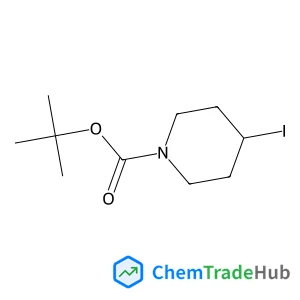
2-Methyl-2-propanyl 4-iodo-1-piperidinecarboxylate
CAS Number:
301673-14-3
Molecular Formula:
C10H18INO2
Recommended Suppliers






Disclaimer
This page provides academic journal information for reference and research purposes only. We are not affiliated with any journal publishers and do not handle publication submissions. For publication-related inquiries, please contact the respective journal publishers directly.
If you notice any inaccuracies in the information displayed, please contact us at support@chemtradehub.com. We will promptly review and address your concerns.