












Gradient copolymer prepared from alternating ring-opening metathesis of three monomers
Literature Information
Publication Date
2021-09-13
DOI
10.1039/D1PY00690H
Impact Factor
5.582
Authors
Francis O. Boadi, Nicole S. Sampson
View Original
Abstract
Bicyclo[4.2.0]oct-6-ene-7-carboxamide is a simple but highly strained olefin monomer which forms an alternating copolymer with cyclohexene in the presence of N-heterocyclic carbene-ruthenium catalyst. [4.2.0] moieties with a bulky substituent on C7 that chelate with the ruthenium center of the catalyst propagate more slowly than monomers that cannot chelate. Accordingly, the reactivity ratio of N-propylbicyclo[4.2.0]oct-6-ene-7-carboxamide with cyclohexene is significantly higher than that of N-(2-(2-ethoxyethoxy)ethan)-bicyclo[4.2.0]oct-6-ene-7-carboxamide with cyclohexene. A copolymerization involving the three monomers in a 1 : 1 : 2 (propyl : ethylene glycol : cyclohexene) molar ratio formed a gradient copolymer in a one-pot reaction. Surface hydrophobicity, topology, and thermal properties of the gradient copolymer were similar to those of a copolymer comprised of six microblocks prepared through multistep synthesis by alternately employing the same two bicyclo[4.2.0]oct-6-ene-7-carboxamides in each microblock. The properties of the gradient copolymer were distinct from a copolymer comprised of two larger blocks based on the same bicyclo[4.2.0]oct-6-ene-7-carboxamides.
Related Literature
Recent advances in the total synthesis of cyclobutane-containing natural products
Jinshan Li, Kai Gao, Ming Bian
2019-11-12
Review Article
DOI: 10.1039/C9QO01178A
Ag-Catalyzed cycloisomerization of 1,6-enynamide: an intramolecular type II Alder-ene reaction
Mei-Hua Shen, Yu-Mei Zhang, Chun Jiang, Hua-Dong Xu, Defeng Xu
2019-11-18
Research Article
DOI: 10.1039/C9QO01258C
Spiroetherones A and B, sesquiterpene naphthoquinones, as angiogenesis inhibitors from the marine sponge Dysidea etheria
Wei-Hua Jiao, Qi-Hang Xu, Jie Cui, Ru-Yi Shang, Yun Zhang, Jia-Bao Sun, Qi Yang, Ke-Chun Liu, Hou-Wen Lin
2019-12-09
Research Article
DOI: 10.1039/C9QO01346F
Computational exploration of substrate and ligand effects in nickel-catalyzed C–Si bond carboxylation with CO2
Xiangying Lv, Xiaotian Zhang, Rongjian Sa, Fang Huang, Gang Lu
2019-09-20
Research Article
DOI: 10.1039/C9QO00854C
Selective assembly of N1- and N2-alkylated 1,2,3-triazoles via copper-catalyzed decarboxylative cycloaddition of alkynyl carboxylic acids with ethers and azidotrimethylsilane
Pengli Bao, Na Meng, Yufen Lv, Huilan Yue, Jiang-Sheng Li
2019-11-04
Research Article
DOI: 10.1039/C9QO01277J
Cu(ii)-Catalyzed formal [4 + 2] cycloaddition between quinone methides (QMs) and electron-poor 3-vinylindoles
Hong-Ming Huang, Xu-Yan Wu, Bo-Rong Leng, Yi-Long Zhu, Xin-Chao Meng, Yu Hong, Bo Jiang, De-Cai Wang
2019-12-12
Research Article
DOI: 10.1039/C9QO01343A
Trifluoroacetimidoyl halides: a potent synthetic origin
Zhengkai Chen, Sipei Hu
2019-12-02
Review Article
DOI: 10.1039/C9QO01167F
Cascade cyclization reactions of alkylidenecyclopropanes for the construction of polycyclic lactams and lactones by visible light photoredox catalysis
Mintao Chen, Yin Wei
2019-12-10
Research Article
DOI: 10.1039/C9QO01360A
Aromaticity and tautomerism of a 4n π electron dihydrohexaazapentacene
Chun-Lin Sun, Xiao-E Luo, Huan Xu, Qi-Wei Song, Zhi-Ping Fan, Xiao-Zhen Wang, Jing-Jing Cao, Zi-Fa Shi
2019-12-06
Research Article
DOI: 10.1039/C9QO01285K
You might also like
Compound Q&A
How should waste containing (6-Bromo-2-naphthyl)oxy](dimethyl)(2-methyl-2-propanyl)silane be handled?
Waste containing (6-Bromo-2-naphthyl)oxy](dimethyl)(2-methyl-2-propanyl)silane (...
100751-65-3[(6-Bromo-2-naphthyl...
Compound Q&A
How is 7-Fluoro-4-isoquinolinecarboxylic acid (CAS: 1841081-40-0) typically synthesized?
7-Fluoro-4-isoquinolinecarboxylic acid can be synthesized via a multi-step proce...
1841081-40-07-Fluoro-4-isoquinol...
Compound Q&A
What are the physical and chemical properties of 2,3,5,6-Tetrabromothieno[3,2-b]thiophene (CAS: 124638-53-5)?
2,3,5,6-Tetrabromothieno[3,2-b]thiophene is a crystalline compound with a high m...
124638-53-52,3,5,6-Tetrabromoth...
Compound Q&A
Is 1-[4-(Benzylamino)-7,8-dihydro-5H-pyrano[4,3-d]pyrimidin-2-yl]-2-methyl-1H-indole-4-carboxamide (CAS: 1542705-92-9) safe?
1-[4-(Benzylamino)-7,8-dihydro-5H-pyrano[4,3-d]pyrimidin-2-yl]-2-methyl-1H-indol...
1542705-92-91-[4-(Benzylamino)-7...
Compound Q&A
What is the market or research trend for imidazo[5,1-d]-1,2,3,5-tetrazine-8-carboxylic acid, 3,4-dihydro-3-methyl-4-oxo- (CAS: 113942-30-6)?
The market for imidazo[5,1-d]-1,2,3,5-tetrazine-8-carboxylic acid, 3,4-dihydro-3...
113942-30-6Imidazo[5,1-d]-1,2,3...
Compound Q&A
What is 3-(Triisopropylsilyl)propiolaldehyde (CAS: 163271-80-5)?
3-(Triisopropylsilyl)propiolaldehyde is a synthetic organic compound with the CA...
163271-80-53-(Triisopropylsilyl...
Compound Q&A
What regulatory guidelines apply to 6-Nitro-2H-1,4-benzoxazin-3(4H)-one (CAS: 81721-87-1)?
6-Nitro-2H-1,4-benzoxazin-3(4H)-one (CAS: 81721-87-1) is subject to various regu...
81721-87-16-Nitro-2H-1,4-benzo...
Compound Q&A
How should waste containing (3-Fluorophenyl)(4-{[(2-methyl-2-propanyl)oxy]carbonyl}-1-piperazinyl)acetic acid (CAS: 885272-91-3) be handled?
Waste containing (3-Fluorophenyl)(4-{[(2-methyl-2-propanyl)oxy]carbonyl}-1-piper...
885272-91-3(3-Fluorophenyl)(4-{...
Compound Q&A
What are the physical and chemical properties of N,N'-4,4'-Biphenyldiyldiisonicotinamide (CAS: 55119-40-9)?
N,N'-4,4'-Biphenyldiyldiisonicotinamide is a white crystalline solid with a mole...
55119-40-9N,N'-4,4'-Biphenyldi...
Compound Q&A
What industries use 6-Bromo-8-fluoro-2-quinazolinol (CAS: 1036756-15-6)?
6-Bromo-8-fluoro-2-quinazolinol is primarily used in the pharmaceutical industry...
1036756-15-66-Bromo-8-fluoro-2-q...
Source Journal
Polymer Chemistry

CiteScore:
8.6
Self-citation Rate:
7.3%
Articles per Year:
457
Polymer Chemistry welcomes submissions in all areas of polymer science that have a strong focus on macromolecular chemistry. Manuscripts may cover a broad range of fields, yet no direct application focus is required.
Recommended Compounds
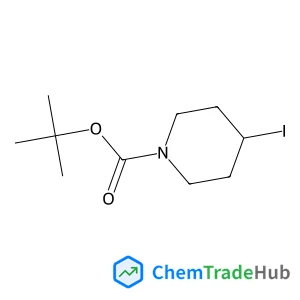
2-Methyl-2-propanyl 4-iodo-1-piperidinecarboxylate
CAS Number:
301673-14-3
Molecular Formula:
C10H18INO2
![2,9-Dichloro-5,12-dihydroquinolino[2,3-b]acridine-7,14-dione structure](https://static.chemtradehub.com/structs/308/3089-17-6-750b.webp "2,9-Dichloro-5,12-dihydroquinolino[2,3-b]acridine-7,14-dione structure")
2,9-Dichloro-5,12-dihydroquinolino[2,3-b]acridine-7,14-dione
CAS Number:
3089-17-6
Molecular Formula:
C20H10Cl2N2O2
![(2S)-2-({[(2-Methyl-2-propanyl)oxy]carbonyl}amino)-4-pentynoic acid structure](https://static.chemtradehub.com/structs/630/63039-48-5-b66d.webp "(2S)-2-({[(2-Methyl-2-propanyl)oxy]carbonyl}amino)-4-pentynoic acid structure")
(2S)-2-({[(2-Methyl-2-propanyl)oxy]carbonyl}amino)-4-pentynoic acid
CAS Number:
63039-48-5
Molecular Formula:
C10H15NO4
Recommended Suppliers






Disclaimer
This page provides academic journal information for reference and research purposes only. We are not affiliated with any journal publishers and do not handle publication submissions. For publication-related inquiries, please contact the respective journal publishers directly.
If you notice any inaccuracies in the information displayed, please contact us at support@chemtradehub.com. We will promptly review and address your concerns.