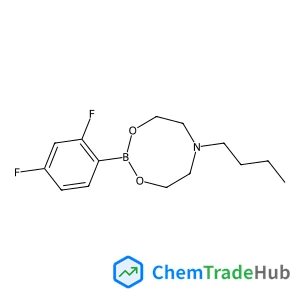
6-Butyl-2-(2,4-difluorophenyl)-1,3,6,2-dioxazaborocane
CAS Number:
1190988-98-7
Molecular Formula:
C14H20BF2NO2
Charu Upadhyay, Poonam, Sumit Kumar, Brijesh Rathi
Malaria remains one of the world's most life-threatening diseases and, thus, it is a major public health concern all around the world. The disease can become devastating if not treated with proper medication in a timely manner. Currently, the number of viable treatment therapies is in continuous decline due to compromised effectiveness, probably owing to the complex life cycle of Plasmodium falciparum. The factors responsible for the unclear status of malaria eradication programmes include ever-developing parasite resistance to the most effective treatments used on the frontline (i.e., artemisinin derivatives) and the paucity of new effective therapeutics. Due to these circumstances, the development of novel effective drug candidates with unique modes of action is essential for overcoming the listed obstacles. As such, the discovery of novel chemical compounds based on validated pharmacophores remains an unmet need in the field of medicinal chemistry. In this area, functionalized phthalimide (Pht) analogs have been explored as potential candidates against various diseases, including malaria. Pht presents a promising bioactive scaffold that can be easily functionalized and thus utilized as a starting point for the development of new antimalarial candidates suitable for preclinical and clinical studies. In this short review, we highlight a wide range of Pht analogs that have been investigated for their activity against various strains of Plasmodium falciparum.
Bartolomeo Della Ventura, Martina Banchelli, Riccardo Funari, Anna Illiano, Marella De Angelis, Paola Taroni, Angela Amoresano, Paolo Matteini, Raffaele Velotta
DOI: 10.1039/C9AN00443B
Chen Zhou, Yingmei Chen, Pengxiang Shang, Yuwu Chi
DOI: 10.1039/C6AN00664G
Jonathan Sjögren, Fredrik Olsson, Alain Beck
DOI: 10.1039/C6AN00071A
Han Zhao, Ying Yan, Mingjian Chen, Tingting Hu, Kefeng Wu, Haisheng Liu, Changbei Ma
DOI: 10.1039/C9AN01659G
Bruno Pagano, Nunzia Iaccarino, Anna Di Porzio, Antonio Randazzo, Jussara Amato
DOI: 10.1039/C9AN01463B
Yijia Wang, Shiwu Zhang, Chunze Zhang, Zhenying Zhao, Xiaoli Zheng, Lihua Xue, Jun Liu, X.-C. Yuan
DOI: 10.1039/C6AN00264A
Ziyi Cheng, Rui Wang, Yanlong Xing, Linlu Zhao, Jaebum Choo, Fabiao Yu
DOI: 10.1039/C9AN01260E
Xian Wang, Quan-Lan Liao, Shuai Zhao, Wei-Hua Huang, Yu-Qi Feng
DOI: 10.1039/C9AN01566C
Liqing Gu, Renã A. S. Robinson
DOI: 10.1039/C6AN00417B
Waste containing 6-Chloro-5-(2'-hydroxy-3'-methoxy-4-biphenylyl)-3-(3-methoxyphe...
(3alpha,5alpha)-3-Hydroxypregnane-11,20-dione is primarily used in the pharmaceu...
The market for 4-Amino-6-chloro-2-pyridinecarboxylic acid (CAS: 546141-56-4) is ...
Alternatives to (2-Benzoylethyl)trimethylammonium chloride (CAS: 24472-88-6) in ...
N-[4-Nitro-3-(trifluoromethyl)phenyl]acetamide (CAS: 393-12-4) is generally safe...
Alternative reagents such as other phosphates or similar functional groups can b...
There are alternatives to N,N'-Bis(3-aminopropyl)-1,3-propanediamine (CAS: 4605-...
When handling Aluminium trihexadecanoate, it is important to use appropriate per...
(1,1-Dioxido-3-oxo-1,2-benzothiazol-2(3H)-yl)acetic acid is a chemical compound ...
Several alternatives to 5,5-dimethyloxolan-2-one (CAS: 3123-97-5) can be used in...
![Benzyl 2-{[(tert-butoxy)carbonyl]amino}acetate structure](https://static.chemtradehub.com/structs/542/54244-69-8-6399.webp "Benzyl 2-{[(tert-butoxy)carbonyl]amino}acetate structure")