












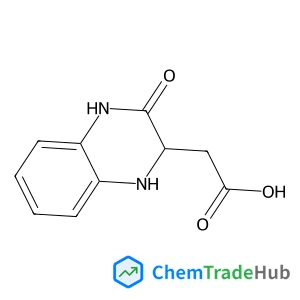
(3-Oxo-1,2,3,4-tetrahydro-2-quinoxalinyl)acetic acid
CAS Number:
136584-14-0
Molecular Formula:
C10H10N2O3
Bernhard M. Krause, Britta Bauer, Jörg-Martin Neudörfl, Hans-Günther Schmalz
Endogenous itaconate as well as the gasotransmitter CO have recently been described as powerful anti-inflammatory and immunomodulating agents. However, each of the two agents comes along with a major drawback: Whereas itaconates only exert beneficial effects at high concentrations above 100 μM, the uncontrolled application of CO has strong toxic effects. To solve these problems, we designed hybrid prodrugs, i.e. itaconates that are conjugated with an esterase-triggered CO-releasing acyloxycyclohexadiene–Fe(CO)3 unit (ItaCORMs). Here, we describe the synthesis of different ItaCORMs and demonstrate their anti-inflammatory potency in cellular assays of primary murine immune cells in the low μmolar range (<10 μM). Thus, ItaCORMs represent a promising new class of hybrid compounds with high clinical potential as anti-inflammatory agents.
K. Kirievsky, D. Fuks, Y. Gelbstein
DOI: 10.1039/D0CP00956C
Tran Thi Thu Hanh, Nguyen Minh Phi, Nguyen Van Hoa
DOI: 10.1039/D0CP00016G
Pengfei Qiu, Kunpeng Zhao, Dudi Ren, Xun Shi
DOI: 10.1039/D0CP00733A
Eugenii Ya. Misochko, Alexander V. Akimov, Denis V. Korchagin, Yulia S. Ganushevich, Egor A. Melnikov, Vasili A. Miluykov
DOI: 10.1039/D0CP05254J
Xiao-Ming Cao, Zheng-Jiang Shao
DOI: 10.1039/D0CP00554A
Yannick J. Dappe, Oleksiy L. Kapitanchuk, Delphine Coursault, Emmanuelle Lacaze
DOI: 10.1039/C9CP06519A
Larissa Zibordi-Besse, Lucas G. Verga, Vivianne K. Ocampo-Restrepo, Juarez L. F. Da Silva
DOI: 10.1039/D0CP00584C
Li Wang, Denglu Hou, Chunfang Wu, Yuanping Shi, Shaohui Shi, Weikun Gao, Shunzhen Feng, Yingdi Liu, Li Li, Denghui Ji
DOI: 10.1039/C9CP05608D
Žiga Medoš, Sergej Friesen, Richard Buchner, Marija Bešter-Rogač
DOI: 10.1039/D0CP00877J
This compound is mainly used as an intermediate in the synthesis of antipsychoti...
Waste containing 1-(D-Ribofuranosyl)-1,4-dihydro-3-pyridinecarboxamide (CAS: 191...
2-Methyl-2-propanyl 3-bromo-3-(hydroxymethyl)-1-azetidinecarboxylate (CAS: 20079...
N-(4-Chloro-2-pyridinyl)acetamide (CAS: 245056-66-0) is a chemical compound with...
5-Chloro-2-hydroxybenzoic acid, also known as 5-chlorosalicylic acid, is an arom...
When handling 1,1-Dichloro-1-fluoroethane (CAS: 1717-00-6), it is important to u...
Fmoc-(2S,3R)-3-phenylpyrrolidine-2-carboxylic acid is a white crystalline solid ...
4-Amino-5-bromo-2-pyridinecarboxylic acid is primarily used as a precursor in th...
Handling this compound should be done with personal protective equipment (PPE) i...
When handling 8-bromo-2,2-dimethyl-3,4-dihydro-2H-1,4-benzoxazin-3-one, use prop...

![4-Chloro-3-(trifluoromethyl)-1H-pyrrolo[2,3-b]pyridine structure](https://static.chemtradehub.com/structs/869/869335-75-1-a9d0.webp "4-Chloro-3-(trifluoromethyl)-1H-pyrrolo[2,3-b]pyridine structure")






