


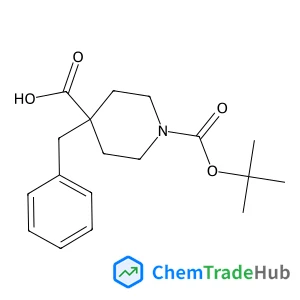
4-Benzyl-1-(tert-butoxycarbonyl)piperidine-4-carboxylic acid
CAS Number:
170838-87-6
Molecular Formula:
C18H25NO4
Gisela Andrea Camacho-Hernandez, Deborah Rudin, Therese C. Ku, Daryl A. Guthrie, Valentina Straniero, Ermanno Valoti, Gerhard J. Schütz, Harald H. Sitte, Amy Hauck Newman
The utilization of fluorescent ligands to study the monoamine transporters (MATs) has increased our knowledge of their function and distribution in live cell systems. In this study, we extend SAR for nisoxetine and talopram as parent compounds, to identify high affinity rhodamine-labeled fluorescent probes for the norepinephrine transporter (NET). Nisoxetine-based fluorescent probe 6 demonstrated high binding affinity (Ki = 43 nM) for NET and an overall selectivity compared to the other transporters for dopamine (DAT; Ki = 1540 nM) and serotonin (SERT; Ki = 785 nM) in competitive radioligand binding assays. Using confocal microscopy, compound 6 was shown to stain both NET and SERT, but not DAT, at low nanomolar concentrations, in transporter-expressing cells.

Anti-Corrosion Methods and Materials

Canadian Metallurgical Quarterly

Chemistry of Natural Compounds

Doklady Chemistry

Advances in Colloid and Interface Science

Accounts of Chemical Research

Journal of the American Chemical Society

Bulletin of the Chemical Society of Japan

Biopolymers

Cement and Concrete Research
Samuel Moxon, Adam R. Symington, Joshua S. Tse, James Dawson, Joseph M. Flitcroft, Stephen C. Parker, David J. Cooke, Robert M. Harker, Marco Molinari
DOI: 10.1039/D0CP00021C
Antonio Gennaro, Alexander Karabanov, Alexey Potapov, Walter Köckenberger
DOI: 10.1039/D0CP00892C
Qianwen Chen, Yun Zhao, Lei Zeng, Chunzhen Yang, Feng Huang
DOI: 10.1039/C9CP07002H
Bhaskar Rana, John M. Herbert
DOI: 10.1039/D0CP05216G
Florian R. Rehak, GiovanniMaria Piccini, Maristella Alessio, Joachim Sauer
DOI: 10.1039/D0CP00394H
DOI: 10.1039/D0CP00524J
Mahendra Bhujel, David L. Marshall, Alan T. Maccarone, Benjamin I. McKinnon, Adam J. Trevitt, Gabriel da Silva, Stephen J. Blanksby, Berwyck L. J. Poad
DOI: 10.1039/D0CP01498B
Benjamin A. Link, Ammon J. Sindt, Linda S. Shimizu, Thanh D. Do
DOI: 10.1039/C9CP06938K
Björn Kriete, Carolien J. Feenstra, Maxim S. Pshenichnikov
DOI: 10.1039/D0CP01734E
This compound is mainly used as an intermediate in the synthesis of antipsychoti...
Waste containing 1-(D-Ribofuranosyl)-1,4-dihydro-3-pyridinecarboxamide (CAS: 191...
2-Methyl-2-propanyl 3-bromo-3-(hydroxymethyl)-1-azetidinecarboxylate (CAS: 20079...
N-(4-Chloro-2-pyridinyl)acetamide (CAS: 245056-66-0) is a chemical compound with...
5-Chloro-2-hydroxybenzoic acid, also known as 5-chlorosalicylic acid, is an arom...
When handling 1,1-Dichloro-1-fluoroethane (CAS: 1717-00-6), it is important to u...
Fmoc-(2S,3R)-3-phenylpyrrolidine-2-carboxylic acid is a white crystalline solid ...
4-Amino-5-bromo-2-pyridinecarboxylic acid is primarily used as a precursor in th...
Handling this compound should be done with personal protective equipment (PPE) i...
When handling 8-bromo-2,2-dimethyl-3,4-dihydro-2H-1,4-benzoxazin-3-one, use prop...
![tert-Butyl N-[(2-chloropyridin-4-yl)methyl]carbamate structure](https://static.chemtradehub.com/structs/916/916210-27-0-9f95.webp "tert-Butyl N-[(2-chloropyridin-4-yl)methyl]carbamate structure")


