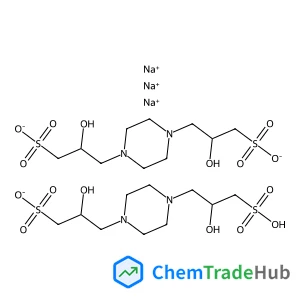
3,3'-(Piperazine-1,4-diyl)bis(2-hydroxypropane-1-sulfonic acid) Sodium Salt
CAS Number:
108321-08-0
Molecular Formula:
C20H41N4Na3O16S4
A graphical abstract is available for this content
Chunfeng Jiang, Quan Liu, Jiaming Liu, Kaixuan Liu, Liangliang Tian, Mingfei Duan, Ying Wang, Zhufang Shen, Youjun Xu
DOI: 10.1039/C9OB00762H
Tinghua Wang, Alexei V. Demchenko
DOI: 10.1039/C9OB00573K
Manickam Bakthadoss, Selvakumar Raman, Mohammad Mushaf
DOI: 10.1039/C9OB00639G
Olga Michalak, Piotr Cmoch, Piotr Krzeczyński, Marcin Cybulski
DOI: 10.1039/C8OB02552E
Tao Zhou, Tingjie You, Jianhui Chen, Chenliang Su, Yuanzhi Xia
DOI: 10.1039/C9OB00494G
Yang Yuan, Hailu Tan, Lingkai Kong, Zhong Zheng, Murong Xu, Jiaqi Huang, Yanzhong Li
DOI: 10.1039/C9OB00081J
Yuan-Zhao Ji, Jin-Yu Zhang, Hui-Jing Li, Chunguang Han, Yi-Kun Yang
DOI: 10.1039/C9OB00526A
DOI: 10.1039/C9OB00641A
Qianqian Zhen, Yinlin Shao, Tianxing Cheng, Jiuxi Chen
DOI: 10.1039/C8OB02680G
3-Fluoro-2-methylbenzylamine is an organic compound with the CAS number 771573-3...
Tert-butyl 2-(oxetan-3-ylidene)acetate is considered safe for its intended uses ...
Proper personal protective equipment (PPE) such as gloves, goggles, and a lab co...
2-Ethyl-4-methyl-1,3-thiazole is commonly synthesized via the reaction of thiour...
This compound should be stored in a cool, dry place away from direct sunlight an...
L-Lysine Acetate Salt (CAS: 52315-92-1) is subject to various regulatory guideli...
6-Fluoro-3-hydroxy-2-pyrazinecarboxamide (CAS: 259793-96-9) is generally conside...
1,1'-Sulfonylbis(1H-imidazole) is a crystalline solid with a molecular weight of...
4-Methyl-7-nitro-1H-indole-3-carbonitrile (CAS: 289483-82-5) is primarily used i...
Waste containing 5-Bromo-3-indolyl-beta-galactoside (CAS: 97753-82-7) should be ...

Physical Chemistry Chemical Physics (PCCP) is an international journal co-owned by 19 physical chemistry and physics societies from around the world. This journal publishes original, cutting-edge research in physical chemistry, chemical physics and biophysical chemistry. To be suitable for publication in PCCP, articles must include significant innovation and/or insight into physical chemistry; this is the most important criterion that reviewers and Editors will judge against when evaluating submissions. The journal has a broad scope and welcomes contributions spanning experiment, theory, computation and data science. Topical coverage includes spectroscopy, dynamics, kinetics, statistical mechanics, thermodynamics, electrochemistry, catalysis, surface science, quantum mechanics, quantum computing and machine learning. Interdisciplinary research areas such as polymers and soft matter, materials, nanoscience, energy, surfaces/interfaces, and biophysical chemistry are welcomed if they demonstrate significant innovation and/or insight into physical chemistry. Joined experimental/theoretical studies are particularly appreciated when complementary and based on up-to-date approaches.