


Microwave spectra, molecular geometries, and internal rotation of CH3 in N-methylimidazole⋯H2O and 2-methylimidazole⋯H2O Complexes
Literature Information
Publication Date
2022-05-06
DOI
10.1039/D1CP05526G
Impact Factor
3.676
Authors
Eva Gougoula, Charlotte N. Cummings, Chris Medcraft, Juliane Heitkämper, Nicholas R. Walker
View Original
Abstract
Broadband microwave spectra have been recorded between 7.0 and 18.5 GHz for N-methylimidazole⋯H2O and 2-methylimidazole⋯H2O complexes. Each complex was generated by co-expansion of low concentrations of methylimidazole and H2O in argon buffer gas. The rotational spectra of five isotopologues of each complex have been assigned and analysed to determine rotational constants (A0, B0, C0), centrifugal distortion constants (DJ, DJK) and parameters that describe the internal rotation of the CH3 group. The results allow the determination of parameters in the (r0) molecular geometry of each complex. H2O is the hydrogen bond donor and the pyridinic nitrogen of imidazole is the hydrogen bond acceptor in each case. The ∠(O–Hb⋯N3) angles are 177(5)° and 166.3(28)° for N-methylimidazole⋯H2O and 2-methylimidazole⋯H2O respectively. These results are consistent with the presence of a weak electrostatic interaction between the oxygen atom of H2O and the hydrogen atom (or CH3 group) attached to the C2 carbon atom of imidazole, and with the results of density functional theory calculations. The (V3) barrier to internal rotation of the CH3 group within N-methylimidazole⋯H2O is essentially unchanged from the value of this parameter for the N-methylimidazole monomer. The same parameter is significantly higher for the 2-methylimidazole⋯H2O complex than for the 2-methylimidazole monomer as a consequence of the weak electrostatic interaction between the O atom and the CH3 group of 2-methylimidazole.
Recommended Journals

Organic Preparations and Procedures International

Fibre Chemistry

Pharmacological Reviews

Journal of Physics and Chemistry of Solids

Science

Helvetica Chimica Acta

Journal of Organometallic Chemistry

Journal of Medicinal Chemistry

Proceedings of the National Academy of Sciences of the United States of America

Molecular Pharmacology
Related Literature
A coarse-grained model of room-temperature ionic liquids between metal electrodes: a molecular dynamics study
Benjamin Bobin Ye, Zhen-Gang Wang
2022-04-28
Paper
DOI: 10.1039/D2CP00166G
Vibrational mode analysis of hydrogen-bonded organic frameworks (HOFs): synchrotron infrared studies
Dominique R. T. Appadoo, Stephanie A. Boer, Nicholas G. White
2022-04-27
Paper
DOI: 10.1039/D2CP00796G
Volume viscosity and ultrasonic relaxation of ethanol–water mixtures studied by molecular dynamics simulations
2022-04-22
Paper
DOI: 10.1039/D2CP00856D
Optical absorption and shape transition in neutral SnN clusters with N ≤ 40: a photodissociation spectroscopy and electric beam deflection study
Andreas Lehr, Filip Rivic, Marc Jäger, Martin Gleditzsch, Rolf Schäfer
2022-05-04
Paper
DOI: 10.1039/D2CP01171A
Tunable Schottky and ohmic contacts in the Ti2NF2/α-Te van der Waals heterostructure
Jingwen Jiang, Yiguo Xu, Xiuwen Zhang
2022-08-16
Paper
DOI: 10.1039/D2CP02054H
On the atomic structure of two-dimensional materials with Janus structures
2022-03-11
Communication
DOI: 10.1039/D1CP05311F
Electronic polarization effects on membrane translocation of anti-cancer drugs
Atiyeh (Najla) Hosseini, Mohammad Reza Ejtehadi
2022-04-18
Paper
DOI: 10.1039/D2CP00056C
Probing the mechanisms of enhanced crystallisation of APS in the presence of ultrasound
Peter R. Birkin, Jack J. Youngs, Tadd T. Truscott, Silvana Martini
2022-05-04
Paper
DOI: 10.1039/D1CP05701D
Recent advances in dendrite-free lithium metal anodes for high-performance batteries
Xiang Zhang, Chunwen Sun
2022-08-05
Review Article
DOI: 10.1039/D2CP01655A
Excited state dynamics of normal dithienylethene molecules either isolated or deposited on an argon cluster
Aude Lietard, Giovanni Piani, Rodolphe Pollet, Jean-Michel Mestdagh
2022-04-06
Paper
DOI: 10.1039/D1CP05729D
You might also like
Compound Q&A
How is Ethyl 4-chlorothieno[2,3-b]pyridine-5-carboxylate (CAS: 59713-58-5) typically synthesized?
Ethyl 4-chlorothieno[2,3-b]pyridine-5-carboxylate (CAS: 59713-58-5) can be synth...
59713-58-5Ethyl 4-chlorothieno...
Compound Q&A
What regulatory guidelines apply to 5-Methyl-1H-indole-3-carbaldehyde (CAS: 52562-50-2)?
5-Methyl-1H-indole-3-carbaldehyde (CAS: 52562-50-2) is subject to various regula...
52562-50-25-Methyl-1H-indole-3...
Compound Q&A
What are the physical and chemical properties of (1,3-Dimethyl-2,4-dioxo-1,2,3,4-tetrahydro-5-pyrimidinyl)boronic acid (CAS: 223418-73-3)?
(1,3-Dimethyl-2,4-dioxo-1,2,3,4-tetrahydro-5-pyrimidinyl)boronic acid is a white...
223418-73-3(1,3-Dimethyl-2,4-di...
Compound Q&A
How should waste containing Sulfocostunolide A (CAS: 1016983-51-9) be handled?
Waste containing Sulfocostunolide A (CAS: 1016983-51-9) should be handled with c...
1016983-51-9Sulfocostunolide A
Compound Q&A
What precautions should be taken when handling Murraxocin (CAS: 88478-44-8)?
When handling Murraxocin (CAS: 88478-44-8), ensure proper personal protective eq...
88478-44-8Murraxocin
Compound Q&A
What are the physical and chemical properties of Formvar (CAS: 63148-64-1)?
Formvar (CAS: 63148-64-1) is an alkyd resin characterized by a high molecular we...
63148-64-1Formvar(R)
Compound Q&A
Is (S)-4-benzyl-2-((benzyloxy)methyl)morpholine (CAS: 205242-66-6) safe?
(S)-4-benzyl-2-((benzyloxy)methyl)morpholine is generally safe when handled with...
205242-66-6(S)-4-benzyl-2-((ben...
Compound Q&A
What industries use Methyl 1-(5-bromo-2-pyrimidinyl)cyclopropanecarboxylate (CAS: 1447607-69-3)?
Methyl 1-(5-bromo-2-pyrimidinyl)cyclopropanecarboxylate (CAS: 1447607-69-3) is p...
1447607-69-3Methyl 1-(5-bromo-2-...
Compound Q&A
Is 2-Methyl-1-phenyl-1-propanamine hydrochloride (CAS: 24290-47-9) safe?
2-Methyl-1-phenyl-1-propanamine hydrochloride (CAS: 24290-47-9) is generally con...
24290-47-92-Methyl-1-phenyl-1-...
Compound Q&A
How is 3-(4-Bromophenyl)-2-methylpropanoic acid (CAS: 66735-01-1) typically synthesized?
3-(4-Bromophenyl)-2-methylpropanoic acid is synthesized through a multi-step pro...
66735-01-13-(4-Bromophenyl)-2-...
Source Journal
Physical Chemistry Chemical Physics

CiteScore:
5.5
Self-citation Rate:
10.3%
Articles per Year:
3036
Physical Chemistry Chemical Physics (PCCP) is an international journal co-owned by 19 physical chemistry and physics societies from around the world. This journal publishes original, cutting-edge research in physical chemistry, chemical physics and biophysical chemistry. To be suitable for publication in PCCP, articles must include significant innovation and/or insight into physical chemistry; this is the most important criterion that reviewers and Editors will judge against when evaluating submissions. The journal has a broad scope and welcomes contributions spanning experiment, theory, computation and data science. Topical coverage includes spectroscopy, dynamics, kinetics, statistical mechanics, thermodynamics, electrochemistry, catalysis, surface science, quantum mechanics, quantum computing and machine learning. Interdisciplinary research areas such as polymers and soft matter, materials, nanoscience, energy, surfaces/interfaces, and biophysical chemistry are welcomed if they demonstrate significant innovation and/or insight into physical chemistry. Joined experimental/theoretical studies are particularly appreciated when complementary and based on up-to-date approaches.
Recommended Compounds
![4-{1-[4-(4,4,5,5-Tetramethyl-1,3,2-dioxaborolan-2-yl)phenyl]cyclopropyl}morpholine structure](https://static.chemtradehub.com/structs/120/1206594-08-2-7afb.webp "4-{1-[4-(4,4,5,5-Tetramethyl-1,3,2-dioxaborolan-2-yl)phenyl]cyclopropyl}morpholine structure")
4-{1-[4-(4,4,5,5-Tetramethyl-1,3,2-dioxaborolan-2-yl)phenyl]cyclopropyl}morpholine
CAS Number:
1206594-08-2
Molecular Formula:
C19H28BNO3
![4-[(1-Methyl-1H-pyrrol-2-yl)methylene]-1,3(2H,4H)-isoquinolinedione structure](https://static.chemtradehub.com/structs/110/1104546-89-5-a600.webp "4-[(1-Methyl-1H-pyrrol-2-yl)methylene]-1,3(2H,4H)-isoquinolinedione structure")
4-[(1-Methyl-1H-pyrrol-2-yl)methylene]-1,3(2H,4H)-isoquinolinedione
CAS Number:
1104546-89-5
Molecular Formula:
C15H12N2O2
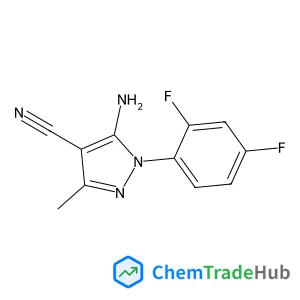
5-Amino-1-(2,4-difluorophenyl)-3-methyl-1H-pyrazole-4-carbonitrile
CAS Number:
1020057-92-4
Molecular Formula:
C11H8F2N4
Recommended Suppliers





Disclaimer
This page provides academic journal information for reference and research purposes only. We are not affiliated with any journal publishers and do not handle publication submissions. For publication-related inquiries, please contact the respective journal publishers directly.
If you notice any inaccuracies in the information displayed, please contact us at support@chemtradehub.com. We will promptly review and address your concerns.