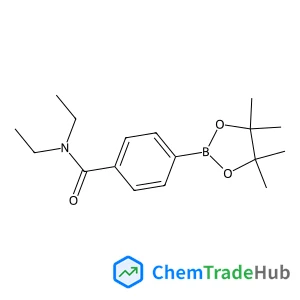
N,N-Diethyl-4-(4,4,5,5-tetramethyl-1,3,2-dioxaborolan-2-yl)benzamide
CAS Number:
325142-99-2
Molecular Formula:
C17H26BNO3
Lorena Zamora, Cristina Benito, Alberto Gutiérrez, Rafael Alcalde, Noor Alomari, Ahmad Al Bodour, Mert Atilhan, Santiago Aparicio
Type V natural deep eutectic solvents based on monoterpenoids (cineole, carvone, menthol, and thymol) are studied using a combined experimental and molecular modeling approach. The reported physicochemical properties showed low viscous fluids whose properties were characterized as a function of temperature. The theoretical study combining quantum chemistry and classical molecular dynamics simulations provided a nanoscopic characterization of the fluids, particularly for the hydrogen bonding network and its relationship with the macroscopic properties. The considered fluids constitute a suitable type of solvents considering their properties, cost, origin, and sustainability in different technological applications and sow the possibility of developing type V NADES from different types of molecules, especially in the terpenoid family of compounds.
George F. Harrington, Andrea Cavallaro, Stephen J. Skinner
DOI: 10.1039/C7CP02017A
Ewelina Krzyszkowska, Justyna Walkowiak-Kulikowska, Sven Stienen, Aleksandra Wojcik
DOI: 10.1039/C7CP01267E
Johan O. Nilsson, Mikael Leetmaa, Sergei I. Simak
DOI: 10.1039/C6CP06460D
Tao Xu, Wenliang Wang, Shiwei Yin, Yun Wang
DOI: 10.1039/C7CP01534H
F. Bianchini, H. Fjellvåg, P. Vajeeston
DOI: 10.1039/C7CP01395G
Carlos-A Polanco-Ramírez, Paul W. Ayers, José L. Gázquez, Alberto Vela
DOI: 10.1039/C7CP02613G
L.-M. Herzig, I. Elamri, H. Schwalbe, J. Wachtveitl
DOI: 10.1039/C7CP02030A
Xiaoyan Mu, Alan C. Hopkinson, Ivan K. Chu
DOI: 10.1039/C7CP02355C
This compound is mainly used as an intermediate in the synthesis of antipsychoti...
Waste containing 1-(D-Ribofuranosyl)-1,4-dihydro-3-pyridinecarboxamide (CAS: 191...
2-Methyl-2-propanyl 3-bromo-3-(hydroxymethyl)-1-azetidinecarboxylate (CAS: 20079...
N-(4-Chloro-2-pyridinyl)acetamide (CAS: 245056-66-0) is a chemical compound with...
5-Chloro-2-hydroxybenzoic acid, also known as 5-chlorosalicylic acid, is an arom...
When handling 1,1-Dichloro-1-fluoroethane (CAS: 1717-00-6), it is important to u...
Fmoc-(2S,3R)-3-phenylpyrrolidine-2-carboxylic acid is a white crystalline solid ...
4-Amino-5-bromo-2-pyridinecarboxylic acid is primarily used as a precursor in th...
Handling this compound should be done with personal protective equipment (PPE) i...
When handling 8-bromo-2,2-dimethyl-3,4-dihydro-2H-1,4-benzoxazin-3-one, use prop...

Physical Chemistry Chemical Physics (PCCP) is an international journal co-owned by 19 physical chemistry and physics societies from around the world. This journal publishes original, cutting-edge research in physical chemistry, chemical physics and biophysical chemistry. To be suitable for publication in PCCP, articles must include significant innovation and/or insight into physical chemistry; this is the most important criterion that reviewers and Editors will judge against when evaluating submissions. The journal has a broad scope and welcomes contributions spanning experiment, theory, computation and data science. Topical coverage includes spectroscopy, dynamics, kinetics, statistical mechanics, thermodynamics, electrochemistry, catalysis, surface science, quantum mechanics, quantum computing and machine learning. Interdisciplinary research areas such as polymers and soft matter, materials, nanoscience, energy, surfaces/interfaces, and biophysical chemistry are welcomed if they demonstrate significant innovation and/or insight into physical chemistry. Joined experimental/theoretical studies are particularly appreciated when complementary and based on up-to-date approaches.
![2,6-Di(thiophen-2-yl)dithieno[3,2-b:2',3'-d]thiophene structure](https://static.chemtradehub.com/structs/910/910788-24-8-5b70.webp "2,6-Di(thiophen-2-yl)dithieno[3,2-b:2',3'-d]thiophene structure")