












First-principles study of the structural stability and electrochemical properties of Na2MSiO4 (M = Mn, Fe, Co and Ni) polymorphs
Literature Information
Publication Date
2017-05-08
DOI
10.1039/C7CP01395G
Impact Factor
3.676
Authors
F. Bianchini, H. Fjellvåg, P. Vajeeston
View Original
Abstract
Sodium orthosilicates Na2MSiO4 (M = Mn, Fe, Co and Ni) have attracted much attention due to the possibility of exchanging two electrons per formula unit. They are also found to exhibit great structural stability due to a diamond-like arrangement of tetrahedral groups. In this work, we have systematically studied the possible polymorphism of these compounds by means of density functional theory, optimising the structure of a number of systems with different group symmetries. The ground state is found to be Pc-symmetric for all the considered M = Mn, Fe, Co, Ni, and several similar structures exhibiting different symmetries coexist within a 0.3 eV energy window from this structural minimum. The intercalation/deintercalation potential is calculated for varying transition metal atoms M. Iron sodium orthosilicates, attractive due to the natural abundance of both materials, exhibit a low voltage, which can be enhanced by doping with nickel. The diffusion pathways for Na atoms are discussed, and the relevant barriers are calculated using the nudged elastic band method on top of DFT calculations. Also in this case, nickel impurities would improve the material performances by lowering the barrier heights. Notably, the ionic conductivity is found to be systematically larger with respect to the case of lithium orthosilicates, due to a larger spacing between atomic layers and to the non-directional bonding between Na and the neighbouring atoms. Overall, the great structural stability of the material together with the low barriers for Na diffusion indicates this class of materials as good candidates for modern battery technologies.
Related Literature
Chemical tools for the generation and detection of singlet oxygen
2018-04-24
Review Article
DOI: 10.1039/C8OB00504D
Unexpected cyclization of 2-(2-aminophenyl)indoles with nitroalkenes to furnish indolo[3,2-c]quinolines
Alexander V. Aksenov, Dmitrii A. Aksenov, Nicolai A. Aksenov, Leonid G. Voskressensky
2018-05-22
Paper
DOI: 10.1039/C8OB00588E
In situ phosphonium-containing Lewis base-catalyzed 1,6-cyanation reaction: a facile way to obtain α-diaryl and α-triaryl acetonitriles
Yuan Chen, Xiaoyu Ren, Yumeng Guo, Bing Yi, Hongkui Zhang, Guowei Gao, Tianli Wang
2021-11-11
Research Article
DOI: 10.1039/D1QO01501J
Synthesis of δ-phosphorothiolated alcohols by photoredox/copper catalyzed remote C(sp3)–H phosphorothiolation of N-alkoxypyridinium salts
Zhipeng Zheng, Shanshan Shi, Qianru Ma, Yufei Yang, Yan Liu, Guo Tang
2021-10-02
Research Article
DOI: 10.1039/D1QO01178B
From imines to amides via NHC-mediated oxidation
Shaofa Sun, Donghui Guo, Fangyi Li
2021-11-30
Research Article
DOI: 10.1039/D1QO01661J
Efficient enantioselective synthesis of CF2H-containing dispiro[benzo[b]thiophene-oxindole-pyrrolidine]s via organocatalytic cycloaddition
Yabo Deng, Yongzhen Li, Yalan Wang, Shuo Sun, Sichao Ma, Pengfei Jia, Wenguang Li, Kairong Wang, Wenjin Yan
2021-11-24
Research Article
DOI: 10.1039/D1QO01392K
Regioselective synthesis and biological evaluation of N-substituted 2-aminoquinazolin-4-ones
Zhen-Yuan Liao, Wen-Hsiung Yeh, Pen-Yuan Liao, Yu-Ting Liu, Ying-Cheng Chen, Yi-Hung Chen, Tsung-Han Hsieh, Chia-Chi Lin, Ming-Hsuan Lu, Yi-Song Chen, Ming-Chih Hsu, Tsai-Kun Li, Tun-Cheng Chien
2018-04-27
Paper
DOI: 10.1039/C8OB00624E
Homolysis/mesolysis of alkoxyamines activated by chemical oxidation and photochemical-triggered radical reactions at room temperature
Gérard Audran, Mitchell T. Blyth, Michelle L. Coote, Georg Gescheidt, Micael Hardy, Jeffrey Havot, Maxence Holzritter, Samuel Jacoutot, Jean-Patrick Joly, Sylvain R. A. Marque, Tataye Moussounda Moussounda Koumba, Dmytro Neshchadin, Enzo Vaiedelich
2021-10-14
Research Article
DOI: 10.1039/D1QO01276B
Nickel-catalyzed electrochemical reductive relay cross-coupling of alkyl halides with alkyl carboxylic acids
Cong Ma, Dong Liu, Hui Qiu, Bin Cheng, Tian-Sheng Mei
2021-10-07
Research Article
DOI: 10.1039/D1QO01219C
Rh(iii)-Catalyzed tandem C(sp2)–H allylation/N-alkylation annulation of arene amides with 2-alkylidenetrimethylene carbonates
Hui Xie, Jin-Yi Liang, Zhuo-Jun Huang, Bing Shu, Yi-Chuan Zheng, Yan-Zhi Liu, Shao-Yong Chen, Xu-Ge Liu, Shang-Shi Zhang
2021-10-08
Research Article
DOI: 10.1039/D1QO01129D
You might also like
Compound Q&A
What industries use (1R,3S)-1,3-Cyclopentanediol (CAS: 16326-97-9)?
(1R,3S)-1,3-Cyclopentanediol finds applications in various industries. In the ph...
16326-97-9(1R,3S)-1,3-Cyclopen...
Compound Q&A
What precautions should be taken when handling N'-[4-(Dimethylamino)phenyl]-N,N-dimethyl-1,4-benzenediamine (CAS: 637-31-0)?
When handling N'-[4-(Dimethylamino)phenyl]-N,N-dimethyl-1,4-benzenediamine, it i...
637-31-0N'-[4-(Dimethylamino...
Compound Q&A
Are there alternatives to 5-(2,4-Difluorophenyl)-2-methoxypyrimidine (CAS: 1352318-16-1) in synthesis?
There are several alternatives to 5-(2,4-Difluorophenyl)-2-methoxypyrimidine in ...
1352318-16-15-(2,4-Difluoropheny...
Compound Q&A
What regulatory guidelines apply to 1-(3-Methoxyphenoxy)propan-2-ol (CAS: 382141-68-6)?
1-(3-Methoxyphenoxy)propan-2-ol (CAS: 382141-68-6) must comply with the Globally...
382141-68-61-(3-Methoxyphenoxy)...
Compound Q&A
Is Tetrodotoxin Citrate (CAS: 18660-81-6) safe?
Tetrodotoxin Citrate is extremely dangerous and should be handled with extreme c...
18660-81-6Tetrodotoxin Citrate
Compound Q&A
What are the main uses of 2-Methyl-2-propanyl [(1R,3S)-3-hydroxycyclopentyl]carbamate (CAS: 225641-84-9)?
2-Methyl-2-propanyl [(1R,3S)-3-hydroxycyclopentyl]carbamate (CAS: 225641-84-9) i...
225641-84-92-Methyl-2-propanyl ...
Compound Q&A
How should waste containing 4-(2-Hydroxyhexafluoroisopropyl)Benzoic Acid (CAS: 16261-80-6) be handled?
Waste containing 4-(2-Hydroxyhexafluoroisopropyl)Benzoic Acid (CAS: 16261-80-6) ...
16261-80-64-(2-Hydroxyhexafluo...
Compound Q&A
How is 2-Methyl-2-proanyl {(2S)-1-[(benzyloxy)amino]-3-hydroxy-3-methyl-1-oxo-2-butanyl}carbamate (CAS: 102507-19-7) typically synthesized?
2-Methyl-2-proanyl {(2S)-1-[(benzyloxy)amino]-3-hydroxy-3-methyl-1-oxo-2-butanyl...
102507-19-72-Methyl-2-propanyl ...
Compound Q&A
What is Benzeneethanamine, α-ethyl-, hydrochloride (1:1) (CAS: 20735-15-3)?
Benzeneethanamine, α-ethyl-, hydrochloride (1:1) is an organic compound with the...
20735-15-3Benzeneethanamine, α...
Compound Q&A
Are there alternatives to 3-{(E)-[4-(Dimethylamino)phenyl]diazenyl}benzoic acid (CAS: 20691-84-3) in synthesis?
In the synthesis of compounds similar to 3-{(E)-[4-(Dimethylamino)phenyl]diazeny...
20691-84-33-{(E)-[4-(Dimethyla...
Source Journal
Physical Chemistry Chemical Physics

CiteScore:
5.5
Self-citation Rate:
10.3%
Articles per Year:
3036
Physical Chemistry Chemical Physics (PCCP) is an international journal co-owned by 19 physical chemistry and physics societies from around the world. This journal publishes original, cutting-edge research in physical chemistry, chemical physics and biophysical chemistry. To be suitable for publication in PCCP, articles must include significant innovation and/or insight into physical chemistry; this is the most important criterion that reviewers and Editors will judge against when evaluating submissions. The journal has a broad scope and welcomes contributions spanning experiment, theory, computation and data science. Topical coverage includes spectroscopy, dynamics, kinetics, statistical mechanics, thermodynamics, electrochemistry, catalysis, surface science, quantum mechanics, quantum computing and machine learning. Interdisciplinary research areas such as polymers and soft matter, materials, nanoscience, energy, surfaces/interfaces, and biophysical chemistry are welcomed if they demonstrate significant innovation and/or insight into physical chemistry. Joined experimental/theoretical studies are particularly appreciated when complementary and based on up-to-date approaches.
Recommended Compounds
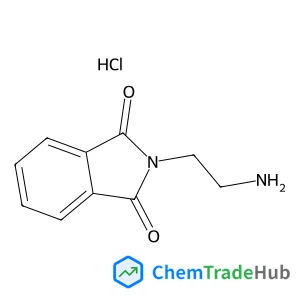
2-(2-Aminoethyl)-1H-isoindole-1,3(2H)-dione hydrochloride (1:1)
CAS Number:
30250-67-0
Molecular Formula:
C10H11ClN2O2
Recommended Suppliers





Disclaimer
This page provides academic journal information for reference and research purposes only. We are not affiliated with any journal publishers and do not handle publication submissions. For publication-related inquiries, please contact the respective journal publishers directly.
If you notice any inaccuracies in the information displayed, please contact us at support@chemtradehub.com. We will promptly review and address your concerns.