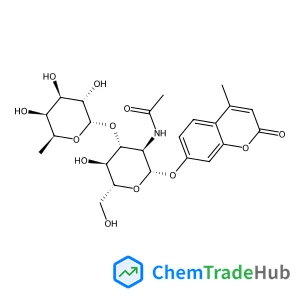
4-Methyl-2-oxo-2H-chromen-7-yl 2-acetamido-2-deoxy-3-O-(6-deoxy-alpha-L-galactopyranosyl)-beta-D-glucopyranoside
CAS Number:
383160-12-1
Molecular Formula:
C24H31NO12
Xuanhao Chang, Egor O. Dobrolyubov, Sergey V. Krasnoshchekov
A fundamental quantitative study of the vibrational resonances of three H216O H,D-isotopologues with a quartic Watson Hamiltonian was carried out using the resummation of the high-order (∼λn, n ≤ 203) divergent Rayleigh–Schrödinger perturbation theory (RSPT) series by quartic Padé–Hermite multivalued diagonal approximants PH[m,m,m,m,m], m ≤ 40. The resonance condition between a pair of states is formulated as the existence of a common complex energy solution branch point inside the unit circle: |E(λj)|, Re(λj)2 + Im(λj)2 ≤ 1. For the matrix formulation of the vibrational problem (VCI), the existence of common branch points is governed by the Katz theorem and they can be found as roots of discriminant polynomials. The main branches of the Padé–Hermite approximants typically reproduce VCI energies with high accuracy while alternative branches often fit nearby resonant states. The resummation of the RSPT series for H2O and D2O (up to the tenth polyad) revealed not only Fermi and Darling–Dennison resonances, but also unusual (0,2,−5) and (5,−2,0) resonance effects matching the (5,2,5) polyad structure, while the (3,2,1) structure was rigorously confirmed for HDO. It is demonstrated that the (5,2,5) polyad structure ensures good organization of high-energy resonating states and breaks down the classic (2,1,2) structure. The advocated methodology of quantitative description of resonance phenomena and revealing polyad structures is suitable for larger molecules and can be adapted to linear molecules and symmetric tops. Its application ensures rigorous classification of vibrational states and can be used in quantitative vibration–rotation spectroscopy.
Kunfeng Chen, Dongfeng Xue
DOI: 10.1039/C4CP00811A
Reshu Sanan, Tejwant Singh Kang, Rakesh Kumar Mahajan
DOI: 10.1039/C3CP54030H
Liancheng Wang, Ruimin Ding, Yao Xu
DOI: 10.1039/C4CP00647J
Graeme Williams, Sibi Sutty, Hany Aziz
DOI: 10.1039/C4CP01295J
Shota Kuwahara, Soichiro Taya, Taro Toyoda, Kenji Katayama
DOI: 10.1039/C3CP53964D
Karine Gorgy, Eleonora-Mihaela Ungureanu, George-Octavian Buica, Michael Holzinger, Serge Cosnier
DOI: 10.1039/C3CP55100H
Pan Ouyang, Hong Zhang, Yulong Liu, Ying Wang
DOI: 10.1039/C3CP54252A
Maciej J. Marczewski, Bernhard Stanje, Martin Wilkening
DOI: 10.1039/C4CP01133C
Yun Hee Jang, Yves Lansac, Jae-Ki Kim, Hee-Soo Yoo, Chang-Geun Chae, Cheol Ho Choi, Shashadhar Samal, Jae-Suk Lee
DOI: 10.1039/C4CP03596H
When handling lithium chloride hydrate (1:1:1) (CAS: 16712-20-2), it is importan...
4-(4H-1,2,4-Triazol-4-yl)piperidine is generally considered safe for use in phar...
Waste containing 1,3-Thiazole-2-carboxamide (CAS: 16733-85-0) should be collecte...
5-(Difluoromethyl)-2-fluorobenzonitrile (CAS: 934175-58-3) is subject to regulat...
Methyl 3-acetamido-2-thiophenecarboxylate can be synthesized by the reaction of ...
4-Isoquinolinecarbonitrile is a chemical compound with the CAS number 34846-65-6...
Store Methyl 1H-1,2,3-triazole-4-carboxylate (CAS: 877309-59-6) in a cool, dry p...
6-Bromo[1,3]thiazolo[5,4-b]pyridin-2-amine (CAS: 1160791-13-8) is subject to the...
(2S,3S)-2-Ammonio-3-(3,4-dihydroxyphenyl)-3-hydroxypropanoate (CAS: 23651-95-8) ...
7-Bromo-3-methyl-3,4-dihydroquinazolin-4-one is a solid with a crystalline form....

Physical Chemistry Chemical Physics (PCCP) is an international journal co-owned by 19 physical chemistry and physics societies from around the world. This journal publishes original, cutting-edge research in physical chemistry, chemical physics and biophysical chemistry. To be suitable for publication in PCCP, articles must include significant innovation and/or insight into physical chemistry; this is the most important criterion that reviewers and Editors will judge against when evaluating submissions. The journal has a broad scope and welcomes contributions spanning experiment, theory, computation and data science. Topical coverage includes spectroscopy, dynamics, kinetics, statistical mechanics, thermodynamics, electrochemistry, catalysis, surface science, quantum mechanics, quantum computing and machine learning. Interdisciplinary research areas such as polymers and soft matter, materials, nanoscience, energy, surfaces/interfaces, and biophysical chemistry are welcomed if they demonstrate significant innovation and/or insight into physical chemistry. Joined experimental/theoretical studies are particularly appreciated when complementary and based on up-to-date approaches.
![1-[4-(4-Methyl-1H-imidazol-1-yl)phenyl]ethanone structure](https://static.chemtradehub.com/structs/142/142161-53-3-7f55.webp "1-[4-(4-Methyl-1H-imidazol-1-yl)phenyl]ethanone structure")
![Ethyl 4-[8-chloro(5,5,6,6,7-~2~H_5_)-5,6-dihydro-11H-benzo[5,6]cyclohepta[1,2-b]pyridin-11-ylidene]-1-piperidinecarboxylate structure](https://static.chemtradehub.com/structs/102/1020719-57-6-37e2.webp "Ethyl 4-[8-chloro(5,5,6,6,7-~2~H_5_)-5,6-dihydro-11H-benzo[5,6]cyclohepta[1,2-b]pyridin-11-ylidene]-1-piperidinecarboxylate structure")