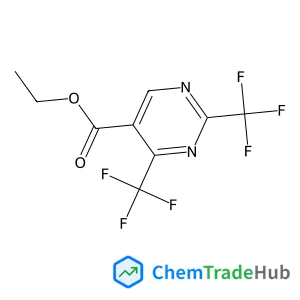
Ethyl 2,4-bis(trifluoromethyl)-5-pyrimidinecarboxylate
CAS Number:
188781-15-9
Molecular Formula:
C9H6F6N2O2
Reshu Sanan, Tejwant Singh Kang, Rakesh Kumar Mahajan
The interactions of methylene blue (MB), a redox active dye with surface active biamphiphilic ionic liquids (BAILs): 1-butyl-3-methylimidazolium dodecylsulfate, [C4mim][C12OSO3] and 1-hexyl-3-methylimidazolium dodecylsulfate [C6mim][C12OSO3] have been investigated in aqueous medium to explore the candidature of surface active ionic liquids (ILs) in the field of dye–surfactant chemistry. Various thermodynamic, spectroscopic and electrochemical techniques such as conductivity, steady-state fluorescence, UV-visible absorption, and cyclic voltammetry (CV) have been used to obtain comprehensive information about MB–BAIL interactions. The presence of MB is seen to enhance the critical micellar concentration (cmc) of BAILs. The extent of interaction between the MB and BAILs varies with the concentration as well as the nature of BAILs. Different interactional phenomena such as the formation of ion-pair complexes, dimers, and solubilisation of monomers of MB have been observed in different concentration regimes of BAILs. A quantitative evaluation of the process of interaction between MB and BAILs has been made in terms of various micellar and binding parameters exploiting UV-visible absorption and CV measurements. Comparatively more hydrophobic [C6mim][C12OSO3] interacts strongly with MB as compared to [C4mim][C12OSO3] via hydrophobic and electrostatic interactions.
Linlin Zhuang, Jiansen Gong, Yongxin Ji, Peilong Tian, Fei Kong, Huiyuan Bai, Ning Gu, Yu Zhang
DOI: 10.1039/C9AN02011J
Lei Zhang, Zhenyu Tang, LiLi Hou, Yang Qu, Yawen Deng, Chenghao Zhang, Congxia Xie, Zhongtao Wu
DOI: 10.1039/C9AN02286D
Linfeng Chen, Xike Tian, Yuan Zhao, Yong Li, Chao Yang, Zhaoxin Zhou
DOI: 10.1039/C6AN00740F
Shruti D. Bindesri, Ricardo Jebailey, Najwan Albarghouthi, Cory C. Pye, Christa L. Brosseau
DOI: 10.1039/C9AN02173F
Kai Hu, Da-Wei Li, Yi-Tao Long
DOI: 10.1039/C6AN00319B
Xiang-Juan Kong, Shuang Wu, Yao Cen, Ting-Ting Chen, Ru-Qin Yu, Xia Chu
DOI: 10.1039/C6AN00738D
Yao Lei, Fei Qiu, Jian-Mei Yang, Mao Liu, Qing-Mei Ge, Hang Cong, Zhu Tao
DOI: 10.1039/C9AN02156F
Haidong Li, Patrick Garrigue, Laurent Bouffier, Stéphane Arbault, Alexander Kuhn, Neso Sojic
DOI: 10.1039/C6AN00652C
When handling lithium chloride hydrate (1:1:1) (CAS: 16712-20-2), it is importan...
4-(4H-1,2,4-Triazol-4-yl)piperidine is generally considered safe for use in phar...
Waste containing 1,3-Thiazole-2-carboxamide (CAS: 16733-85-0) should be collecte...
5-(Difluoromethyl)-2-fluorobenzonitrile (CAS: 934175-58-3) is subject to regulat...
Methyl 3-acetamido-2-thiophenecarboxylate can be synthesized by the reaction of ...
4-Isoquinolinecarbonitrile is a chemical compound with the CAS number 34846-65-6...
Store Methyl 1H-1,2,3-triazole-4-carboxylate (CAS: 877309-59-6) in a cool, dry p...
6-Bromo[1,3]thiazolo[5,4-b]pyridin-2-amine (CAS: 1160791-13-8) is subject to the...
(2S,3S)-2-Ammonio-3-(3,4-dihydroxyphenyl)-3-hydroxypropanoate (CAS: 23651-95-8) ...
7-Bromo-3-methyl-3,4-dihydroquinazolin-4-one is a solid with a crystalline form....

Physical Chemistry Chemical Physics (PCCP) is an international journal co-owned by 19 physical chemistry and physics societies from around the world. This journal publishes original, cutting-edge research in physical chemistry, chemical physics and biophysical chemistry. To be suitable for publication in PCCP, articles must include significant innovation and/or insight into physical chemistry; this is the most important criterion that reviewers and Editors will judge against when evaluating submissions. The journal has a broad scope and welcomes contributions spanning experiment, theory, computation and data science. Topical coverage includes spectroscopy, dynamics, kinetics, statistical mechanics, thermodynamics, electrochemistry, catalysis, surface science, quantum mechanics, quantum computing and machine learning. Interdisciplinary research areas such as polymers and soft matter, materials, nanoscience, energy, surfaces/interfaces, and biophysical chemistry are welcomed if they demonstrate significant innovation and/or insight into physical chemistry. Joined experimental/theoretical studies are particularly appreciated when complementary and based on up-to-date approaches.
![N-[2-(2-Pyridinyl)ethyl]-1-propanamine structure](https://static.chemtradehub.com/structs/554/55496-57-6-22b4.webp "N-[2-(2-Pyridinyl)ethyl]-1-propanamine structure")
![tert-butyl 8-benzyl-2,8-diazaspiro[4.5]decane-2-carboxylate structure](https://static.chemtradehub.com/structs/336/336191-16-3-bb55.webp "tert-butyl 8-benzyl-2,8-diazaspiro[4.5]decane-2-carboxylate structure")
![8-Bromo-6-fluoro[1,2,4]triazolo[1,5-a]pyridin-2-amine structure](https://static.chemtradehub.com/structs/125/1257705-51-3-9f4a.webp "8-Bromo-6-fluoro[1,2,4]triazolo[1,5-a]pyridin-2-amine structure")