












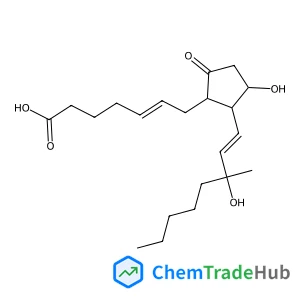
(5Z,11alpha,13E,15R)-11,15-Dihydroxy-15-methyl-9-oxoprosta-5,13-dien-1-oic acid
CAS Number:
55028-70-1
Molecular Formula:
C21H34O5
Zhikai Zhang, Cece Xue, Kai Yang, Rong Gao, Na Yu
Due to efficient intersystem crossing (ISC), combined with efficient non-radiative processes of the triplet excited state, oligothiophenes generally exhibit very weak photoluminescence. Phosphorus (P)-bridged terthiophenes (P-terThs) and phosphorus (P)-bridged bithiophenes (P-biThs) were synthesized. The diverse and well-defined P-chemistry has been applied to fine tune the photophysical properties of these materials. The asymmetric electronic coupling between the P-center and terThs suppressed the electronic interactions of two terTh and biTh moieties in the ground state S0. Particularly, P-terThs and P-biThs having a positively charged P(+)-center induce pronounced asymmetric electronic environments on the two terThs and two biThs, respectively, which allows relaxation from the initial excited state via symmetry breaking charge transfer (SBCT) to give the charge separated state SSBCT. P-terThs and P-biThs having a positively charged P(+)-center exhibit stronger SBCT than others, which may result in a weaker ISC of oligothiophenes, and consequently lead to the photoluminescence quantum yields (PLQYs) being as high as 71% and 39%, respectively. The current study uncovered detailed insights on the effects of phosphorus chemistry on the SBCT of oligothiophenes and their resulting effects on the photophysical properties of P-bridged oligothiophenes, which have not been previously addressed in oligothiophenes.
Deborah J. Last, Juan J. Nájera, Carl J. Percival, Andrew B. Horn
DOI: 10.1039/B901815H
Vicki H. Grassian
DOI: 10.1039/B907584D
Takashi Yumura, Keisuke Kimura, Hisayoshi Kobayashi, Ryo Tanaka, Norio Okumura, Tokio Yamabe
DOI: 10.1039/B905866D
Dorota Koziej, Michael Hübner, Nicolae Barsan, Udo Weimar, Marcin Sikora, Jan-Dierk Grunwaldt
DOI: 10.1039/B906829E
Josh J. Newby, Christian W. Müller, Ching-Ping Liu, Timothy S. Zwier
DOI: 10.1039/B903830B
Giuliano Bandoli, Davide Barreca, Alberto Gasparotto, Roberta Seraglia, Eugenio Tondello, Anjana Devi, Roland A. Fischer, Manuela Winter, Ettore Fois, Aldo Gamba, Gloria Tabacchi
DOI: 10.1039/B904145A
Xiaohua Wu, Yugang Sun, Matthew Pelton
DOI: 10.1039/B903053K
Sergey P. Laptenok, Katharine M. Mullen, Ivo H. M. van Stokkum
DOI: 10.1039/B919700A
DOI: 10.1039/B903677F
When handling 2-Methyl-2-propanyl 5-amino-2-thiophenecarboxylate (CAS: 1498311-5...
5-Bromo-1,2-dichloro-3-fluorobenzene (CAS: 1000572-93-9) is a crystalline solid ...
(2R)-2-Amino-2-(4-bromophenyl)ethanol (CAS: 354153-64-3) should be stored in a c...
Methyl 4-(aminomethyl)tetrahydro-2H-pyran-4-carboxylate hydrochloride (CAS: 3627...
1,4-Dimethyl-1H-pyrazole-5-sulfonyl chloride is primarily used as an intermediat...
Dinaphtho[1,2-b:2',1'-d]furan is generally safe when handled with appropriate pe...
The market for 7-Methyl-7,9-dihydro-1H-purine-2,6,8(3H)-trione (CAS: 612-37-3) i...
2-(4-Chlorophenyl)malonaldehyde (CAS: 205676-17-1) is a colorless or light yello...
2-Methylchrysene (CAS: 3351-32-4) is typically synthesized via the reaction of c...
N-(6-aminopyrimidin-4-yl)acetamide (CAS: 89533-23-3) is generally considered saf...

Physical Chemistry Chemical Physics (PCCP) is an international journal co-owned by 19 physical chemistry and physics societies from around the world. This journal publishes original, cutting-edge research in physical chemistry, chemical physics and biophysical chemistry. To be suitable for publication in PCCP, articles must include significant innovation and/or insight into physical chemistry; this is the most important criterion that reviewers and Editors will judge against when evaluating submissions. The journal has a broad scope and welcomes contributions spanning experiment, theory, computation and data science. Topical coverage includes spectroscopy, dynamics, kinetics, statistical mechanics, thermodynamics, electrochemistry, catalysis, surface science, quantum mechanics, quantum computing and machine learning. Interdisciplinary research areas such as polymers and soft matter, materials, nanoscience, energy, surfaces/interfaces, and biophysical chemistry are welcomed if they demonstrate significant innovation and/or insight into physical chemistry. Joined experimental/theoretical studies are particularly appreciated when complementary and based on up-to-date approaches.
![1-Oxa-8-azaspiro[4.5]decan-3-ol structure](https://static.chemtradehub.com/structs/757/757239-76-2-a0ec.webp "1-Oxa-8-azaspiro[4.5]decan-3-ol structure")




