












Vibrational energy relaxation of a diatomic molecule in a superfluid helium nanodroplet: influence of the nanodroplet size, interaction energy and energy gap
Literature Information
Publication Date
2021-11-02
DOI
10.1039/D1CP03629G
Impact Factor
3.676
Authors
Miquel Blancafort-Jorquera, Miguel González
View Original
Abstract
The influence of the nanodroplet size, molecule–helium interaction potential energy and ν = 1 − ν = 0 vibrational energy gap on the vibrational energy relaxation (VER) of a diatomic molecule (X2) in a superfluid helium nanodroplet [HeND or (4He)N; finite quantum solvent at T = 0.37 K] has been studied using a hybrid quantum approach recently proposed by us and taking as a reference the VER results on the I2@(4He)100 doped nanodroplet (Vilà et al., Phys. Chem. Chem. Phys., 2018, 20, 118, which corresponds to the first theoretical study on the VER of molecules embedded in a HeND). This has allowed us to obtain a deeper insight into the vibrational relaxation dynamics. The nanodroplet size has a very small effect on the VER, as this process mainly depends on the interaction between the molecule and the nanodroplet first solvation shell. Regarding the interaction potential energy and the energy gap, both factors play an important and comparable role in the VER time properties (global relaxation time, lifetime and transition time). As the former becomes stronger the relaxation time properties decrease in a significant way (their inverse follows a linear dependence with respect to the ν = 1 − ν = 0 coupling term) and they also decrease in a significant manner when the energy gap diminishes (linear dependence on the ν = 1 − ν = 0 energy difference). We expect that this study will motivate further work on the vibrational relaxation process in HeNDs.
Related Literature
Coupled mutual diffusion in solutions of micelles and solubilizates
Michelle Everist, Jennifer A. MacNeil, Jonathan R. Moulins, Derek G. Leaist
2009-07-01
Paper
DOI: 10.1039/B906452D
XPS study of nitrogen dioxide adsorption on metal oxide particle surfaces under different environmental conditions
Vicki H. Grassian
2009-07-02
Paper
DOI: 10.1039/B907584D
Electron attachment to trinitrotoluene (TNT) embedded in He droplets: complete freezing of dissociation intermediates in an extended range of electron energies
Eugen Illenberger
2009-06-30
Paper
DOI: 10.1039/B908192E
The positive influence of electrochemical cyclic potentiodynamic passivation (CPP) of a SS316LS surface on its response to fibronectin and pre-osteoblasts
Fereshteh Azari, Hojatollah Vali
2009-05-19
Paper
DOI: 10.1039/B902881A
Ab initio study of the structure and magnetism of atomic oxygen adsorbed Scn (n = 2–14) clusters
Mingli Yang
2009-05-27
Paper
DOI: 10.1039/B902627D
Themed issue: Solid state and cluster structure prediction
2010-07-19
Editorial
DOI: 10.1039/C0CP90058C
Quantum coherence and its interplay with protein environments in photosynthetic electronic energy transfer
2010-06-12
Perspective
DOI: 10.1039/C003389H
Jet-cooled vibronic spectroscopy and asymmetric torsional potentials of phenylcyclopentene
Josh J. Newby, Christian W. Müller, Ching-Ping Liu, Timothy S. Zwier
2009-07-07
Paper
DOI: 10.1039/B903830B
You might also like
Compound Q&A
What precautions should be taken when handling 2-Methyl-2-propanyl 5-amino-2-thiophenecarboxylate (CAS: 1498311-57-1)?
When handling 2-Methyl-2-propanyl 5-amino-2-thiophenecarboxylate (CAS: 1498311-5...
1498311-57-12-Methyl-2-propanyl ...
Compound Q&A
What are the physical and chemical properties of 5-Bromo-1,2-dichloro-3-fluorobenzene (CAS: 1000572-93-9)?
5-Bromo-1,2-dichloro-3-fluorobenzene (CAS: 1000572-93-9) is a crystalline solid ...
1000572-93-95-Bromo-1,2-dichloro...
Compound Q&A
How should (2R)-2-Amino-2-(4-bromophenyl)ethanol (CAS: 354153-64-3) be stored?
(2R)-2-Amino-2-(4-bromophenyl)ethanol (CAS: 354153-64-3) should be stored in a c...
354153-64-3(2R)-2-Amino-2-(4-br...
Compound Q&A
What regulatory guidelines apply to Methyl 4-(aminomethyl)tetrahydro-2H-pyran-4-carboxylate hydrochloride (CAS: 362707-24-2)?
Methyl 4-(aminomethyl)tetrahydro-2H-pyran-4-carboxylate hydrochloride (CAS: 3627...
362707-24-2Methyl 4-(aminomethy...
Compound Q&A
What are the main uses of 1,4-dimethyl-1H-pyrazole-5-sulfonyl chloride (CAS: 1174834-52-6)?
1,4-Dimethyl-1H-pyrazole-5-sulfonyl chloride is primarily used as an intermediat...
1174834-52-61,4-dimethyl-1H-pyra...
Compound Q&A
Is Dinaphtho[1,2-b:2',1'-d]furan (CAS: 239-69-0) safe?
Dinaphtho[1,2-b:2',1'-d]furan is generally safe when handled with appropriate pe...
239-69-0Dinaphtho[1,2-b:2',1...
Compound Q&A
What is the market or research trend for 7-Methyl-7,9-dihydro-1H-purine-2,6,8(3H)-trione (CAS: 612-37-3)?
The market for 7-Methyl-7,9-dihydro-1H-purine-2,6,8(3H)-trione (CAS: 612-37-3) i...
612-37-37-Methyl-7,9-dihydro...
Compound Q&A
What are the physical and chemical properties of 2-(4-Chlorophenyl)malonaldehyde (CAS: 205676-17-1)?
2-(4-Chlorophenyl)malonaldehyde (CAS: 205676-17-1) is a colorless or light yello...
205676-17-12-(4-Chlorophenyl)ma...
Compound Q&A
How is 2-Methylchrysene (CAS: 3351-32-4) typically synthesized?
2-Methylchrysene (CAS: 3351-32-4) is typically synthesized via the reaction of c...
3351-32-42-Methylchrysene
Compound Q&A
Is N-(6-aminopyrimidin-4-yl)acetamide (CAS: 89533-23-3) safe?
N-(6-aminopyrimidin-4-yl)acetamide (CAS: 89533-23-3) is generally considered saf...
89533-23-3N-(6-aminopyrimidin-...
Source Journal
Physical Chemistry Chemical Physics

CiteScore:
5.5
Self-citation Rate:
10.3%
Articles per Year:
3036
Physical Chemistry Chemical Physics (PCCP) is an international journal co-owned by 19 physical chemistry and physics societies from around the world. This journal publishes original, cutting-edge research in physical chemistry, chemical physics and biophysical chemistry. To be suitable for publication in PCCP, articles must include significant innovation and/or insight into physical chemistry; this is the most important criterion that reviewers and Editors will judge against when evaluating submissions. The journal has a broad scope and welcomes contributions spanning experiment, theory, computation and data science. Topical coverage includes spectroscopy, dynamics, kinetics, statistical mechanics, thermodynamics, electrochemistry, catalysis, surface science, quantum mechanics, quantum computing and machine learning. Interdisciplinary research areas such as polymers and soft matter, materials, nanoscience, energy, surfaces/interfaces, and biophysical chemistry are welcomed if they demonstrate significant innovation and/or insight into physical chemistry. Joined experimental/theoretical studies are particularly appreciated when complementary and based on up-to-date approaches.
Recommended Compounds
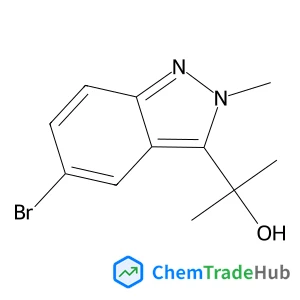
2-(5-Bromo-2-methyl-2H-indazol-3-yl)-2-propanol
CAS Number:
1823787-20-7
Molecular Formula:
C11H13BrN2O
Recommended Suppliers




Disclaimer
This page provides academic journal information for reference and research purposes only. We are not affiliated with any journal publishers and do not handle publication submissions. For publication-related inquiries, please contact the respective journal publishers directly.
If you notice any inaccuracies in the information displayed, please contact us at support@chemtradehub.com. We will promptly review and address your concerns.