












Flow effects on the surface properties of surfactant foam films
Literature Information
Publication Date
2021-11-15
DOI
10.1039/D1CP03279H
Impact Factor
3.676
Authors
Zhicheng Ye, Jie Yang, Haiping Su, Yazhuo Shang
View Original
Abstract
The surface electrostatic properties of liquid foam, involving the electrokinetic (EK) phenomena in the liquid–gas interface, have significant effects on the stability of the foam. Here, we established a theoretical model for ion transport in liquid films by combining the liquid flow and surface reaction. We found that the surface electrostatic properties of liquid foams were influenced unexpectedly by the pressure-induced flow. The liquid flow will induce the potential and concentration differences in the flow direction. When the pressure drop increases to a certain high value, the induced potential and salt concentration difference increases, leading to the change of the surface electrostatic properties such as zeta potential and the surface charge density. This change shows that the surface electrostatic properties of foam films depend on the coupling of various factors including ion distribution and pressure drop, which deepens our understanding of the electrostatic properties of the foam films.
Related Literature
Aggregation response of triglyceride hydrolysis products in cyclohexane and triolein
Sampsa Vierros, Monika Österberg, Maria Sammalkorpi
2018-10-11
Paper
DOI: 10.1039/C8CP05104F
Variable temperature NMR of organogelators: the intensities of a single sample describe the full phase diagram
Elliot Christ, Dominique Collin, Jean-Philippe Lamps
2018-03-27
Paper
DOI: 10.1039/C8CP00009C
Exploring non-adiabatic approximations to the exchange–correlation functional of TDDFT
Johanna I. Fuks, Lionel Lacombe, Søren E. B. Nielsen, Neepa T. Maitra
2018-10-02
Paper
DOI: 10.1039/C8CP03957G
New tricks for old dogs: improving the accuracy of biomolecular force fields by pair-specific corrections to non-bonded interactions
Aleksei Aksimentiev
2018-02-26
Perspective
DOI: 10.1039/C7CP08185E
Computational strategies to probe CH activation in dioxo-dicopper complexes
Zhenzhuo Lan, Shaama Mallikarjun Sharada
2018-09-27
Paper
DOI: 10.1039/C8CP05096A
Extracting multivalent detachment rates from heterogeneous nanoparticle populations
Mingqiu Wang
2018-07-30
Paper
DOI: 10.1039/C8CP03118E
High-performance thermoelectric materials based on ternary TiO2/CNT/PANI composites
Hui Li, Xizu Wang, FuKe Wang
2018-03-01
Paper
DOI: 10.1039/C7CP07896J
Impact of surface wettability on dynamics of supercooled water confined in nitrogen-doped ordered mesoporous carbon
Clinton G. Wiener, Zhe Qiang, Yanfeng Xia, Bryan D. Vogt
2018-10-23
Paper
DOI: 10.1039/C8CP05670F
Designing a porous-crystalline structure of β-Ga2O3: a potential approach to tune its opto-electronic properties
Swastika Banerjee, Xiangwei Jiang, Lin-Wang Wang
2018-03-06
Paper
DOI: 10.1039/C7CP08565F
You might also like
Compound Q&A
What are the main uses of 1-(3-Aminophenyl)-3-[(3R)-1-(3,3-dimethyl-2-oxobutyl)-2-oxo-5-(2-pyridinyl)-2,3-dihydro-1H-1,4-benzodiazepin-3-yl]urea (CAS: 155412-88-7)?
This compound is mainly used as an intermediate in the synthesis of antipsychoti...
155412-88-71-(3-Aminophenyl)-3-...
Compound Q&A
How should waste containing 1-(D-Ribofuranosyl)-1,4-dihydro-3-pyridinecarboxamide (CAS: 19132-12-8) be handled?
Waste containing 1-(D-Ribofuranosyl)-1,4-dihydro-3-pyridinecarboxamide (CAS: 191...
19132-12-81-(D-Ribofuranosyl)-...
Compound Q&A
What regulatory guidelines apply to 2-Methyl-2-propanyl 3-bromo-3-(hydroxymethyl)-1-azetidinecarboxylate (CAS: 2007919-81-3)?
2-Methyl-2-propanyl 3-bromo-3-(hydroxymethyl)-1-azetidinecarboxylate (CAS: 20079...
2007919-81-32-Methyl-2-propanyl ...
Compound Q&A
What is N-(4-Chloro-2-pyridinyl)acetamide (CAS: 245056-66-0)?
N-(4-Chloro-2-pyridinyl)acetamide (CAS: 245056-66-0) is a chemical compound with...
245056-66-0N-(4-Chloro-2-pyridi...
Compound Q&A
What is 5-Chloro-2-hydroxybenzoic acid (CAS: 321-14-2)?
5-Chloro-2-hydroxybenzoic acid, also known as 5-chlorosalicylic acid, is an arom...
321-14-25-Chloro-2-hydroxybe...
Compound Q&A
What precautions should be taken when handling 1,1-Dichloro-1-fluoroethane (CAS: 1717-00-6)?
When handling 1,1-Dichloro-1-fluoroethane (CAS: 1717-00-6), it is important to u...
1717-00-61,1-Dichloro-1-fluor...
Compound Q&A
What are the physical and chemical properties of Fmoc-(2S,3R)-3-phenylpyrrolidine-2-carboxylic acid (CAS: 281655-32-1)?
Fmoc-(2S,3R)-3-phenylpyrrolidine-2-carboxylic acid is a white crystalline solid ...
281655-32-1Fmoc-(2S,3R)-3-pheny...
Compound Q&A
What are the main uses of 4-Amino-5-bromo-2-pyridinecarboxylic acid (CAS: 1363381-01-4)?
4-Amino-5-bromo-2-pyridinecarboxylic acid is primarily used as a precursor in th...
1363381-01-44-Amino-5-bromo-2-py...
Compound Q&A
What precautions should be taken when handling (S)-tert-butyl 2-((2-(4-bromophenyl)-2-oxoethyl)carbamoyl)pyrrolidine-1-carboxylate (CAS: 1007881-98-2)?
Handling this compound should be done with personal protective equipment (PPE) i...
1007881-98-2(S)-tert-butyl 2-((2...
Compound Q&A
What precautions should be taken when handling 8-bromo-2,2-dimethyl-3,4-dihydro-2H-1,4-benzoxazin-3-one (CAS: 688363-73-7)?
When handling 8-bromo-2,2-dimethyl-3,4-dihydro-2H-1,4-benzoxazin-3-one, use prop...
688363-73-78-bromo-2,2-dimethyl...
Source Journal
Physical Chemistry Chemical Physics

CiteScore:
5.5
Self-citation Rate:
10.3%
Articles per Year:
3036
Physical Chemistry Chemical Physics (PCCP) is an international journal co-owned by 19 physical chemistry and physics societies from around the world. This journal publishes original, cutting-edge research in physical chemistry, chemical physics and biophysical chemistry. To be suitable for publication in PCCP, articles must include significant innovation and/or insight into physical chemistry; this is the most important criterion that reviewers and Editors will judge against when evaluating submissions. The journal has a broad scope and welcomes contributions spanning experiment, theory, computation and data science. Topical coverage includes spectroscopy, dynamics, kinetics, statistical mechanics, thermodynamics, electrochemistry, catalysis, surface science, quantum mechanics, quantum computing and machine learning. Interdisciplinary research areas such as polymers and soft matter, materials, nanoscience, energy, surfaces/interfaces, and biophysical chemistry are welcomed if they demonstrate significant innovation and/or insight into physical chemistry. Joined experimental/theoretical studies are particularly appreciated when complementary and based on up-to-date approaches.
Recommended Compounds
![Methyl 4-({[(2-methyl-2-propanyl)oxy]carbonyl}amino)bicyclo[2.2.2]octane-1-carboxylate structure](https://static.chemtradehub.com/structs/943/943845-74-7-b7e5.webp "Methyl 4-({[(2-methyl-2-propanyl)oxy]carbonyl}amino)bicyclo[2.2.2]octane-1-carboxylate structure")
Methyl 4-({[(2-methyl-2-propanyl)oxy]carbonyl}amino)bicyclo[2.2.2]octane-1-carboxylate
CAS Number:
943845-74-7
Molecular Formula:
C15H25NO4
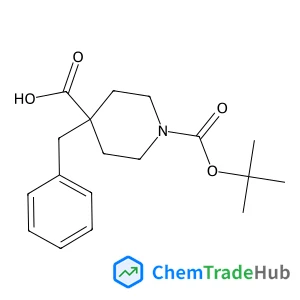
4-Benzyl-1-(tert-butoxycarbonyl)piperidine-4-carboxylic acid
CAS Number:
170838-87-6
Molecular Formula:
C18H25NO4
![4-Chloro-3-(trifluoromethyl)-1H-pyrrolo[2,3-b]pyridine structure](https://static.chemtradehub.com/structs/869/869335-75-1-a9d0.webp "4-Chloro-3-(trifluoromethyl)-1H-pyrrolo[2,3-b]pyridine structure")
4-Chloro-3-(trifluoromethyl)-1H-pyrrolo[2,3-b]pyridine
CAS Number:
869335-75-1
Molecular Formula:
C8H4ClF3N2
Recommended Suppliers






Disclaimer
This page provides academic journal information for reference and research purposes only. We are not affiliated with any journal publishers and do not handle publication submissions. For publication-related inquiries, please contact the respective journal publishers directly.
If you notice any inaccuracies in the information displayed, please contact us at support@chemtradehub.com. We will promptly review and address your concerns.