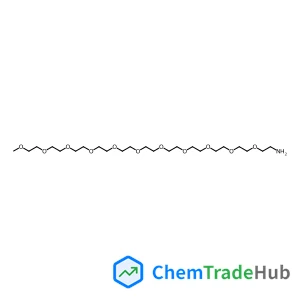
2,5,8,11,14,17,20,23,26,29,32-Undecaoxatetratriacontan-34-amine
CAS Number:
854601-60-8
Molecular Formula:
C23H49NO11
Rui Zhang, Arunabhiram Chutia, Alexey A. Sokol, David Chadwick
We report a detailed density functional theory (DFT) study of the geometrical and electronic properties, and the growth mechanism of a Cun (n = 1–4) cluster on a stoichiometric, and especially on a defective CeO2(110) surface with one surface oxygen vacancy, without using pre-assumed gas-phase Cun cluster shapes. This gives new and valuable theoretical insight into experimental work regarding debatable active sites of promising CuOx/CeO2-nanorod catalysts in many reactions. We demonstrate that CeO2(110) is highly reducible upon Cun adsorption, with electron transfer from Cun clusters, and that a Cun cluster grows along the long bridge sites until Cu3, so that each Cu atom can interact strongly with surface oxygen ions at these sites, forming stable structures on both stoichiometric and defective CeO2(110) surface. Cu–Cu interactions are, however, limited, since Cu atoms are distant from each other, inhibiting the formation of Cu–Cu bonds. This monolayer then begins to grow into a bilayer as seen in the Cu3 to Cu4 transition, with long-bridge site Cu as anchoring sites. Our calculations on Cu4 adsorption reveal a Cu bilayer rich in Cu+ species at the Cu–O interface.
Mio Takagi, Ayako Watanabe, Shigeo Murata, Ryo Takita
DOI: 10.1039/C8OB02708K
Abdrrahman S. Surur, Christian Bock, Kristin Beirow, Konrad Wurm, Lukas Schulig, Markus K. Kindermann, Werner Siegmund, Patrick J. Bednarski, Andreas Link
DOI: 10.1039/C9OB00511K
Cheng Zhang, Yu Qian
DOI: 10.1039/C8OB02420K
Yajie Yang, Jiaqi Huang, Hailu Tan, Lingkai Kong, Mengdan Wang, Yang Yuan, Yanzhong Li
DOI: 10.1039/C8OB03031F
Abbas H. K. Al Temimi, Ruben S. Teeuwen, Vu Tran, Arthur J. Altunc, Danny C. Lenstra, Wansheng Ren, Ping Qian, Hong Guo
DOI: 10.1039/C9OB01038F
Ramdas S. Pathare, Antim K. Maurya, Akriti Kumari, Vijai K. Agnihotri, Ved Prakash Verma, Devesh M. Sawant
DOI: 10.1039/C8OB02627K
Xianjin Zhu, Yongzhen Han, Haijun Yang, Changjin Zhu
DOI: 10.1039/C9OB00606K
Chunchao Tang, Lei Jin, Yuxing Lin, Jing Su, Yingai Sun, Pan Liu, Qi Li, Guankai Wang, Zheng Zhang, Lupei Du
DOI: 10.1039/C8OB01777H
Tinghua Wang, Alexei V. Demchenko
DOI: 10.1039/C9OB00573K
3-Fluoro-2-methylbenzylamine is an organic compound with the CAS number 771573-3...
Tert-butyl 2-(oxetan-3-ylidene)acetate is considered safe for its intended uses ...
Proper personal protective equipment (PPE) such as gloves, goggles, and a lab co...
2-Ethyl-4-methyl-1,3-thiazole is commonly synthesized via the reaction of thiour...
This compound should be stored in a cool, dry place away from direct sunlight an...
L-Lysine Acetate Salt (CAS: 52315-92-1) is subject to various regulatory guideli...
6-Fluoro-3-hydroxy-2-pyrazinecarboxamide (CAS: 259793-96-9) is generally conside...
1,1'-Sulfonylbis(1H-imidazole) is a crystalline solid with a molecular weight of...
4-Methyl-7-nitro-1H-indole-3-carbonitrile (CAS: 289483-82-5) is primarily used i...
Waste containing 5-Bromo-3-indolyl-beta-galactoside (CAS: 97753-82-7) should be ...

Physical Chemistry Chemical Physics (PCCP) is an international journal co-owned by 19 physical chemistry and physics societies from around the world. This journal publishes original, cutting-edge research in physical chemistry, chemical physics and biophysical chemistry. To be suitable for publication in PCCP, articles must include significant innovation and/or insight into physical chemistry; this is the most important criterion that reviewers and Editors will judge against when evaluating submissions. The journal has a broad scope and welcomes contributions spanning experiment, theory, computation and data science. Topical coverage includes spectroscopy, dynamics, kinetics, statistical mechanics, thermodynamics, electrochemistry, catalysis, surface science, quantum mechanics, quantum computing and machine learning. Interdisciplinary research areas such as polymers and soft matter, materials, nanoscience, energy, surfaces/interfaces, and biophysical chemistry are welcomed if they demonstrate significant innovation and/or insight into physical chemistry. Joined experimental/theoretical studies are particularly appreciated when complementary and based on up-to-date approaches.
![(1R,3S,5R)-2-{[(2-Methyl-2-propanyl)oxy]carbonyl}-2-azabicyclo[3.1.0]hexane-3-carboxylic acid structure](https://static.chemtradehub.com/structs/197/197142-34-0-6a44.webp "(1R,3S,5R)-2-{[(2-Methyl-2-propanyl)oxy]carbonyl}-2-azabicyclo[3.1.0]hexane-3-carboxylic acid structure")
![1,1'-[(E)-1,2-Ethenediyl]bis(4-bromobenzene) structure](https://static.chemtradehub.com/structs/188/18869-30-2-c907.webp "1,1'-[(E)-1,2-Ethenediyl]bis(4-bromobenzene) structure")