


Distinct molecular dynamics dividing liquid-like and gas-like supercritical hydrogens
Literature Information
Publication Date
2021-09-09
DOI
10.1039/D1CP02650J
Impact Factor
3.676
Authors
Shutaro Yamaoka, Kim Hyeon-Deuk
View Original
Abstract
Understanding how a supercritical fluid is related to normal liquid and gas and separating it into liquid-like and gas-like regions are of fundamental and practical importance. Despite the usefulness of hydrogen storage, molecular dynamics images on supercritical hydrogens exhibiting strong nuclear quantum effects are scarce. Taking advantage of the non-empirical ab initio molecular dynamics method for hydrogen molecules, we found that, while radial distribution functions and diffusion show a monotonic change along the density, van Hove time correlation functions and intramolecular properties such as bond length and vibrational frequency exhibit the anomalous order crossing the Widom line. By demonstrating that the anomalous order stemmed from the largest deviations between liquid-like and gas-like solvations formed around the Widom line, we concluded that this supercritical fluid is a mixture of liquid and gas possessing heterogeneity. The obtained physical insights can be an index to monitor the supercriticality and to identify distinct liquid-like and gas-like supercritical fluids.
Recommended Journals

Proceedings of the National Academy of Sciences of the United States of America

Journal of Medicinal Chemistry

Pure and Applied Chemistry

Journal of Organometallic Chemistry

Journal of Heterocyclic Chemistry

Journal of Catalysis

Journal of Physics and Chemistry of Solids

Helvetica Chimica Acta

Planta Medica

Fibre Chemistry
Related Literature
Heat capacity behaviour of pore confined benzene and hexafluorobenzene in NaY zeolite
Guohua Zhao, Barara Groß, Herbert Dilger, Emil Roduner
2002-02-11
Paper
DOI: 10.1039/B110158G
Solvation dynamics of Coumarin 490 in methanol and acetonitrile reverse micelles
Partha Hazra, Nilmoni Sarkar
Paper
DOI: 10.1039/B109447E
Proton relaxation and intermolecular structure of liquid formic acid: a nuclear magnetic resonance study
2002-03-14
Paper
DOI: 10.1039/B110358J
Scaling and dynamics of “flow distributed oscillation patterns” in the Belousov–Zhabotinsky reaction
R. Tóth, V. Gáspár
2002-01-15
Paper
DOI: 10.1039/B107627B
Effects of surface tension and rotation on the Rayleigh–Taylor instability
A. H. A. Ayyad
2002-03-13
Paper
DOI: 10.1039/B106242P
Electrodeposition at polarisable liquid|liquid interfaces: The role of interfacial tension on nucleation kinetics
Christoffer Johans, Peter Liljeroth, Kyösti Kontturi
2002-02-13
Paper
DOI: 10.1039/B110182J
Near-diffusion-controlled reactions of muonium in sub- and supercritical water
Khashayar Ghandi, Brenda Addison-Jones, Jean-Claude Brodovitch, Iain McKenzie, Paul W. Percival, Joachim Schüth
2002-01-16
Paper
DOI: 10.1039/B108656A
Symmetry and distortive π-electrons in two- and three-dimensional conjugated systems
A. Rassat
2002-02-22
Paper
DOI: 10.1039/B109712C
Perturbation theory of polar Kihara molecule mixtures applied to supercritical fluid extraction systems
2002-02-26
Paper
DOI: 10.1039/B108703G
You might also like
Compound Q&A
What regulatory guidelines apply to 6-Bromo-2-methylimidazo[1,2-a]pyrimidine (CAS: 1111638-05-1)?
6-Bromo-2-methylimidazo[1,2-a]pyrimidine (CAS: 1111638-05-1) falls under various...
1111638-05-16-Bromo-2-methylimid...
Compound Q&A
Are there alternatives to 1-Pyrrolidineethanol, β-methyl-α-phenyl-, (αS,βR) (CAS: 123620-80-4) in synthesis?
While there are no direct alternatives, similar compounds like 1-Pyrrolidineetha...
123620-80-41-Pyrrolidineethanol...
Compound Q&A
Is 4-Methyl-2,6-bis(2-methyl-2-propanyl)phenyl methylcarbamate (CAS: 1918-11-2) safe?
4-Methyl-2,6-bis(2-methyl-2-propanyl)phenyl methylcarbamate (CAS: 1918-11-2) is ...
1918-11-24-Methyl-2,6-bis(2-m...
Compound Q&A
How should 2-(3-Bromo-4-fluorophenyl)-1,3-dioxolane (CAS: 77771-04-1) be stored?
2-(3-Bromo-4-fluorophenyl)-1,3-dioxolane (CAS: 77771-04-1) should be stored in a...
77771-04-12-(3-Bromo-4-fluorop...
Compound Q&A
What are the physical and chemical properties of 4,5,6,7-Tetrahydro-1H-indazole hydrochloride (CAS: 18161-11-0)?
4,5,6,7-Tetrahydro-1H-indazole hydrochloride is a white crystalline solid with a...
18161-11-04,5,6,7-Tetrahydro-1...
Compound Q&A
What is (2R)-1-Methoxy-3-phenyl-2-propanamine (CAS: 59919-07-2)?
(2R)-1-Methoxy-3-phenyl-2-propanamine is a chiral organic compound with the CAS ...
59919-07-2(2R)-1-Methoxy-3-phe...
Compound Q&A
What industries use Ethyl 1-(1-phenylethyl)-1H-imidazole-5-carboxylate (CAS: 56649-47-9)?
Ethyl 1-(1-phenylethyl)-1H-imidazole-5-carboxylate is used in various industries...
56649-47-9Ethyl 1-(1-phenyleth...
Compound Q&A
What regulatory guidelines apply to 4-[(1E,3S)-1-(4-Hydroxyphenyl)-1,4-pentadien-3-yl]phenol (CAS: 17676-24-3)?
4-[(1E,3S)-1-(4-Hydroxyphenyl)-1,4-pentadien-3-yl]phenol (CAS: 17676-24-3) falls...
17676-24-34-[(1E,3S)-1-(4-Hydr...
Compound Q&A
What industries use (S)-3-Amino-5-phenylpentanoic acid hydrochloride (CAS: 331846-97-0)?
(S)-3-Amino-5-phenylpentanoic acid hydrochloride is primarily used in the pharma...
331846-97-0(S)-3-Amino-5-phenyl...
Compound Q&A
How is 7-methoxy-1-benzothiophene-2-carboxylic acid (CAS: 88791-07-5) typically synthesized?
7-Methoxy-1-benzothiophene-2-carboxylic acid is typically synthesized by reactin...
88791-07-57-methoxy-1-benzothi...
Source Journal
Physical Chemistry Chemical Physics

CiteScore:
5.5
Self-citation Rate:
10.3%
Articles per Year:
3036
Physical Chemistry Chemical Physics (PCCP) is an international journal co-owned by 19 physical chemistry and physics societies from around the world. This journal publishes original, cutting-edge research in physical chemistry, chemical physics and biophysical chemistry. To be suitable for publication in PCCP, articles must include significant innovation and/or insight into physical chemistry; this is the most important criterion that reviewers and Editors will judge against when evaluating submissions. The journal has a broad scope and welcomes contributions spanning experiment, theory, computation and data science. Topical coverage includes spectroscopy, dynamics, kinetics, statistical mechanics, thermodynamics, electrochemistry, catalysis, surface science, quantum mechanics, quantum computing and machine learning. Interdisciplinary research areas such as polymers and soft matter, materials, nanoscience, energy, surfaces/interfaces, and biophysical chemistry are welcomed if they demonstrate significant innovation and/or insight into physical chemistry. Joined experimental/theoretical studies are particularly appreciated when complementary and based on up-to-date approaches.
Recommended Compounds
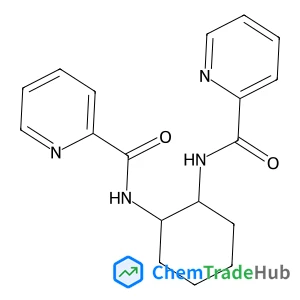
N,N'-(1R,2R)-1,2-Cyclohexanediyldi(2-pyridinecarboxamide)
CAS Number:
218290-24-5
Molecular Formula:
C18H20N4O2
![(3R)-4-(4-Chlorophenyl)-3-({[(2-methyl-2-propanyl)oxy]carbonyl}amino)butanoic acid structure](https://static.chemtradehub.com/structs/218/218608-96-9-f871.webp "(3R)-4-(4-Chlorophenyl)-3-({[(2-methyl-2-propanyl)oxy]carbonyl}amino)butanoic acid structure")
(3R)-4-(4-Chlorophenyl)-3-({[(2-methyl-2-propanyl)oxy]carbonyl}amino)butanoic acid
CAS Number:
218608-96-9
Molecular Formula:
C15H20ClNO4
![(3aS,6aS)-1-Methyloctahydropyrrolo[3,4-b]pyrrole structure](https://static.chemtradehub.com/structs/877/877212-98-1-9157.webp "(3aS,6aS)-1-Methyloctahydropyrrolo[3,4-b]pyrrole structure")
Recommended Suppliers





Disclaimer
This page provides academic journal information for reference and research purposes only. We are not affiliated with any journal publishers and do not handle publication submissions. For publication-related inquiries, please contact the respective journal publishers directly.
If you notice any inaccuracies in the information displayed, please contact us at support@chemtradehub.com. We will promptly review and address your concerns.