


Evolution of transition metal charge states in correlation with the structural and magnetic properties in disordered double perovskites Ca2−xLaxFeRuO6 (0.5 ≤ x ≤ 2)
Literature Information
Publication Date
2021-09-01
DOI
10.1039/D1CP02318G
Impact Factor
3.676
Authors
Kumari Naveen, Tanmay Rom, Shams Sohel Islam, Manfred Reehuis, Peter Adler, Claudia Felser, Andreas Hoser, Ramesh Chandra Nath, Ashok Kumar Yadav, Shambhu Nath Jha, Dibyendu Bhattacharyya, Marcus Schmidt, Avijit Kumar Paul
View Original
Abstract
A series of disordered Ca1.5La0.5FeRuO6, CaLaFeRuO6 and La2FeRuO6 double perovskites were prepared by the solid-state reaction method and investigated by neutron powder diffraction, X-ray absorption near-edge structure (XANES) analysis at the Ru–K edge, Mössbauer spectroscopy, DC magnetization and resistivity measurements. All compounds crystallize in the orthorhombic crystal structure with the space group Pbnm down to 3 K, showing a random distribution of Fe and Ru at the B site. Thermogravimetric analysis indicates oxygen deficiency in the Ca-rich and formal oxygen hyperstoichiometry in the La-rich members of the present series. While Mössbauer spectra verify the Fe3+ state for all compositions, the XANES study reveals a variable Run+ oxidation state which decreases with increasing La content. The end member actually is a Ru3+/Ru4+ compound with possibly some cation vacancies. From magnetic susceptibility and neutron diffraction measurements, the presence of a G-type antiferromagnetic ordering was observed with a drastic increase in transition temperature from 275 K (Ca1.5La0.5FeRuO6) to 570 K (La2FeRuO6). Mössbauer spectroscopy confirms the presence of long-range ordering but, due to local variations in the exchange interactions, the magnetic states are microscopically inhomogeneous. All the samples are variable range hopping semiconductors. A complex interplay between structural features, charge states, anion or cation defects, and atomic disorder determines the magnetic properties of the present disordered 3d/4d double perovskite series.
Recommended Journals

Journal of Saudi Chemical Society

Russian Journal of Bioorganic Chemistry

Russian Journal of Coordination Chemistry

Organic Process Research & Development

Crystallography Reports

Current Opinion in Colloid & Interface Science

Drug Discovery Today

Current Opinion in Solid State & Materials Science

Acta Materialia

Chemical Communications
Related Literature
Trion dynamics and charge photogeneration in MoS2 nanosheets prepared by liquid phase exfoliation
Le-Yi Zhao, Dan-Ao Han, Lei Wang, Hai-Yu Wang, Bing-Rong Gao, Hong-Bo Sun
2021-09-01
Paper
DOI: 10.1039/D1CP02455H
Two-photon absorption properties of multipolar triarylamino/tosylamido 1,1,4,4-tetracyanobutadienes‡
Marie Betou, Clotilde Philippe, Yann Trolez, Olivier Mongin, Marta Dudek, Ziemowit Pokladek, Katarzyna Matczyszyn, Marek Samoc, Thierry Roisnel, Loic Toupet, Marie Cordier, Graeme J. Moxey, Mark G. Humphrey, Frédéric Paul
2021-09-15
Paper
DOI: 10.1039/D1CP03346H
Carbon nanohorns as nanocontainers for cisplatin: insight into their interaction with the plasma membranes of normal and breast cancer cells
Eduardo R. Almeida, Hélio F. Dos Santos, Priscila V. S. Z. Capriles
2021-07-05
Paper
DOI: 10.1039/D1CP02015C
Divide-and-link peptide docking: a fragment-based peptide docking protocol
Lu Sun, Dan Zhao, Hongjun Fan, Shijun Zhong
2021-09-16
Paper
DOI: 10.1039/D1CP02098F
Compositional flexibility in Li–N–H materials: implications for ammonia catalysis and hydrogen storage
Joshua W. Makepeace, Alisha Sukhwani Manghnani, Claire A. Murray, Thomas J. Wood
2021-07-05
Paper
DOI: 10.1039/D1CP02440J
Giant tunneling electroresistance arising from reversible partial barrier metallization in the NaTiO3/BaTiO3/LaTiO3 ferroelectric tunnel junction
Hua Hao, Yanhong Zhou
2021-07-06
Paper
DOI: 10.1039/D1CP01767E
Excited-state symmetry breaking in 9,10-dicyanoanthracene-based quadrupolar molecules: the effect of donor–acceptor branch length
Zoltán Szakács, Florian Glöcklhofer, Felix Plasser, Eric Vauthey
2021-07-02
Paper
DOI: 10.1039/D1CP02376D
A distal regulatory strategy of enzymes: from local to global conformational dynamics
Xue Peng, Chenlin Lu, Jian Pang, Zheng Liu, Diannan Lu
2021-08-20
Paper
DOI: 10.1039/D1CP01519B
Dynamics of aqueous peptide solutions in folded and disordered states examined by dynamic light scattering and dielectric spectroscopy
Jorge H. Melillo, Florian Pabst, Thomas Blochowicz
2021-06-24
Paper
DOI: 10.1039/D1CP01893K
Photophysical properties of 1,2,3,4,5-pentaarylcyclopentadienyl–hydrotris(indazolyl)borate ruthenium(ii) complexes
Sheng Gao, Yohan Gisbert, Guillaume Erbland, Seifallah Abid, Claire Kammerer, Alessandro Venturini, Barbara Ventura, Nicola Armaroli
2021-07-15
Paper
DOI: 10.1039/D1CP02261J
You might also like
Compound Q&A
Is 4-Benzyl-2,2-dimethylmorpholine (CAS: 84761-04-6) safe?
4-Benzyl-2,2-dimethylmorpholine is generally considered safe when handled under ...
84761-04-64-Benzyl-2,2-dimethy...
Compound Q&A
What is (5,6-Dimethoxy-3-pyridinyl)boronic acid (CAS: 1346526-61-1)?
(5,6-Dimethoxy-3-pyridinyl)boronic acid is a chemical compound with the molecula...
1346526-61-1(5,6-Dimethoxy-3-pyr...
Compound Q&A
How is 1,1,3,3-Tetramethyl-1,3-bis(2-methyl-2-propanyl)disiloxane (CAS: 67875-55-2) typically synthesized?
1,1,3,3-Tetramethyl-1,3-bis(2-methyl-2-propanyl)disiloxane is synthesized throug...
67875-55-21,1,3,3-Tetramethyl-...
Compound Q&A
What are the main uses of (2R,4S)-1-Boc-4-methylpyrrolidine-2-carboxylic acid (CAS: 1018818-04-6)?
(2R,4S)-1-Boc-4-methylpyrrolidine-2-carboxylic acid is primarily used as a build...
1018818-04-6(2R,4S)-1-Boc-4-meth...
Compound Q&A
What precautions should be taken when handling 2,3-Dichloroacrylonitrile (CAS: 22410-58-8)?
When handling 2,3-Dichloroacrylonitrile, it is crucial to wear appropriate perso...
22410-58-82,3-Dichloroacryloni...
Compound Q&A
How should (S)-1-(o-Tolyl)ethanamine hydrochloride (CAS: 1332832-16-2) be stored?
(S)-1-(o-Tolyl)ethanamine hydrochloride should be stored in a cool, dry place to...
1332832-16-2(S)-1-(o-Tolyl)ethan...
Compound Q&A
What are the physical and chemical properties of Benzyl [1-(hydroxyamino)-1-imino-2-methyl-2-propanyl]carbamate (CAS: 518047-98-8)?
Benzyl [1-(hydroxyamino)-1-imino-2-methyl-2-propanyl]carbamate (CAS: 518047-98-8...
518047-98-8Benzyl [1-(hydroxyam...
Compound Q&A
What industries use 2-Methyloxazole-5-carbaldehyde (CAS: 885273-42-7)?
2-Methyloxazole-5-carbaldehyde is used in the pharmaceutical industry for the sy...
885273-42-72-Methyloxazole-5-ca...
Compound Q&A
What is the market or research trend for 2-Methyl-2-propanyl 4-[(1S)-1-hydroxyethyl]-1-piperidinecarboxylate (CAS: 389889-82-1)?
The market for 2-Methyl-2-propanyl 4-[(1S)-1-hydroxyethyl]-1-piperidinecarboxyla...
389889-82-12-Methyl-2-propanyl ...
Compound Q&A
Is 1-Butyl-3-methylpyridinium bromide (CAS: 26576-85-2) safe?
1-Butyl-3-methylpyridinium bromide is generally considered safe for laboratory u...
26576-85-21-Butyl-3-methylpyri...
Source Journal
Physical Chemistry Chemical Physics

CiteScore:
5.5
Self-citation Rate:
10.3%
Articles per Year:
3036
Physical Chemistry Chemical Physics (PCCP) is an international journal co-owned by 19 physical chemistry and physics societies from around the world. This journal publishes original, cutting-edge research in physical chemistry, chemical physics and biophysical chemistry. To be suitable for publication in PCCP, articles must include significant innovation and/or insight into physical chemistry; this is the most important criterion that reviewers and Editors will judge against when evaluating submissions. The journal has a broad scope and welcomes contributions spanning experiment, theory, computation and data science. Topical coverage includes spectroscopy, dynamics, kinetics, statistical mechanics, thermodynamics, electrochemistry, catalysis, surface science, quantum mechanics, quantum computing and machine learning. Interdisciplinary research areas such as polymers and soft matter, materials, nanoscience, energy, surfaces/interfaces, and biophysical chemistry are welcomed if they demonstrate significant innovation and/or insight into physical chemistry. Joined experimental/theoretical studies are particularly appreciated when complementary and based on up-to-date approaches.
Recommended Compounds
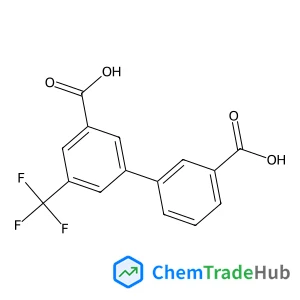
3-(3-Carboxyphenyl)-5-(trifluoromethyl)benzoic acid
CAS Number:
1261930-96-4
Molecular Formula:
C15H9F3O4
![2-[1-(4-Chlorobenzyl)-1H-indol-3-yl]-2-oxo-N-(6-quinolinyl)acetamide structure](https://static.chemtradehub.com/structs/501/501921-61-5-756a.webp "2-[1-(4-Chlorobenzyl)-1H-indol-3-yl]-2-oxo-N-(6-quinolinyl)acetamide structure")
2-[1-(4-Chlorobenzyl)-1H-indol-3-yl]-2-oxo-N-(6-quinolinyl)acetamide
CAS Number:
501921-61-5
Molecular Formula:
C26H18ClN3O2
![5,10-Dihydro-11H-dibenzo[b,e][1,4]diazepin-11-one structure](https://static.chemtradehub.com/structs/581/5814-41-5-0b01.webp "5,10-Dihydro-11H-dibenzo[b,e][1,4]diazepin-11-one structure")
Recommended Suppliers





Disclaimer
This page provides academic journal information for reference and research purposes only. We are not affiliated with any journal publishers and do not handle publication submissions. For publication-related inquiries, please contact the respective journal publishers directly.
If you notice any inaccuracies in the information displayed, please contact us at support@chemtradehub.com. We will promptly review and address your concerns.