













Decomposition of nitrous oxide in hydrated cobalt(i) clusters: a theoretical insight into the mechanistic roles of ligand-binding modes
Literature Information
Publication Date
2021-07-06
DOI
10.1039/D1CP01820E
Impact Factor
3.676
Authors
Ephrem G. Demissie, Wing Ka Lam, Wai Kit Tang, Chi-Kit Siu
View Original
Abstract
Hydrated cobalt(I) cluster ions, [Co(H2O)n]+, can decompose the inert nitrous oxide molecule, N2O. Density functional theory suggests that N2O can anchor to Co+ of [Co(N2O)(H2O)n]+ through either O end-on (η1-OL) or N end-on (η1-NL) coordinate mode. The latter is thermodynamically more favorable resulting from a subtle π backdonation from Co+ to N2O. N2O decomposition involves two major processes: (1) redox reaction and (2) N–O bond dissociation. The initial activation of N2O through an electron transfer from Co+ to N2O yields anionic N2O−, which binds to the metal center of [Co2+(N2O−)(H2O)n] also through either O end-on (η1-O) or N end-on (η1-N) mode and is stabilized by water molecules through hydrogen bonding. From η1-O, subsequent N–O bond dissociation to liberate N2, producing [CoO(H2O)n]+, is straightforward via a mechanism that is commonplace for typical metal-catalyzed N2O decompositions. Unexpectedly, the N–O bond dissociation directly from η1-N is also possible and eliminates both N2 and OH, explaining the formation of [CoOH(H2O)n]+ as observed in a previous experimental study. Interestingly, formation of [CoO(H2O)n]+ is kinetically controlled by the initial redox process between Co+ and the O-bound N2O, the activation barriers of which in large water clusters (n ≥ 14) are higher than that of the unexpected N–O bond dissociation from the N-bound structure forming [CoOH(H2O)n]+. This theoretical discovery implies that in the present of water molecules, the metal-catalyzed N2O decomposition starting from an O-bound metal complex is not mandatory.
Related Literature
Self-assembly of (perfluoroalkyl)alkanes on a substrate surface from solutions in supercritical carbon dioxide
Marat O. Gallyamov, Ahmed Mourran, Bernd Tartsch, Rostislav A. Vinokur, Lev N. Nikitin, Kjeld Schaumburg, Martin Möller
2006-05-04
Paper
DOI: 10.1039/B602959K
Detection of hydrogen bonding in solution: A 2H nuclear magnetic resonance method based on rotational motion of a donor/acceptor complex
Nathaniel K. Szymczak, Alan B. Oelkers, David R. Tyler
2006-08-04
Paper
DOI: 10.1039/B608147A
The Ni2 + O2 reaction: the IR spectrum and structure of Ni2O2. A combined IR matrix isolation and theoretical study
Fayçal Allouti, Laurent Manceron, Mohammad Esmaïl Alikhani
2006-07-04
Paper
DOI: 10.1039/B606248B
The heterogeneous kinetics of HOBr and HOCl on acidified sea salt and model aerosol at 40–90% relative humidity and ambient temperature
Pascal Pratte, Michel J. Rossi
2006-07-20
Paper
DOI: 10.1039/B604321F
Enhanced photolysis in aerosols: evidence for important surface effects
Paul Nissenson, Christopher J. H. Knox, Barbara J. Finlayson-Pitts, Leon F. Phillips, Donald Dabdub
2006-09-14
Paper
DOI: 10.1039/B609219E
Ammonium ions in alkali metal halide crystals: Tunnelling and spin relaxation
J. Tomkinson, M. T. F. Telling
2006-08-31
Paper
DOI: 10.1039/B608590C
Onsager heat of transport for water vapour at the surface of water and ice: thermal accommodation coefficients for water vapour on a stainless-steel surface
Christopher J. Pursell, Leon F. Phillips
2006-09-19
Paper
DOI: 10.1039/B608369B
Vibrational mode and collision energy effects on reaction of H2CO+ with CO2
Jianbo Liu, Brady W. Uselman, Brian Van Devener, Scott L. Anderson
2006-09-11
Paper
DOI: 10.1039/B610814H
The reaction products of the 193 nm photolysis of vinyl bromide and vinyl chloride studied by time-resolved Fourier transform infrared emission spectroscopy
Antonio Carvalho, Gus Hancock, Mark Saunders
2006-08-23
Paper
DOI: 10.1039/B607882F
You might also like
Compound Q&A
How is Ethyl 4-chlorothieno[2,3-b]pyridine-5-carboxylate (CAS: 59713-58-5) typically synthesized?
Ethyl 4-chlorothieno[2,3-b]pyridine-5-carboxylate (CAS: 59713-58-5) can be synth...
59713-58-5Ethyl 4-chlorothieno...
Compound Q&A
What regulatory guidelines apply to 5-Methyl-1H-indole-3-carbaldehyde (CAS: 52562-50-2)?
5-Methyl-1H-indole-3-carbaldehyde (CAS: 52562-50-2) is subject to various regula...
52562-50-25-Methyl-1H-indole-3...
Compound Q&A
What are the physical and chemical properties of (1,3-Dimethyl-2,4-dioxo-1,2,3,4-tetrahydro-5-pyrimidinyl)boronic acid (CAS: 223418-73-3)?
(1,3-Dimethyl-2,4-dioxo-1,2,3,4-tetrahydro-5-pyrimidinyl)boronic acid is a white...
223418-73-3(1,3-Dimethyl-2,4-di...
Compound Q&A
How should waste containing Sulfocostunolide A (CAS: 1016983-51-9) be handled?
Waste containing Sulfocostunolide A (CAS: 1016983-51-9) should be handled with c...
1016983-51-9Sulfocostunolide A
Compound Q&A
What precautions should be taken when handling Murraxocin (CAS: 88478-44-8)?
When handling Murraxocin (CAS: 88478-44-8), ensure proper personal protective eq...
88478-44-8Murraxocin
Compound Q&A
What are the physical and chemical properties of Formvar (CAS: 63148-64-1)?
Formvar (CAS: 63148-64-1) is an alkyd resin characterized by a high molecular we...
63148-64-1Formvar(R)
Compound Q&A
Is (S)-4-benzyl-2-((benzyloxy)methyl)morpholine (CAS: 205242-66-6) safe?
(S)-4-benzyl-2-((benzyloxy)methyl)morpholine is generally safe when handled with...
205242-66-6(S)-4-benzyl-2-((ben...
Compound Q&A
What industries use Methyl 1-(5-bromo-2-pyrimidinyl)cyclopropanecarboxylate (CAS: 1447607-69-3)?
Methyl 1-(5-bromo-2-pyrimidinyl)cyclopropanecarboxylate (CAS: 1447607-69-3) is p...
1447607-69-3Methyl 1-(5-bromo-2-...
Compound Q&A
Is 2-Methyl-1-phenyl-1-propanamine hydrochloride (CAS: 24290-47-9) safe?
2-Methyl-1-phenyl-1-propanamine hydrochloride (CAS: 24290-47-9) is generally con...
24290-47-92-Methyl-1-phenyl-1-...
Compound Q&A
How is 3-(4-Bromophenyl)-2-methylpropanoic acid (CAS: 66735-01-1) typically synthesized?
3-(4-Bromophenyl)-2-methylpropanoic acid is synthesized through a multi-step pro...
66735-01-13-(4-Bromophenyl)-2-...
Source Journal
Physical Chemistry Chemical Physics

CiteScore:
5.5
Self-citation Rate:
10.3%
Articles per Year:
3036
Physical Chemistry Chemical Physics (PCCP) is an international journal co-owned by 19 physical chemistry and physics societies from around the world. This journal publishes original, cutting-edge research in physical chemistry, chemical physics and biophysical chemistry. To be suitable for publication in PCCP, articles must include significant innovation and/or insight into physical chemistry; this is the most important criterion that reviewers and Editors will judge against when evaluating submissions. The journal has a broad scope and welcomes contributions spanning experiment, theory, computation and data science. Topical coverage includes spectroscopy, dynamics, kinetics, statistical mechanics, thermodynamics, electrochemistry, catalysis, surface science, quantum mechanics, quantum computing and machine learning. Interdisciplinary research areas such as polymers and soft matter, materials, nanoscience, energy, surfaces/interfaces, and biophysical chemistry are welcomed if they demonstrate significant innovation and/or insight into physical chemistry. Joined experimental/theoretical studies are particularly appreciated when complementary and based on up-to-date approaches.
Recommended Compounds
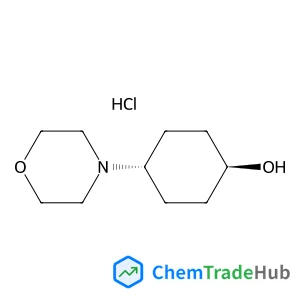
trans-4-(4-Morpholinyl)cyclohexanol hydrochloride (1:1)
CAS Number:
1588441-09-1
Molecular Formula:
C10H20ClNO2
Recommended Suppliers








Disclaimer
This page provides academic journal information for reference and research purposes only. We are not affiliated with any journal publishers and do not handle publication submissions. For publication-related inquiries, please contact the respective journal publishers directly.
If you notice any inaccuracies in the information displayed, please contact us at support@chemtradehub.com. We will promptly review and address your concerns.