












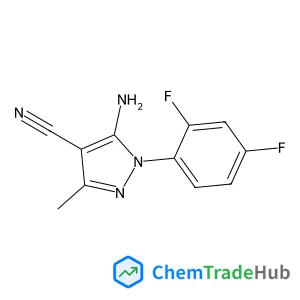
5-Amino-1-(2,4-difluorophenyl)-3-methyl-1H-pyrazole-4-carbonitrile
CAS Number:
1020057-92-4
Molecular Formula:
C11H8F2N4
Fayçal Allouti, Laurent Manceron, Mohammad Esmaïl Alikhani
The formation of Ni2O2 can be observed from the condensation of effusive beams of Ni and O2 in neon or argon matrices. Observation of 58Ni216O2, 58Ni60Ni16O2, 60Ni216O2, Ni218O2 and Ni216O18O isotopic data for five fundamental transitions enable a discussion of structural parameters for matrix-isolated Ni2O2 in its cyclic ground state. Analysis of the nickel isotopic effects on the 58,60Ni216O18O fundamentals suggest an elongated rhombic structure with a Ni–O bond force constant (240 ± 10 N m−1) and NiONi bond angles around 79°. The latter points to a Ni–Ni internuclear distance shorter than the O–O one. Low-lying singlet, triplet and quintet states have been studied using density functional theory with an unrestricted wave function and broken symmetry formalism. The high spin states and closed shell singlet states have been also investigated at the CCSD(T) level. The Ni2O2 ground state is calculated to be an antiferromagnetic singlet state with all the hybrid functionals. The first order properties (energies, geometry) calculated with a hybrid functional are very similar when different exchange–correlation functionals with different exact exchange fractions are used and the calculated ground state geometry (NiONi bond angle near 80°, NiO bond distance around 179.5 pm) is in good agreement with the experimental estimate. Nevertheless, a correct reproduction of the experimental vibrational properties is found only when a hybrid functional containing an exact exchange fraction in the 0.4–0.5 range is used. The orbital and topological bonding analyses of Ni2O2 reveal that the relatively short Ni–Ni internuclear distance within the molecule should not be interpreted as a remaining metal–metal bonding interaction, but clearly indicate that the bonding driving force is due to the formation of four strong and highly polarized Ni–O bonds. Even in such an early stage of metal oxidation, the Ni–Ni interaction has virtually disappeared.
Kyoungmin Min, Young-Han Shin
DOI: 10.1039/D0CP04974C
Junchao Huang, Chun Zhou, Zhaoqin Chu, Xu Liu
DOI: 10.1039/D0CP05306F
A. G. Chronis, F. I. Michos, C. S. Garoufalis, M. M. Sigalas
DOI: 10.1039/D0CP05780K
Yun Ni, Jia Li, Wei Tao, Hao Ding, Rui-Xue Li
DOI: 10.1039/D0CP05640E
Hamish Cavaye
DOI: 10.1039/D0CP06253G
Khalid Ahmed, Shaukatali Najikhan Inamdar, Nashiour Rohman, Adam A. Skelton
DOI: 10.1039/D0CP04498A
Miao Yan, Si-Dian Li
DOI: 10.1039/D0CP05385F
Qian Su, Lei Liu, Ting Ying, Li Dong, Weiguo Cheng
DOI: 10.1039/D0CP06041K
A. C. L. Pereira, K. S. Bezerra, J. L. S. Santos, J. I. N. Oliveira, V. N. Freire, U. L. Fulco
DOI: 10.1039/D0CP05322H
Pierre L. Stigliano, Nicolò Pianta, Simone Bonizzoni, Michele Mauri, Roberto Simonutti, Roberto Lorenzi, Barbara Vigani, Vittorio Berbenni, Silvia Rossi
DOI: 10.1039/D0CP04151C
Ethyl 4-chlorothieno[2,3-b]pyridine-5-carboxylate (CAS: 59713-58-5) can be synth...
5-Methyl-1H-indole-3-carbaldehyde (CAS: 52562-50-2) is subject to various regula...
(1,3-Dimethyl-2,4-dioxo-1,2,3,4-tetrahydro-5-pyrimidinyl)boronic acid is a white...
Waste containing Sulfocostunolide A (CAS: 1016983-51-9) should be handled with c...
When handling Murraxocin (CAS: 88478-44-8), ensure proper personal protective eq...
Formvar (CAS: 63148-64-1) is an alkyd resin characterized by a high molecular we...
(S)-4-benzyl-2-((benzyloxy)methyl)morpholine is generally safe when handled with...
Methyl 1-(5-bromo-2-pyrimidinyl)cyclopropanecarboxylate (CAS: 1447607-69-3) is p...
2-Methyl-1-phenyl-1-propanamine hydrochloride (CAS: 24290-47-9) is generally con...
3-(4-Bromophenyl)-2-methylpropanoic acid is synthesized through a multi-step pro...

Physical Chemistry Chemical Physics (PCCP) is an international journal co-owned by 19 physical chemistry and physics societies from around the world. This journal publishes original, cutting-edge research in physical chemistry, chemical physics and biophysical chemistry. To be suitable for publication in PCCP, articles must include significant innovation and/or insight into physical chemistry; this is the most important criterion that reviewers and Editors will judge against when evaluating submissions. The journal has a broad scope and welcomes contributions spanning experiment, theory, computation and data science. Topical coverage includes spectroscopy, dynamics, kinetics, statistical mechanics, thermodynamics, electrochemistry, catalysis, surface science, quantum mechanics, quantum computing and machine learning. Interdisciplinary research areas such as polymers and soft matter, materials, nanoscience, energy, surfaces/interfaces, and biophysical chemistry are welcomed if they demonstrate significant innovation and/or insight into physical chemistry. Joined experimental/theoretical studies are particularly appreciated when complementary and based on up-to-date approaches.
![9H-Fluoren-9-ylmethyl [(2S)-1-hydroxy-3-(1H-indol-3-yl)-2-propanyl]carbamate structure](https://static.chemtradehub.com/structs/153/153815-60-2-a67d.webp "9H-Fluoren-9-ylmethyl [(2S)-1-hydroxy-3-(1H-indol-3-yl)-2-propanyl]carbamate structure")

![2-(Methylsulfonyl)-2,4,5,6-tetrahydropyrrolo[3,4-c]pyrazole structure](https://static.chemtradehub.com/structs/122/1226781-80-1-09d5.webp "2-(Methylsulfonyl)-2,4,5,6-tetrahydropyrrolo[3,4-c]pyrazole structure")
![4-{1-[4-(4,4,5,5-Tetramethyl-1,3,2-dioxaborolan-2-yl)phenyl]cyclopropyl}morpholine structure](https://static.chemtradehub.com/structs/120/1206594-08-2-7afb.webp "4-{1-[4-(4,4,5,5-Tetramethyl-1,3,2-dioxaborolan-2-yl)phenyl]cyclopropyl}morpholine structure")





