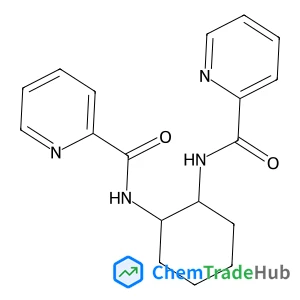
N,N'-(1R,2R)-1,2-Cyclohexanediyldi(2-pyridinecarboxamide)
CAS Number:
218290-24-5
Molecular Formula:
C18H20N4O2
Vincent Binette, Mohamed Haddad, Phuong Trang Nguyen, Sébastien Bélanger, Steve Bourgault, Charles Ramassamy, Roger Gaudreault, Normand Mousseau
The COVID-19 disease caused by the virus SARS-CoV-2, first detected in December 2019, is still emerging through virus mutations. Although almost under control in some countries due to effective vaccines that are mitigating the worldwide pandemic, the urgency to develop additional vaccines and therapeutic treatments is imperative. In this work, the natural polyphenols corilagin and 1,3,6-tri-O-galloy-β-D-glucose (TGG) are investigated to determine the structural basis of inhibitor interactions as potential candidates to inhibit SARS-CoV-2 viral entry into target cells. First, the therapeutic potential of the ligands are assessed on the ACE2/wild-type RBD. We first use molecular docking followed by molecular dynamics, to take into account the conformational flexibility that plays a significant role in ligand binding and that cannot be captured using only docking, and then analyze more precisely the affinity of these ligands using MMPBSA binding free energy. We show that both ligands bind to the ACE2/wild-type RBD interface with good affinities which might prevent the ACE2/RBD association. Second, we confirm the potency of these ligands to block the ACE2/RBD association using a combination of surface plasmon resonance and biochemical inhibition assays. These experiments confirm that TGG and, to a lesser extent, corilagin, inhibit the binding of RBD to ACE2. Both experiments and simulations show that the ligands interact preferentially with RBD, while weak binding is observed with ACE2, hence, avoiding potential physiological side-effects induced by the inhibition of ACE2. In addition to the wild-type RBD, we also study numerically three RBD mutations (E484K, N501Y and E484K/N501Y) found in the main SARS-CoV-2 variants of concerns. We find that corilagin could be as effective for RBD/E484K but less effective for the RBD/N501Y and RBD/E484K-N501Y mutants, while TGG strongly binds at relevant locations to all three mutants, demonstrating the significant interest of these molecules as potential inhibitors for variants of SARS-CoV-2.
Santosh Kumar Mishra
DOI: 10.1039/C9OB02439E
Masahiro Kubo, Ko Takase, Keiichi Noguchi, Koji Nakano
DOI: 10.1039/C9OB02681A
Hua Yao, Bo Xie, Xiaoyang Zhong, Shengzhou Jin, Sen Lin, Zhaohua Yan
DOI: 10.1039/D0OB00491J
Yue Qi, Fang Zhang, Lin Wang, Aili Feng, Rongxiu Zhu, Shutao Sun, Wei Li, Lei Liu
DOI: 10.1039/D0OB00551G
Diksha Haksar, Linda Quarles van Ufford, Roland J. Pieters
DOI: 10.1039/C9OB02369K
Azam Rahimi Niaraki, Mohammad Reza Saraee, Babak Kaboudin
DOI: 10.1039/C9OB02183C
Bhaskar Paul, Milan Maji, Kaushik Chakrabarti, Sabuj Kundu
DOI: 10.1039/C9OB02760B
6-Bromo-2-methylimidazo[1,2-a]pyrimidine (CAS: 1111638-05-1) falls under various...
While there are no direct alternatives, similar compounds like 1-Pyrrolidineetha...
4-Methyl-2,6-bis(2-methyl-2-propanyl)phenyl methylcarbamate (CAS: 1918-11-2) is ...
2-(3-Bromo-4-fluorophenyl)-1,3-dioxolane (CAS: 77771-04-1) should be stored in a...
4,5,6,7-Tetrahydro-1H-indazole hydrochloride is a white crystalline solid with a...
(2R)-1-Methoxy-3-phenyl-2-propanamine is a chiral organic compound with the CAS ...
Ethyl 1-(1-phenylethyl)-1H-imidazole-5-carboxylate is used in various industries...
4-[(1E,3S)-1-(4-Hydroxyphenyl)-1,4-pentadien-3-yl]phenol (CAS: 17676-24-3) falls...
(S)-3-Amino-5-phenylpentanoic acid hydrochloride is primarily used in the pharma...
7-Methoxy-1-benzothiophene-2-carboxylic acid is typically synthesized by reactin...

Physical Chemistry Chemical Physics (PCCP) is an international journal co-owned by 19 physical chemistry and physics societies from around the world. This journal publishes original, cutting-edge research in physical chemistry, chemical physics and biophysical chemistry. To be suitable for publication in PCCP, articles must include significant innovation and/or insight into physical chemistry; this is the most important criterion that reviewers and Editors will judge against when evaluating submissions. The journal has a broad scope and welcomes contributions spanning experiment, theory, computation and data science. Topical coverage includes spectroscopy, dynamics, kinetics, statistical mechanics, thermodynamics, electrochemistry, catalysis, surface science, quantum mechanics, quantum computing and machine learning. Interdisciplinary research areas such as polymers and soft matter, materials, nanoscience, energy, surfaces/interfaces, and biophysical chemistry are welcomed if they demonstrate significant innovation and/or insight into physical chemistry. Joined experimental/theoretical studies are particularly appreciated when complementary and based on up-to-date approaches.