













A first-principles study of phthalocyanine-based multifunctional spintronic molecular devices
Literature Information
Publication Date
2021-06-23
DOI
10.1039/D1CP01126J
Impact Factor
3.676
Authors
Yang Song, Chuan-Kui Wang, Guang-Ping Zhang
View Original
Abstract
In this study, using the first-principles method, we theoretically investigated the spin-dependent transport properties of a phthalocyanine (Pc) molecule, which is sandwiched between two zigzag-edged graphene nanoribbon (zGNR) electrodes. Owing to the spatial symmetry of the Pc molecule and spin splitting of zGNRs around Fermi energy, perfect spin filtering behavior is observed in designed molecular junctions. Meanwhile, the spin of electrons allowed through the device is right opposite to the spin polarization of zGNR electrodes. Further studies show that the spin filtering performance can be largely modulated by insetting different transition metal atoms (TM = Mn or Cr) into the central Pc molecule, and changing the spin-polarized direction of the TM atom leads to the spin filtering direction inversion. More intriguingly, the antiparallel magnetic configuration of two zGNR electrodes gives rise to the control of the conducting channel by bias polarization, which eventually leads to remarkable spin rectifying and giant magnetoresistance behaviors in transition metal phthalocyanine (TMPc) molecular junctions. The corresponding mechanisms are revealed by an analysis of spin-resolved transmission spectra, molecular projected self-consistent Hamiltonian and a projected density of states. These results are helpful in the design of TMPc-based multifunctional spin molecular devices.
Related Literature
Promiscuous zinc-dependent acylase-mediated carbon–carbon bond formation in organic media
Jian-Ming Xu, Fu Zhang, Bo-Kai Liu, Qi Wu, Xian-Fu Lin
2007-02-22
Communication
DOI: 10.1039/B700327G
Synthesis of para-methoxybenzyl (PMB) ethers under neutral conditions
Ernest O. Nwoye, Gregory B. Dudley
2007-02-26
Communication
DOI: 10.1039/B617926F
Nitrogen-doped magnetic carbon nanoparticles as catalyst supports for efficient recovery and recycling
Hyeonseok Yoon, Sungrok Ko, Jyongsik Jang
2007-03-05
Communication
DOI: 10.1039/B616660A
Template controlled synthesis of a coordinated [11]ane-P2CNHC macrocycle
Oliver Kaufhold, Andreas Stasch, Peter G. Edwards, F. Ekkehardt Hahn
2007-02-08
Communication
DOI: 10.1039/B617033A
Synthesis of molecular imprinted polymer coated photocatalysts with high selectivity
Xiantao Shen, Lihua Zhu, Jing Li, Heqing Tang
2007-02-15
Communication
DOI: 10.1039/B615303H
Human frataxin: iron and ferrochelatase binding surface
Krisztina Z. Bencze, Taejin Yoon, César Millán-Pacheco, Patrick B. Bradley, Nina Pastor, J. A. Cowan, Timothy L. Stemmler
2007-03-28
Communication
DOI: 10.1039/B703195E
Use of porous anodic alumina membranes as a nanometre-diameter column for high performance liquid chromatography
Tomohisa Yamashita, Shuji Kodama, Mikiya Ohto, Eriko Nakayama, Nobutaka Takayanagi, Tomoko Kemmei, Norio Teramae, Yukio Saito
2007-02-12
Communication
DOI: 10.1039/B615369K
DNA hybridization “turns on” electrocatalysis at gold electrodes
Lihua Wang, Dun Pan, Shiping Song, Chunhai Fan
2007-01-10
Communication
DOI: 10.1039/B615742D
Fabrication of silica-coated magnetic nanoparticles with highly photoluminescent lanthanide probes
Jungkweon Choi, Jin Chul Kim, Yong Bok Lee, In Seon Kim, Yong Ki Park, Nam Hwi Hur
2007-02-06
Communication
DOI: 10.1039/B617608A
Photochromism of 7-(N,N-diethylamino)-4′-hydroxyflavylium in a water–ionic liquid biphasic system
Fernando Pina, A. Jorge Parola, César A. T. Laia, Carlos A. M. Afonso
2007-02-08
Communication
DOI: 10.1039/B618169D
You might also like
Compound Q&A
What precautions should be taken when handling 2-Chloro-1,2-bis(4-methylphenyl)ethanone (CAS: 71193-32-3)?
When handling 2-Chloro-1,2-bis(4-methylphenyl)ethanone (CAS: 71193-32-3), it is ...
71193-32-32-Chloro-1,2-bis(4-m...
Compound Q&A
What industries use 4-Ethoxy-3-(5-methyl-4-oxo-7-propyl-1,4-dihydroimidazo[5,1-f][1,2,4]triazin-2-yl)benzenesulfonyl chloride (CAS: 224789-26-8)?
4-Ethoxy-3-(5-methyl-4-oxo-7-propyl-1,4-dihydroimidazo[5,1-f][1,2,4]triazin-2-yl...
224789-26-84-Ethoxy-3-(5-methyl...
Compound Q&A
How should Methyl 3-Oxo-4-Androsten-17-Carboxylate (CAS: 2681-55-2) be stored?
Methyl 3-Oxo-4-Androsten-17-Carboxylate (CAS: 2681-55-2) should be stored in a c...
2681-55-2Methyl 3-Oxo-4-Andro...
Compound Q&A
What are the main uses of (R)-3-Amino-4-(3-hexylphenylamino)-4-oxobutylphosphonic acid (CAS: 909725-61-7)?
(R)-3-Amino-4-(3-hexylphenylamino)-4-oxobutylphosphonic acid is primarily used i...
909725-61-7(R)-3-Amino-4-(3-hex...
Compound Q&A
What regulatory guidelines apply to 2-Methyl-2-propanyl 3-amino-3-carbamoyl-1-azetidinecarboxylate (CAS: 1254120-14-3)?
2-Methyl-2-propanyl 3-amino-3-carbamoyl-1-azetidinecarboxylate (CAS: 1254120-14-...
1254120-14-32-Methyl-2-propanyl ...
Compound Q&A
Are there alternatives to (E)-4-(tert-Butoxy)-4-oxobut-2-enoic acid (CAS: 135355-96-3) in synthesis?
There are alternative reagents that can be used in synthesis instead of (E)-4-(t...
135355-96-3(E)-4-(tert-Butoxy)-...
Compound Q&A
What are the physical and chemical properties of [2-(3-Chlorophenyl)-1,3-thiazol-4-yl]methanol (CAS: 121202-20-8)?
[2-(3-Chlorophenyl)-1,3-thiazol-4-yl]methanol (CAS: 121202-20-8) is a crystallin...
121202-20-8[2-(3-Chlorophenyl)-...
Compound Q&A
What is the market or research trend for Methyl (2S)-[(4S)-2,2-dimethyl-1,3-dioxolan-4-yl]{[(4-methylphenyl)sulfonyl]oxy}acetate (CAS: 166249-17-8)?
The market and research trends for Methyl (2S)-[(4S)-2,2-dimethyl-1,3-dioxolan-4...
166249-17-8Methyl (2S)-[(4S)-2,...
Compound Q&A
What is the market or research trend for 1-Bromo-2-isocyanatoethane (CAS: 42865-19-0)?
The market for 1-Bromo-2-isocyanatoethane (CAS: 42865-19-0) is driven by its use...
42865-19-01-Bromo-2-isocyanato...
Compound Q&A
What are the main uses of 4-Nitro-D-phenylalanine hydrochloride (CAS: 147065-06-3)?
4-Nitro-D-phenylalanine hydrochloride (CAS: 147065-06-3) is primarily used in re...
147065-06-34-Nitro-D-phenylalan...
Source Journal
Physical Chemistry Chemical Physics

CiteScore:
5.5
Self-citation Rate:
10.3%
Articles per Year:
3036
Physical Chemistry Chemical Physics (PCCP) is an international journal co-owned by 19 physical chemistry and physics societies from around the world. This journal publishes original, cutting-edge research in physical chemistry, chemical physics and biophysical chemistry. To be suitable for publication in PCCP, articles must include significant innovation and/or insight into physical chemistry; this is the most important criterion that reviewers and Editors will judge against when evaluating submissions. The journal has a broad scope and welcomes contributions spanning experiment, theory, computation and data science. Topical coverage includes spectroscopy, dynamics, kinetics, statistical mechanics, thermodynamics, electrochemistry, catalysis, surface science, quantum mechanics, quantum computing and machine learning. Interdisciplinary research areas such as polymers and soft matter, materials, nanoscience, energy, surfaces/interfaces, and biophysical chemistry are welcomed if they demonstrate significant innovation and/or insight into physical chemistry. Joined experimental/theoretical studies are particularly appreciated when complementary and based on up-to-date approaches.
Recommended Compounds
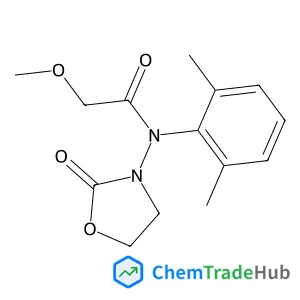
N-(2,6-Dimethylphenyl)-2-methoxy-N-(2-oxo-1,3-oxazolidin-3-yl)acetamide
CAS Number:
77732-09-3
Molecular Formula:
C14H18N2O4

Recommended Suppliers





Disclaimer
This page provides academic journal information for reference and research purposes only. We are not affiliated with any journal publishers and do not handle publication submissions. For publication-related inquiries, please contact the respective journal publishers directly.
If you notice any inaccuracies in the information displayed, please contact us at support@chemtradehub.com. We will promptly review and address your concerns.