












Photochromism of 7-(N,N-diethylamino)-4′-hydroxyflavylium in a water–ionic liquid biphasic system
Literature Information
Publication Date
2007-02-08
DOI
10.1039/B618169D
Impact Factor
6.222
Authors
Fernando Pina, A. Jorge Parola, César A. T. Laia, Carlos A. M. Afonso
View Original
Abstract
Photochromism of trans-4-(N,N-diethylamino)-2,4′-dihydroxychalcone, with formation of the photoproduct 7-(N,N-diethylamino)-4′-hydroxyflavylium, is promoted in the ionic liquid phase of a water/[bmim][PF6] biphasic system.
Related Literature
Enhanced dihydrogen adsorption in symmetry-lowered metal–porphyrin-containing frameworks
Y. Y. Sun, Woon Ih Choi, Joongoo Kang, S. B. Zhang
2009-09-25
Paper
DOI: 10.1039/B913711D
Editorial Highlight: Molecules in confined spaces
Bert M. Weckhuysen
2009-03-24
Paper
DOI: 10.1039/B905015A
Physical chemistry of solids—the science behind materials engineering
2009-03-31
Editorial
DOI: 10.1039/B905911N
Facilitated search of proteins on DNA: correlations are important
Rahul K. Das, Anatoly B. Kolomeisky
2010-02-05
Paper
DOI: 10.1039/B921303A
Computational identification of a metal organic framework for high selectivity membrane-based CO2/CH4 separations: Cu(hfipbb)(H2hfipbb)0.5
Taku Watanabe, Seda Keskin, Sankar Nair, David S. Sholl
2009-10-29
Communication
DOI: 10.1039/B918254N
An experimental confirmation of the products of the reaction between CN radicals and NH3
Mark A. Blitz, Paul W. Seakins, Ian W. M. Smith
2009-10-20
Communication
DOI: 10.1039/B917734E
An investigation of slow charge separation in a Tyrosine M210 to Tryptophan mutant of the Rhodobacter sphaeroidesreaction center by femtosecond mid-infrared spectroscopy
Natalia P. Pawlowicz, Ivo H. M. van Stokkum, Jacques Breton, Rienk van Grondelle, Michael R. Jones
2010-01-28
Paper
DOI: 10.1039/B905934B
Graph–topological approach to magnetic properties of benzenoid hydrocarbons‡
Tadeusz M. Krygowski, Michał K. Cyrański, Michał A. Dobrowolski, Jun-ichi Aihara
2009-10-26
Paper
DOI: 10.1039/B913895A
Chirality transition in the epoxidation of (−)-α-pinene and successive hydrolysis studied by Raman optical activity and DFT
Zhaochi Feng, Can Li
2010-02-09
Paper
DOI: 10.1039/B919993D
A new route for local probing of inner interactions within a layered double hydroxide/benzene derivative hybrid material
S. Fleutot, J. C. Dupin, I. Baraille, C. Forano, G. Renaudin, F. Leroux, D. Gonbeau, H. Martinez
2009-03-02
Paper
DOI: 10.1039/B818730D
You might also like
Compound Q&A
What precautions should be taken when handling 2-Chloro-1,2-bis(4-methylphenyl)ethanone (CAS: 71193-32-3)?
When handling 2-Chloro-1,2-bis(4-methylphenyl)ethanone (CAS: 71193-32-3), it is ...
71193-32-32-Chloro-1,2-bis(4-m...
Compound Q&A
What industries use 4-Ethoxy-3-(5-methyl-4-oxo-7-propyl-1,4-dihydroimidazo[5,1-f][1,2,4]triazin-2-yl)benzenesulfonyl chloride (CAS: 224789-26-8)?
4-Ethoxy-3-(5-methyl-4-oxo-7-propyl-1,4-dihydroimidazo[5,1-f][1,2,4]triazin-2-yl...
224789-26-84-Ethoxy-3-(5-methyl...
Compound Q&A
How should Methyl 3-Oxo-4-Androsten-17-Carboxylate (CAS: 2681-55-2) be stored?
Methyl 3-Oxo-4-Androsten-17-Carboxylate (CAS: 2681-55-2) should be stored in a c...
2681-55-2Methyl 3-Oxo-4-Andro...
Compound Q&A
What are the main uses of (R)-3-Amino-4-(3-hexylphenylamino)-4-oxobutylphosphonic acid (CAS: 909725-61-7)?
(R)-3-Amino-4-(3-hexylphenylamino)-4-oxobutylphosphonic acid is primarily used i...
909725-61-7(R)-3-Amino-4-(3-hex...
Compound Q&A
What regulatory guidelines apply to 2-Methyl-2-propanyl 3-amino-3-carbamoyl-1-azetidinecarboxylate (CAS: 1254120-14-3)?
2-Methyl-2-propanyl 3-amino-3-carbamoyl-1-azetidinecarboxylate (CAS: 1254120-14-...
1254120-14-32-Methyl-2-propanyl ...
Compound Q&A
Are there alternatives to (E)-4-(tert-Butoxy)-4-oxobut-2-enoic acid (CAS: 135355-96-3) in synthesis?
There are alternative reagents that can be used in synthesis instead of (E)-4-(t...
135355-96-3(E)-4-(tert-Butoxy)-...
Compound Q&A
What are the physical and chemical properties of [2-(3-Chlorophenyl)-1,3-thiazol-4-yl]methanol (CAS: 121202-20-8)?
[2-(3-Chlorophenyl)-1,3-thiazol-4-yl]methanol (CAS: 121202-20-8) is a crystallin...
121202-20-8[2-(3-Chlorophenyl)-...
Compound Q&A
What is the market or research trend for Methyl (2S)-[(4S)-2,2-dimethyl-1,3-dioxolan-4-yl]{[(4-methylphenyl)sulfonyl]oxy}acetate (CAS: 166249-17-8)?
The market and research trends for Methyl (2S)-[(4S)-2,2-dimethyl-1,3-dioxolan-4...
166249-17-8Methyl (2S)-[(4S)-2,...
Compound Q&A
What is the market or research trend for 1-Bromo-2-isocyanatoethane (CAS: 42865-19-0)?
The market for 1-Bromo-2-isocyanatoethane (CAS: 42865-19-0) is driven by its use...
42865-19-01-Bromo-2-isocyanato...
Compound Q&A
What are the main uses of 4-Nitro-D-phenylalanine hydrochloride (CAS: 147065-06-3)?
4-Nitro-D-phenylalanine hydrochloride (CAS: 147065-06-3) is primarily used in re...
147065-06-34-Nitro-D-phenylalan...
Source Journal
Chemical Communications

CiteScore:
8.6
Self-citation Rate:
4.7%
Articles per Year:
2458
ChemComm publishes urgent research which is of outstanding significance and interest to experts in the field, while also appealing to the journal’s broad chemistry readership. Our communication format is ideally suited to short, urgent studies that are of such importance that they require accelerated publication. Our scope covers all topics in chemistry, and research at the interface of chemistry and other disciplines (such as materials science, nanoscience, physics, engineering and biology) where there is a significant novelty in the chemistry aspects. Major topic areas covered include: Analytical Chemistry Catalysis Chemical Biology and medicinal chemistry Computational Chemistry and Machine Learning Energy and sustainable chemistry Environmental Chemistry Green Chemistry Inorganic Chemistry Materials Chemistry Nanoscience Organic Chemistry Physical Chemistry Polymer Chemistry Supramolecular Chemistry
Recommended Compounds
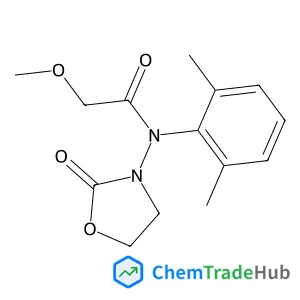
N-(2,6-Dimethylphenyl)-2-methoxy-N-(2-oxo-1,3-oxazolidin-3-yl)acetamide
CAS Number:
77732-09-3
Molecular Formula:
C14H18N2O4
Recommended Suppliers





Disclaimer
This page provides academic journal information for reference and research purposes only. We are not affiliated with any journal publishers and do not handle publication submissions. For publication-related inquiries, please contact the respective journal publishers directly.
If you notice any inaccuracies in the information displayed, please contact us at support@chemtradehub.com. We will promptly review and address your concerns.