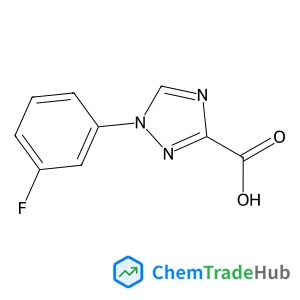
1-(3-Fluorophenyl)-1H-1,2,4-triazole-3-carboxylic acid
CAS Number:
1292369-51-7
Molecular Formula:
C9H6FN3O2
Juan Carlos San Vicente Veliz, Debasish Koner, Raymond J. Bemish
Thermal rates for the C(3P) + O2(3Σg−) ↔ CO(1Σ+)+ O(1D)/O(3P) reaction are investigated over a wide temperature range based on quasi classical trajectory (QCT) simulations on 3-dimensional, reactive potential energy surfaces (PESs) for the 1A′, (2)1A′, 1A′′, 3A′ and 3A′′ states. These five states are the energetically low-lying states of CO2 and their PESs are computed at the MRCISD+Q/aug-cc-pVTZ level of theory using a state-average CASSCF reference wave function. Analysis of the different electronic states for the CO2 → CO + O dissociation channel rationalizes the topography of this region of the PESs. The forward rates from QCT simulations match measurements between 15 K and 295 K whereas the equilibrium constant determined from the forward and reverse rates is consistent with that derived from statistical mechanics at high temperature. Vibrational relaxation, O + CO(ν = 1,2) → O + CO(ν = 0), is found to involve both, non-reactive and reactive processes. The contact time required for vibrational relaxation to take place is τ ≥ 150 fs for non-reacting and τ ≥ 330 fs for reacting (oxygen atom exchange) trajectories and the two processes are shown to probe different parts of the global potential energy surface. In agreement with experiments, low collision energy reactions for the C(3P) + O2(3Σg−, ν = 0) → CO(1Σ+) + O(1D) lead to CO(1Σ+, ν′ = 17) with an onset at Ec ∼ 0.15 eV, dominated by the 1A′ surface with contributions from the 3A′ surface. Finally, the barrier for the COA(1Σ+) + OB(3P) → COB(1Σ+) + OA(3P) atom exchange reaction on the 3A′ PES yields a barrier of ∼7 kcal mol−1 (0.300 eV), consistent with an experimentally reported value of 6.9 kcal mol−1 (0.299 eV).
Zheng-Chang Xiong
DOI: 10.1039/B304527G
Thibault Cantat, Nicolas Mézailles, Nicole Maigrot, Louis Ricard, Pascal Le Floch
DOI: 10.1039/B403436H
Karim M. Awenat, Philip J. Davis, Mark G. Moloney, Warren Ebenezer
DOI: 10.1039/B414856H
Firasat Hussain, Ulrich Kortz
DOI: 10.1039/B415901B
Cristina Carcedo, Athanasia Dervisi, Ian A. Fallis, Liling Ooi, K. M. Abdul Malik
DOI: 10.1039/B401301H
Jochen Antesberger, Gareth W. V. Cave, Matthew C. Ferrarelli, Michael W. Heaven, Colin L. Raston, Jerry L. Atwood
DOI: 10.1039/B412251H
Olga Taran, Anatoly K. Yatsimirsky
DOI: 10.1039/B402432J
Takashi Nakahata, Shigefumi Kuwahara
DOI: 10.1039/B416309E
Soon Bong Park, Howard Alper
DOI: 10.1039/B402477J
Waste containing N-Methoxy-N-methyl-1,3-thiazole-5-carboxamide (CAS: 898825-89-3...
N-(4-Biphenylyl)dibenzo[b,d]furan-4-amine should be stored in a tightly sealed c...
The market for 3-Acetamido-5-amino-2,4,6-triiodobenzoic acid (CAS: 1713-07-1) is...
Benzyl 2-O-acetyl-3,4,6-tri-O-benzyl-beta-D-galactopyranoside (CAS: 61820-03-9) ...
2-Ethylpiperazine dihydrochloride (CAS: 438050-52-3) is regulated under the Glob...
1,1'-[1,3-Phenylenebis(methylene)]bis(3-methyl-1H-pyrrole-2,5-dione) (CAS: 11946...
Several alternatives can be used in the synthesis of 5-Fluoro-2-(1-pyrrolidinyl)...
Proper personal protective equipment (PPE) must be worn when handling this compo...
When handling 6-Bromoimidazo[1,2-a]pyridin-8-amine, it is important to wear appr...
Alternatives to (2S,4R)-4-(4-Nitrobenzyl)pyrrolidine-2-carboxylic acid hydrochlo...

Physical Chemistry Chemical Physics (PCCP) is an international journal co-owned by 19 physical chemistry and physics societies from around the world. This journal publishes original, cutting-edge research in physical chemistry, chemical physics and biophysical chemistry. To be suitable for publication in PCCP, articles must include significant innovation and/or insight into physical chemistry; this is the most important criterion that reviewers and Editors will judge against when evaluating submissions. The journal has a broad scope and welcomes contributions spanning experiment, theory, computation and data science. Topical coverage includes spectroscopy, dynamics, kinetics, statistical mechanics, thermodynamics, electrochemistry, catalysis, surface science, quantum mechanics, quantum computing and machine learning. Interdisciplinary research areas such as polymers and soft matter, materials, nanoscience, energy, surfaces/interfaces, and biophysical chemistry are welcomed if they demonstrate significant innovation and/or insight into physical chemistry. Joined experimental/theoretical studies are particularly appreciated when complementary and based on up-to-date approaches.