











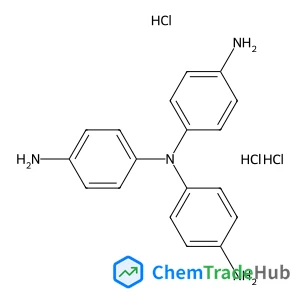
N1,N1-Bis(4-aminophenyl)benzene-1,4-diamine trihydrochloride
CAS Number:
114254-48-7
Molecular Formula:
C18H21Cl3N4
Dengpan Dong, Samhitha Kancharla, Justin Hooper, Marina Tsianou, Dmitry Bedrov, Paschalis Alexandridis
Surface active per- and polyfluoroalkyl substances (PFAS) released in the environment generate great concern in the US and worldwide. The sequestration of PFAS amphiphiles from aqueous media can be limited by their strong tendency to form micelles that plug the pores in the adsorbent material, rendering most of the active surface inaccessible. A joint experimental and simulation approach has been used to investigate the structure of perfluorooctanoate ammonium (PFOA) micelles in aqueous solutions, focusing on the understanding of ethanol addition on PFOA micelle formation and structure. Structurally compact and slightly ellipsoidal in shape, PFOA micelles in pure water become more diffuse with increasing ethanol content, and break into smaller PFOA clusters in aqueous solutions with high ethanol concentration. A transition from a co-surfactant to a co-solvent behavior with the increase of ethanol concentration has been observed by both experiments and simulations, while the latter also provide insight on how to achieve co-solvent conditions with other additives. An improved understanding of how to modulate PFAS surfactant self-assembly in water can inform the fate and transport of PFAS in the environment and the PFAS sequestration from aqueous media.
Subramaniyan Prasanna Kumari, Subbiah Thamotharan, Subramaniapillai Selva Ganesan
DOI: 10.1039/D3NJ05462D
Lei Zhao, Tingting Yang, Pei Xiong, Xiaobin Niu, Jinxia Jiang, Qian Xue, Le Yu, Rui Wu
DOI: 10.1039/D3TA04591A
Jiayong Xiao, Hao Dong, Hui Zhang, Haolan Yang, Ming Qiu, Ying Yu
DOI: 10.1039/D3TA05834D
Vsevolod Dubovik, Anna Dalinova, Alexander Berestetskiy
DOI: 10.1039/D3NP00013C
Musa Dirak, Jefferson Chan, Safacan Kolemen
DOI: 10.1039/D3TB02468G
Li Feng, Hanping Fu, Tianxiang Zhang, Qing Zhang, Shufen Ren, Jiayun Cheng, Qingshuang Liang, Xiufeng Xiao
DOI: 10.1039/D3NJ03815G
Yosuke Nakazono, Ryota Inoue, Ryo Sumitani
DOI: 10.1039/D3NJ05633C
Shuai Ma
DOI: 10.1039/D3TA04953A
Waste containing N-Methoxy-N-methyl-1,3-thiazole-5-carboxamide (CAS: 898825-89-3...
N-(4-Biphenylyl)dibenzo[b,d]furan-4-amine should be stored in a tightly sealed c...
The market for 3-Acetamido-5-amino-2,4,6-triiodobenzoic acid (CAS: 1713-07-1) is...
Benzyl 2-O-acetyl-3,4,6-tri-O-benzyl-beta-D-galactopyranoside (CAS: 61820-03-9) ...
2-Ethylpiperazine dihydrochloride (CAS: 438050-52-3) is regulated under the Glob...
1,1'-[1,3-Phenylenebis(methylene)]bis(3-methyl-1H-pyrrole-2,5-dione) (CAS: 11946...
Several alternatives can be used in the synthesis of 5-Fluoro-2-(1-pyrrolidinyl)...
Proper personal protective equipment (PPE) must be worn when handling this compo...
When handling 6-Bromoimidazo[1,2-a]pyridin-8-amine, it is important to wear appr...
Alternatives to (2S,4R)-4-(4-Nitrobenzyl)pyrrolidine-2-carboxylic acid hydrochlo...

Physical Chemistry Chemical Physics (PCCP) is an international journal co-owned by 19 physical chemistry and physics societies from around the world. This journal publishes original, cutting-edge research in physical chemistry, chemical physics and biophysical chemistry. To be suitable for publication in PCCP, articles must include significant innovation and/or insight into physical chemistry; this is the most important criterion that reviewers and Editors will judge against when evaluating submissions. The journal has a broad scope and welcomes contributions spanning experiment, theory, computation and data science. Topical coverage includes spectroscopy, dynamics, kinetics, statistical mechanics, thermodynamics, electrochemistry, catalysis, surface science, quantum mechanics, quantum computing and machine learning. Interdisciplinary research areas such as polymers and soft matter, materials, nanoscience, energy, surfaces/interfaces, and biophysical chemistry are welcomed if they demonstrate significant innovation and/or insight into physical chemistry. Joined experimental/theoretical studies are particularly appreciated when complementary and based on up-to-date approaches.
![2-Methyl-2-propanyl {3-[4-(4,4,5,5-tetramethyl-1,3,2-dioxaborolan-2-yl)phenyl]-3-oxetanyl}carbamate structure](https://static.chemtradehub.com/structs/127/1279090-25-3-1b84.webp "2-Methyl-2-propanyl {3-[4-(4,4,5,5-tetramethyl-1,3,2-dioxaborolan-2-yl)phenyl]-3-oxetanyl}carbamate structure")

![tert-Butyl 6-chloro-4-oxospiro[chroman-2,4'-piperidine]-1'-carboxylate structure](https://static.chemtradehub.com/structs/101/1011482-37-3-88a5.webp "tert-Butyl 6-chloro-4-oxospiro[chroman-2,4'-piperidine]-1'-carboxylate structure")
![2-(7,7-Difluorobicyclo[4.1.0]hept-1-yl)ethanamine structure](https://static.chemtradehub.com/structs/209/2098065-08-6-ff24.webp "2-(7,7-Difluorobicyclo[4.1.0]hept-1-yl)ethanamine structure")




