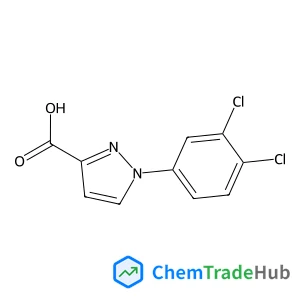
1-(3,4-Dichlorophenyl)-1H-pyrazole-3-carboxylic acid
CAS Number:
1152949-12-6
Molecular Formula:
C10H6Cl2N2O2
Vsevolod Dubovik, Anna Dalinova, Alexander Berestetskiy
Covering: 2012 to 2022 Ten-membered lactones (TMLs) are an interesting and diverse group of natural polyketides that are abundant in fungi and, to a lesser extent, in bacteria, marine organisms, and insects. TMLs are known for their ability to exhibit a wide spectrum of biological activity, including phytotoxic, cytotoxic, antifungal, antibacterial, and others. However, the random discovery of these compounds by scientific groups with various interests worldwide has resulted in patchy information about their distribution among different organisms and their biological activity. Therefore, despite more than 60 years of research history, there is still no common understanding of the natural sources of TMLs, their structural type classification, and most characteristic biological activities. The controversial nomenclature, incorrect or erroneous structure elucidation, poor identification of producing organisms, and scattered information on the biological activity of compounds – all these factors have led to the problems with dereplication and the directed search for TMLs. This review consists of two parts: the first part (Section 2) covers 104 natural TMLs, published between 2012 and 2022 (after the publishing of the previous review), and the second part (Section 3) summarizes information about 214 TMLs described during 1964–2022 and as a result highlights the main problems and trends in the study of these intriguing natural products.
Alessandro Grottesi
DOI: 10.1039/D3CP05530B
Siqi Wang, Mingmin Zhong, Haibo Liu, Meng Ju
DOI: 10.1039/D3CP03678B
Qian Wang, Yu Zhuang, Abuduwayiti Aierken, Qiaogang Song, Qin Zhang, Youbo Dou, Qiuli Zhang, Shuyi Zhang
DOI: 10.1039/D3CP05309A
Bayram Deviren, Seyma Akkaya Deviren, Tevfik Fikret Yagmuroglu
DOI: 10.1039/D3CP04785G
Jing Xie, Dongni Wu, Yangfang Liao, Xiaolong Cao, Shiyou Zhou
DOI: 10.1039/D3CP04382G
Miwako Teranishi, Shin-ichi Naya, Hiroaki Tada
DOI: 10.1039/D3SE01513K
Zifeng Song, Haoliang Liu, Baiyi Chen, Qin Jiang, Fengxiang Sui, Kai Wu, Yonghong Cheng, Bing Xiao
DOI: 10.1039/D3CP05035A
Cesare M. Baronio, Andreas Barth
DOI: 10.1039/D3CP02018E
D. C. Malaspina, J. P. Larentzos, J. K. Brennan, A. D. Mackie, J. Bonet Avalos
DOI: 10.1039/D3CP03791F
Waste containing N-Methoxy-N-methyl-1,3-thiazole-5-carboxamide (CAS: 898825-89-3...
N-(4-Biphenylyl)dibenzo[b,d]furan-4-amine should be stored in a tightly sealed c...
The market for 3-Acetamido-5-amino-2,4,6-triiodobenzoic acid (CAS: 1713-07-1) is...
Benzyl 2-O-acetyl-3,4,6-tri-O-benzyl-beta-D-galactopyranoside (CAS: 61820-03-9) ...
2-Ethylpiperazine dihydrochloride (CAS: 438050-52-3) is regulated under the Glob...
1,1'-[1,3-Phenylenebis(methylene)]bis(3-methyl-1H-pyrrole-2,5-dione) (CAS: 11946...
Several alternatives can be used in the synthesis of 5-Fluoro-2-(1-pyrrolidinyl)...
Proper personal protective equipment (PPE) must be worn when handling this compo...
When handling 6-Bromoimidazo[1,2-a]pyridin-8-amine, it is important to wear appr...
Alternatives to (2S,4R)-4-(4-Nitrobenzyl)pyrrolidine-2-carboxylic acid hydrochlo...

Natural Product Reports (NPR) is a critical review journal that stimulates progress in all areas of natural products research, including isolation, structural and stereochemical determination, biosynthesis, biological activity and synthesis. The scope of the journal is very broad, and many reviews discuss the role of natural products in the wider bioinorganic, bioorganic and chemical biology communities. Areas covered include the following: Enzymology Nucleic acids Genetics Chemical ecology Carbohydrates Primary and secondary metabolism Analytical techniques NPR articles are designed to give an interesting insight into the topic, focusing on the key developments that have shaped a field. Authors are encouraged to include their own perspective on developments, trends and future directions. Articles providing a very comprehensive overview or exhaustive list of previous literature and lacking critical insight are generally not suitable for publication in NPR. Meta-analyses of previously published data using existing tools can be included, however NPR articles should not include any new methods or data.
![tert-Butyl 6-chloro-4-oxospiro[chroman-2,4'-piperidine]-1'-carboxylate structure](https://static.chemtradehub.com/structs/101/1011482-37-3-88a5.webp "tert-Butyl 6-chloro-4-oxospiro[chroman-2,4'-piperidine]-1'-carboxylate structure")