


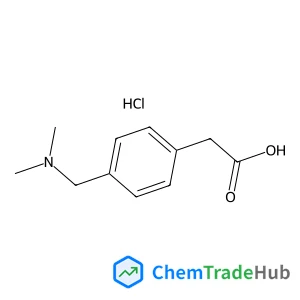
4-(Dimethylaminomethyl)phenylacetic acid hydrochloride
CAS Number:
99985-52-1
Molecular Formula:
C11H16ClNO2
Lei Zhao, Tingting Yang, Pei Xiong, Xiaobin Niu, Jinxia Jiang, Qian Xue, Le Yu, Rui Wu
PtZn is a promising catalyst candidate for the oxygen reduction reaction (ORR) due to its low intermetallic formation energy and high potential stability under reaction conditions. However, the fully occupied electron configuration of Zn (3d104S2) reduces its affinity for surface oxygen species, thus limiting its ORR activity. Herein, we propose a straightforward strategy to prepare small-size PtZn intermetallic nanoparticles supported on a porous carbon that contains atomically dispersed Co anchored at N–C sites (PtZn–CoNC). The coupled PtZn–CoNC catalyst delivers superior ORR activity and remarkable durability with a half-wave potential variation of just 5 mV after 30 000 cycles. The high ORR performance of PtZn–CoNC is associated with the strong metal–support interaction between the PtZn nanoparticles and atomically dispersed Co sites (Co–Nx), as well as the confinement effect of the porous carbon substrate. Density functional theory calculations reveal that Co–Nx sites can adjust the electronic structure of Pt to further optimize the binding energies of oxygen-containing intermediates, thus enhancing ORR activity.

Biocatalysis and Biotransformation

Colloid Journal

Heteroatom Chemistry

Polycyclic Aromatic Compounds

NDT & E International

Critical Reviews in Solid State and Materials Sciences

Journal of Chemical Sciences

Journal of Asian Natural Products Research

Topics in Catalysis

Journal of the Indian Institute of Science
Martí López, Luke Broderick, John J. Carey, Francesc Viñes, Michael Nolan, Francesc Illas
DOI: 10.1039/C8CP03648A
Zicheng Wang, Shuzhou Li, Yaping Zhang, Huaizhe Xu
DOI: 10.1039/C7CP07960E
Jing Xu, Véronique Perraud, Barbara J. Finlayson-Pitts
DOI: 10.1039/C8CP03634A
DOI: 10.1039/C7CP06621J
Andrea Arsiccio, Roberto Pisano
DOI: 10.1039/C7CP08029H
Chunxiao Wu, Shanfu Lu, Jin Zhang, Yan Xiang
DOI: 10.1039/C7CP07744K
Nirmali Prabha Das, Brigitta Müller, Ágota Tóth, Dezső Horváth, Gábor Schuszter
DOI: 10.1039/C8CP01798K
Qian-Rui Huang, Ying-Cheng Li, Kun-Lin Ho, Jer-Lai Kuo
DOI: 10.1039/C8CP00533H
Hung Tan Pham, Thi Tuyet Mai Dang, Long Van Duong
DOI: 10.1039/C8CP00380G
Lei Wang, Zhaoxiang Dai, Rulong Zhou
DOI: 10.1039/C8CP02569J
Waste containing N-Methoxy-N-methyl-1,3-thiazole-5-carboxamide (CAS: 898825-89-3...
N-(4-Biphenylyl)dibenzo[b,d]furan-4-amine should be stored in a tightly sealed c...
The market for 3-Acetamido-5-amino-2,4,6-triiodobenzoic acid (CAS: 1713-07-1) is...
Benzyl 2-O-acetyl-3,4,6-tri-O-benzyl-beta-D-galactopyranoside (CAS: 61820-03-9) ...
2-Ethylpiperazine dihydrochloride (CAS: 438050-52-3) is regulated under the Glob...
1,1'-[1,3-Phenylenebis(methylene)]bis(3-methyl-1H-pyrrole-2,5-dione) (CAS: 11946...
Several alternatives can be used in the synthesis of 5-Fluoro-2-(1-pyrrolidinyl)...
Proper personal protective equipment (PPE) must be worn when handling this compo...
When handling 6-Bromoimidazo[1,2-a]pyridin-8-amine, it is important to wear appr...
Alternatives to (2S,4R)-4-(4-Nitrobenzyl)pyrrolidine-2-carboxylic acid hydrochlo...

Journal of Materials Chemistry A, B & C cover high quality studies across all fields of materials chemistry. The journals focus on those theoretical or experimental studies that report new understanding, applications, properties and synthesis of materials. The journals have a strong history of publishing quality reports of interest to interdisciplinary communities and providing an efficient and rigorous service through peer review and publication. The journals are led by an international team of Editors-in-Chief and Associate Editors who are all active researchers in their fields. Journal of Materials Chemistry A, B & C are separated by the intended application of the material studied. Broadly, applications in energy and sustainability are of interest to Journal of Materials Chemistry A, applications in biology and medicine are of interest to Journal of Materials Chemistry B, and applications in optical, magnetic and electronic devices are of interest to Journal of Materials Chemistry C. More than one Journal of Materials Chemistry journal may be suitable for certain fields and researchers are encouraged to submit their paper to the journal that they feel best fits for their particular article. Example topic areas within the scope of Journal of Materials Chemistry A are listed below. This list is neither exhaustive nor exclusive. Artificial photosynthesis Batteries Carbon dioxide conversion Catalysis Fuel cells Gas capture/separation/storage Green/sustainable materials Hydrogen generation Hydrogen storage Photocatalysis Photovoltaics Self-cleaning materials Self-healing materials Sensors Supercapacitors Thermoelectrics Water splitting Water treatment

![2-(7,7-Difluorobicyclo[4.1.0]hept-1-yl)ethanamine structure](https://static.chemtradehub.com/structs/209/2098065-08-6-ff24.webp "2-(7,7-Difluorobicyclo[4.1.0]hept-1-yl)ethanamine structure")



