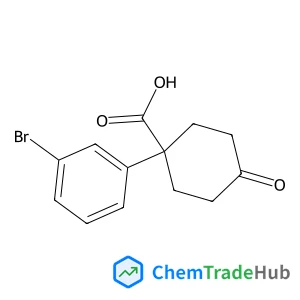
1-(3-Bromophenyl)-4-oxocyclohexanecarboxylic acid
CAS Number:
1385694-53-0
Molecular Formula:
C13H13BrO3
Chunyan Li
As an alternative renewable energy, upgraded biogas by separating CH4 and CO2 can be used to replace natural gas in automobiles and power grids. Adsorption using solid amine adsorbents is a promising technology for CO2 separation, yet the high cost and complex preparation of support materials have seriously hindered its industrial application. In this study, we developed a green and economical method to prepare nano-SiO2 supports and silica-based solid amine adsorbents; i.e., coal fly ash (CFA) derived nano-SiO2 supports, produced using CO2-assisted precipitation technology without adding templates or pore-expanding agents, were impregnated with polyethylenimine (PEI) to synthesize PEI@nano-SiO2 adsorbents for biogas upgrading via adsorbing CO2. The as-synthesized “40%-PEI@SiO2-6%” adsorbent possessed an initial CO2 uptake of 131 mg g−1 under simulated biogas flow, and showed high adsorption selectivity with a CH4 uptake of <1.0 mg g−1. “40%-PEI@SiO2-6%” also exhibited excellent stability under an Ar regeneration atmosphere with only 2.4% decay after 50 cycles; even under a severe regeneration atmosphere of CO2, it still showed competitively high cycling stability. The larger pore volume and the higher hydroxyl density were beneficial for enhancing the CO2 diffusion and PEI loading, and thus improved the CO2 adsorption capacity. The higher hydroxyl density could also promote the conversion of –NH2 to –NH–, which could resist the deactivation caused by the formation of urea compounds, and thus improved the cycling stability of “40%-PEI@SiO2-6%”. Therefore, the use of efficient PEI@nano-SiO2 adsorbents derived from CFA appears to be a promising strategy for biogas upgrading.
Jing Zhang, Milan Gembicky, Marc Messerschmidt, Philip Coppens
DOI: 10.1039/B700073A
Nian Lin, Alexander Langner, Steven L. Tait, Chandrasekar Rajadurai, Mario Ruben
DOI: 10.1039/B712082F
Mingwang Shao, Hui Hu, Min Li, Huizhao Ban, Mengya Wang, Juan Jiang
DOI: 10.1039/B613473D
Jun Shan, Heikki Tenhu
DOI: 10.1039/B707740H
Alexey A. Goryunkov, Ilya N. Ioffe, Pavel A. Khavrel, Stanislav M. Avdoshenko, Vitaly Yu. Markov, Z. Mazej, Lev N. Sidorov, Sergey I. Troyanov
DOI: 10.1039/B615457C
Veejendra K. Yadav, Naganaboina Vijaya Kumar, Masood Parvez
DOI: 10.1039/B700246G
David Díaz Díaz, Tomás Torres, Rudolf Zentel, Riju Davis, Martin Brehmer
DOI: 10.1039/B703685J
Nelly Bonnet, David O'Hagan, Georg Hähner
DOI: 10.1039/B712968H
Yasuharu Yoshimi, Tatsuya Itou, Minoru Hatanaka
DOI: 10.1039/B714526H
4-Amino-3-bromophenol (CAS: 74440-80-5) falls under the classification of a haza...
(17beta)-3-Oxoestr-4-en-17-yl acetate should be stored in a cool, dry place away...
2-[(2,2-Diethoxyethyl)disulfanyl]-1,1-diethoxyethane (CAS: 76505-71-0) is a colo...
The market and research for 1-(β-D-ribofuranosyl)-1H-imidazo[4,5-c]pyridin-4-ami...
Waste containing Conjugated Estrogen (CAS: 12126-59-9) should be collected and d...
The market for Bis(2,2,2-trifluoroethyl) (methoxycarbonylmethyl)phosphonate (CAS...
There are several alternatives to 3,4'-Di-O-methylellagic acid (CAS: 57499-59-9)...
2-Chloro-N,N-dimethylpyridin-4-amine (CAS: 59047-70-0) is regulated under the Gl...
Cerium(3+);oxygen(2-);vanadium(5+) (CAS: 13597-19-8) is a complex inorganic comp...
7-Chloro-1-iodoisoquinoline (CAS: 1203579-27-4) is generally considered safe whe...
![N-[(1R,2R)-2-Amino-1,2-diphenylethyl]-1,1,1-trifluoromethanesulfonamide structure](https://static.chemtradehub.com/structs/852/852212-89-6-5ef9.webp "N-[(1R,2R)-2-Amino-1,2-diphenylethyl]-1,1,1-trifluoromethanesulfonamide structure")
![4-{2-[(9H-Fluoren-9-ylmethoxy)carbonyl]hydrazino}benzoic acid structure](https://static.chemtradehub.com/structs/214/214475-53-3-bf36.webp "4-{2-[(9H-Fluoren-9-ylmethoxy)carbonyl]hydrazino}benzoic acid structure")