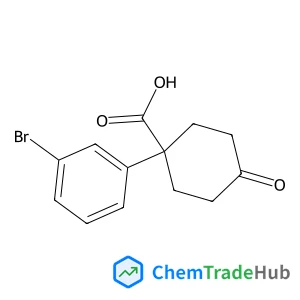
1-(3-Bromophenyl)-4-oxocyclohexanecarboxylic acid
CAS Number:
1385694-53-0
Molecular Formula:
C13H13BrO3
Fen Li, Jinxia Li, Lihui Zhou, Sheng Dai
Metal–organic frameworks (MOFs) have recently emerged as one of the most promising electrocatalysts for oxygen evolution reaction (OER) due to their abundant metal sites and porous structures. However, the limited modulation of the single-metal sites of MOF-based catalysts restricts further promotion of their catalytic performance. In this work, we have developed a composite Co–Fe-based MOF catalyst based on Co–BDC (1,4-benzenedicarboxylate) and Fe–BDC, which modulated the electronic structure via the construction of the heterogeneous interfaces of Co–BDC and Fe–BDC. Enhanced OER performance was achieved in the composite Co–Fe–BDC catalyst, far more exceeding that of the counterpart Co–BDC or Fe–BDC. In addition, it was found that additional ultrasonic treatment effectively facilitated the dispersion of Fe–BDC on Co–BDC, as compared to the composited MOF obtained via physical mixture or magnetic stirring. The composite Co–Fe–BDC catalyst prepared via the ultrasonic-assisted one-pot synthesis exhibited an overpotential of 295 mV at a current density of 10 mA cm−2, which was even superior to that of the commercial RuO2 catalyst, while holding a lower cost and excellent stability. Insights gained in this study may shed new lights on heterogeneous interfaces and composition strategy of MOF-based electrochemical catalysts.

Current Opinion in Colloid & Interface Science

Journal of Peptide Science

New Journal of Chemistry

Russian Journal of Organic Chemistry

Acta Materialia

Current Opinion in Solid State & Materials Science

Russian Journal of Applied Chemistry

Russian Chemical Bulletin

Organic Process Research & Development

Russian Journal of Coordination Chemistry
DOI: 10.1039/D0SE01831G
Shanshan Yan, Liyang Wan, Yejian Xue, Guangjie Shao, Zhaoping Liu
DOI: 10.1039/D0SE01636E
R. Samantray, Vivekanand, K. Subramani, C. Jesica Anjeline, S. C. Mishra
DOI: 10.1039/D0SE01420F
Chaokun Yang, Yanglin Chen, Ye Qu, Jiaxu Zhang, Jianmin Sun
DOI: 10.1039/D0SE01293A
Minghao Zhou, Junming Xu, Haihong Xia, Shibin Shang
DOI: 10.1039/D1SE00104C
Chunyan Li
DOI: 10.1039/D0SE01780A
Qiwei Tan, Kun Han, Wang Zhao, Ping Li, Zhiwei Liu, Shengwei Li, Xuanhui Qu
DOI: 10.1039/D0SE01457E
Maša Hren, Mojca Božič, Darinka Fakin
DOI: 10.1039/D0SE01373K
Jun Kubota, Takaya Okumura
DOI: 10.1039/D0SE01896A
Kalliopi Ladomenou, Georgios Landrou, Georgios Charalambidis, Emmanouil Nikoloudakis, Athanassios G. Coutsolelos
DOI: 10.1039/D0SE01630F
4-Amino-3-bromophenol (CAS: 74440-80-5) falls under the classification of a haza...
(17beta)-3-Oxoestr-4-en-17-yl acetate should be stored in a cool, dry place away...
2-[(2,2-Diethoxyethyl)disulfanyl]-1,1-diethoxyethane (CAS: 76505-71-0) is a colo...
The market and research for 1-(β-D-ribofuranosyl)-1H-imidazo[4,5-c]pyridin-4-ami...
Waste containing Conjugated Estrogen (CAS: 12126-59-9) should be collected and d...
The market for Bis(2,2,2-trifluoroethyl) (methoxycarbonylmethyl)phosphonate (CAS...
There are several alternatives to 3,4'-Di-O-methylellagic acid (CAS: 57499-59-9)...
2-Chloro-N,N-dimethylpyridin-4-amine (CAS: 59047-70-0) is regulated under the Gl...
Cerium(3+);oxygen(2-);vanadium(5+) (CAS: 13597-19-8) is a complex inorganic comp...
7-Chloro-1-iodoisoquinoline (CAS: 1203579-27-4) is generally considered safe whe...
![4-{2-[(9H-Fluoren-9-ylmethoxy)carbonyl]hydrazino}benzoic acid structure](https://static.chemtradehub.com/structs/214/214475-53-3-bf36.webp "4-{2-[(9H-Fluoren-9-ylmethoxy)carbonyl]hydrazino}benzoic acid structure")