



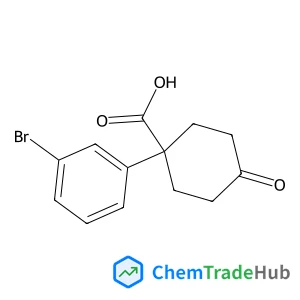
1-(3-Bromophenyl)-4-oxocyclohexanecarboxylic acid
CAS Number:
1385694-53-0
Molecular Formula:
C13H13BrO3
Shanshan Yan, Liyang Wan, Yejian Xue, Guangjie Shao, Zhaoping Liu
Perovskites are promising catalysts for metal–air batteries because of their excellent intrinsic catalytic activities. However, low specific surface area and fewer surface defects lead to low catalytic activities in the oxygen reduction/evolution reaction (ORR/OER). Herein, the Co3O4/LaCoO3 composite material is prepared by a selective dissolution method. The onset and half-wave potentials of the Co3O4/LaCoO3 hybrid material are 0.895 and 0.640 V during the ORR process. It also exhibits a small overpotential of 503 mV at a current density of 10 mA cm−2 for the OER process. What's more, the Zn–air battery that uses the Co3O4/LaCoO3 hybrid material can reach a maximum power density of 155.7 mW cm−2, which is larger than that of the original LaCoO3 (137.8 mW cm−2). In addition, the potential difference of this battery with the Co3O4/LaCoO3 sample increased by 22 mV after 100 charge–discharge cycles, which is much lower than that of Zn–air batteries with the LaCoO3 and Co3O4 samples (52 and 26 mV). The above results illustrate that improved bifunctional catalytic properties of the Co3O4/LaCoO3 hybrid material can be associated with the porous structure, large surface area, weak Co–O bond in the lattice and more surface defects on the surface.

Organic Process Research & Development

Russian Journal of General Chemistry

Current Opinion in Solid State & Materials Science

Saudi Pharmaceutical Journal

Current Opinion in Colloid & Interface Science

Russian Journal of Bioorganic Chemistry

Chemistry Education Research and Practice

Drug Discovery Today

New Journal of Chemistry

Russian Journal of Organic Chemistry
Shanshan Yan, Liyang Wan, Yejian Xue, Guangjie Shao, Zhaoping Liu
DOI: 10.1039/D0SE01636E
R. Samantray, Vivekanand, K. Subramani, C. Jesica Anjeline, S. C. Mishra
DOI: 10.1039/D0SE01420F
Nick Vlachopoulos, Anders Hagfeldt, Guobin Jia, Ruri Agung Wahyuono, Jonathan Plentz, Benjamin Dietzek
DOI: 10.1039/D0SE00596G
Keval K. Sonigara, Jayraj V. Vaghasiya, Jyoti Prasad, Hiren K. Machhi, Mohammad Shaad Ansari, Mohammad Qureshi
DOI: 10.1039/D0SE01527J
Fumiaki Takagi
DOI: 10.1039/D0SE00998A
Ganesh Sunil More, Rajendra Srivastava
DOI: 10.1039/D0SE01912G
Barbara Thijs, Jan Rongé, Johan A. Martens
DOI: 10.1039/D1SE00218J
Wenli Tian, Jie Zhang, Hao Feng, Hao Wen, Xun Sun, Xin Guan, Dengchao Zheng, Jing Liao, Minglei Yan, Yadong Yao
DOI: 10.1039/D0SE01490G
Koichi Yatsuzuka, Kosei Yamauchi, Ken Kawano, Hironobu Ozawa, Ken Sakai
DOI: 10.1039/D0SE01597K
Chuanshuai Chen, Guozhao Ji, Lan Mu, Yutao Zhang, Aimin Li
DOI: 10.1039/D0SE01701A
4-Amino-3-bromophenol (CAS: 74440-80-5) falls under the classification of a haza...
(17beta)-3-Oxoestr-4-en-17-yl acetate should be stored in a cool, dry place away...
2-[(2,2-Diethoxyethyl)disulfanyl]-1,1-diethoxyethane (CAS: 76505-71-0) is a colo...
The market and research for 1-(β-D-ribofuranosyl)-1H-imidazo[4,5-c]pyridin-4-ami...
Waste containing Conjugated Estrogen (CAS: 12126-59-9) should be collected and d...
The market for Bis(2,2,2-trifluoroethyl) (methoxycarbonylmethyl)phosphonate (CAS...
There are several alternatives to 3,4'-Di-O-methylellagic acid (CAS: 57499-59-9)...
2-Chloro-N,N-dimethylpyridin-4-amine (CAS: 59047-70-0) is regulated under the Gl...
Cerium(3+);oxygen(2-);vanadium(5+) (CAS: 13597-19-8) is a complex inorganic comp...
7-Chloro-1-iodoisoquinoline (CAS: 1203579-27-4) is generally considered safe whe...
![Ethyl 5-[({[(2-methyl-2-propanyl)oxy]carbonyl}amino)methyl]-1,2-oxazole-3-carboxylate structure](https://static.chemtradehub.com/structs/253/253196-37-1-8450.webp "Ethyl 5-[({[(2-methyl-2-propanyl)oxy]carbonyl}amino)methyl]-1,2-oxazole-3-carboxylate structure")




